Quicker recoveries

This post isn’t what you think it’s about: how to recover more quickly from hard runs or races. Although I will give a nod to an article by elite runner Julia Lucas — well-written, witty and informative (that’s three elite women runners who can write clearly and appealingly: Lucas, Lauren Fleshman and Shannon Rowbury) — in the September issue of Running Times.

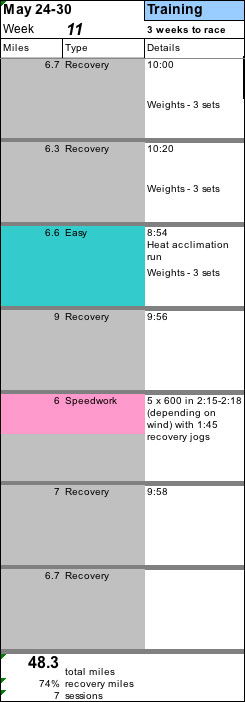
No, this post is about the fact that I’m doing my recovery runs faster these days than I have in the previous 18-24 months. A lot faster. Despite the horrible heat and humidity. Some of it can be explained by the fact that I’m actually trying to run faster on these runs. Coach Sandra noticed a recent recovery run that was an 11:00 pace and she said, “If you’re running that slow and really can’t run faster at a very easy effort, then stop the run. It means you need more recovery in the form of not running.”

Then she said, “You should be doing your recovery runs at 9:45 or faster. Why are you running them so slow?”

I had to think about that. I suspect it’s because when I was doing 80-95 mpw most weeks last year, that truly was as fast as I could go on those slower days. I even remember meeting Robert at our Blogging Runners meetup and feeling a little ashamed when he asked, “Why do you do your recovery runs so slow?” I just thought at the time that it was because I’m in my forties. But now I know it’s because I was just tired on my easy days. But the answer to her question was “habit.”

But now I’m running half that mileage. There’s no reason to be running 10:30+ miles. In recent weeks I’d started getting more toward the 10:00 side of the speed spectrum naturally anyway. Now I’ve picked things up further and seem no worse for the wear. I feel better when I’m running a little faster, and the boring recovery runs get done more quickly too. It’s also no longer such a dramatic shift in pace between fast and slow days.

Now I’m very curious to see how fast I’ll be doing these runs come fall/winter. 9:00? Or faster? That would be pretty neat.

A few minutes with Lornah Kiplagat

Lornah Kiplagat, 36, has been absent from the racing scene for awhile, but she’s back. She has excelled at distances from the 5K to the marathon, and has continued to race competitively across that distance spectrum throughout her career. She holds four world records for road racing: 5K, 10M, 20K and half marathon. Originally from Kenya, she has been a Dutch citizen since 2003. The Mini 10K was one in a series of post-surgery “comeback” races for Kiplagat. A four-time winner of that event, she’d hoped for a fifth title and was leading for the first half of the race before being overtaken by the eventual winner, Linet Masai. Kiplagat would finish fourth.

You’ve been running fast forever. How have you managed to have such a consistent career?
I think it’s just good planning. Good support, the right people around you. And a lot of running. So if I can also do that as a career, then you like to do that extra.

After setting the world record for the half in Udine, Italy, 2007.

What’s it like to have a tulip named after you?
It’s nice. How did you know about that?

I went to one of your sites and there was a story about that. I thought that was pretty neat.
Yes, it was nice of the Dutch that they did that for me. They mentioned this to me about seven years ago, even more. They thought it was a good idea, and they started preparation for it. Because it takes a long time. But it finally came out. It’s a very funny flower because it’s very strong. We have tulips and home and normally tulips don’t last long. They were lasting like for three weeks!

That’s very appropriate for a marathoner.
Yeah. Tulips normally just wither down.

Do you train in Holland?
Yes. But mostly in Kenya. Because of the altitude. It’s nice in Holland in the summer. I like it. But in the winter, it’s better in Kenya, for sure.

I was reading about your High Altitude Training Centre in Kenya. It seems like the focus has become less on athletics and more on academics.
The focus is really both. But we’re more into giving opportunities to top athletes all over the world. So they are able to train there.

Did you always have it in your head that you wanted to start something like this?
It was with a group of people. We have one guy in Kenya that’s selecting students. And they are staying in my place. They get coaching. They also get to study there. After that, they can come to America. We do it with four people. My part is to coach them — not so much to coach them, but to motivate them. So it works really good. They are boys and girls, top students from high school.

Is your foundation still focused on AIDS prevention and AIDS education?
Yeah. We are growing, actually. We’re starting up a high school for 300 girls. The training camp was so small. We could do only 12-15 girls.

How did you manage to grow it so quickly?
We’ve not yet gotten funding, but we have the plans for doing that.

How do you select who gets into the school?
They have to meet a certain academic level. And they all have to be doing something in sport. Football, hockey, running.

Do they have to maintain a certain level of academic consistency to remain in the school?
Yes. They have to. You know, they come there and they go down…we want them to come there and go even higher. Academically and in sport. This would be a boarding school. Before we didn’t have a school. They would only stay there during holidays. They could go to schools all over Kenya. They’d come to us in August and December, but it was not enough. It was too short to do something. Finally, I said, “I’m doing something, but it’s not enough.” So we needed to put [together] a better structure. We hope the first class will be 2013. It’s nearby the altitude training center. We’re trying to get the funding, but even if we don’t get it, it will still happen with our own money. I’ve got the ground to build the school already. It’s 18 hectares. That was the hardest part — getting the ground.

What made it so difficult? Finding the right place?
That and getting the right ground in such a place is almost impossible anymore. Getting a space that big. I had to move four families.

Was that difficult? Did they not want to leave?
No, it was an opportunity for them. If they give me one acre of land, then I have to buy them two and a half somewhere else. But in a nice place, where they can really farm. And still with some money on top of that. So they saw it as an opportunity to get more land. That was the most difficult part, and now that’s done. So the rest — putting up the buildings — is not a big deal for me. If we get funding, it will go quicker. If we don’t, it will go slower. But still, it will happen.

Do people know that you’re doing this project? Do people at these things ask you about it?
I don’t even talk about it. When I see that you’re interested, I talk about it. But normally I don’t even mention it.

No, I ask because I was surprised. I did some research on you yesterday. I know you as a runner but had no idea you were heading up all these other projects.
I don’t think most people are interested. They just want to see how the running will be. This is for my own good feeling. I don’t want to be just a runner and then pass by. I want to be a runner, but establish my roots. You want to know where you came from and where you end, what you brought to influence society. That’s what we [with husband/coach Pieter Langenhorst] do. Pieter supports me very well with this work. He’s the one making things happen. Sometimes you can be together, but if the other partner doesn’t have the same motivation, it doesn’t work. For us, it works very well.

I came across an interview with you a few years ago in which you were describing your experience of going to one of your first races in Kenya. You slept in a bathroom. There was basically no support. Have things improved in the last 18 years?
Yeah. It’s improved a lot. It’s like day and night.

Yes, it was really shocking.
It’s quite impossible now to have that kind of experience. There are so many athletes now, so many girls. Girls running now is a normal thing.

Is it still one of the biggest professional opportunities there?
Absolutely. In the last 10 years, it’s grown like crazy.

Can I ask you about your running, or are you tired of answering questions about that?
No, it’s okay.

You’ve been coming back with some shorter races. Are you planning on returning to the marathon?
I will build up slowly now, since I am coming back from injury. But end up at the marathon.

Do you have one in mind?
Not yet.

As you’ve moved into your thirties, have you found that you need more recovery between hard workouts?
Yes.

Are you doing two workouts a week now? Or three?
I run, of course, every day. I do speed work three times a week. But not very sharp, though.

What kind of mileage are you doing right now?
70-80 miles a week. Not a lot.

What do you get up to when you’re peaking in your training for the marathon?
If I’m going for the marathon, for sure over 100.

Do you think after you turn 40 that you’ll keep competing?
No, I think I will just go to easy running. But not competing. It depends.

Because a lot of women are running well into their forties.
I’m not far from 40…

That’s why I’m asking.
I will just see how it will go.

If you scale back the running, will you spend more time on these other projects?
Yeah. That’s like my baby.

Do you think doping is widespread in women’s distance running?
No, I don’t believe it. Because I know most of the women in distance running and most of them are really clean.

I know it was bad in the eighties. A lot of the Chinese times, people don’t even really count because it’s assumed they were all on something.
And it is possible [to excel without drugs]. It’s just a matter of training hard. Simple. No shortcuts. Knowing most of the girls in long distance, you can tell that they train hard. Even in competition, you can see somebody who you can say, “Hey, something is wrong.” So it happens, but it’s not common.

Do you train by heart rate?
No.

How do you know how hard to run?
I used a GPS watch. Every kilometer, I know what speed I’m running and I feel. So if I’m running under 4:00 per K, and I’m feeling good.

Do you race with a GPS?
Sometimes [Kiplagat wore her Garmin 310xt at the Mini 10K]. When I’m not sure, I race with a GPS.

A lot of people are funny about it. They think it’s cheating, that you have an advantage over other people in the race. Or they assume that elites never use them.
No. It’s no different with a watch. Every kilometer, you can see [the split]. What’s the difference? There’s no difference.

Training July 25-31

Yesterday marked the official one month anniversary of starting work with Coach Sandra. This week was a true assbuster, the first entire week that I can apply that qualification to, although there have certainly been some difficult individual workouts in the past few weeks. But the hard work was piled on this week, three really tough sessions over five days.

The hard work began on Tuesday morning, when I met up with Sandra bright and early at Sleepy Hollow High School’s track. This is a good place to train. While the track is not as fancy as the one at Bronxville High, it’s also not crowded with amblers. There were only two other runners there. Given that Sandra was standing in lane four with a stopwatch and yelling at me, they stayed out of our way.

Okay, Sandra wasn’t actually yelling at me. I just enjoy that image. She was yelling splits and, most of the time, encouragement. I won’t go into what we did, but it was really fucking hard. She even scaled back things a little when she saw that I was struggling through one of the repeats. I felt bad when she did that but she assured me that it’s the whole point of having a coach there and it’s better to be conservative than to overtrain.

To be honest, it’s nervewracking to have someone scrutinizing how you run. I don’t come from a track (or running at all) background, so this is a new experience for me. There’s a lot of pressure to run faster when someone is standing there at each lap, waiting for you. I don’t have trouble doing my workouts alone — meaning I will apply myself regardless of who’s around. But having that extra pressure was a real motivator to pick things up when I felt like shit. After next week Sandra won’t be there for most of my track work, at least through the rest of the summer. But I feel I have a better sense now of how I should adjust the intervals as I go along.

Here’s this week’s running tip: always run your recoveries in the opposite direction. This keeps you from stressing the same outer leg/hip (your right one if you do the hard stuff counterclockwise).

On Thursday I did a longish tempo run. It was absolutely horrible weatherwise: 82F with a dewpoint of 72 when I started. The average time is slow because my warmup/cooldown was practically walking, and my tempo miles were no great shakes due to the weather (around 7:30). I did this run on the northern section of the Old Croton Aqueduct trail and it was really, really lovely. I can’t wait to run there in the fall when it’s cool and colorful. Although there is a .6 mile long section of extreme up/down hill in the form of switchbacks as you head to and from the Hudson’s edge. That was murder to run up fast.

On Friday I got a massage and discovered just how nasty I’d been to my legs over the previous days. Hamstrings, quads, calves — everything was fucked up. Even my arms hurt, especially the forearms for some reason. I wished I’d gone for a 90 minute session since 60 didn’t seem like enough. But I ambled home (it’s a short walk from my house through suburban streets) and collapsed on the couch for a few hours. I felt okay this morning, more or less ready for another epic run.

This time I tried the middle section of the OCA. I didn’t like that one as much. Much of it is a narrow track of dirt cutting through grass. Some of it is rooted and rocky. And it’s broken up by streets (including one that required a full seven minute wait at a stoplight where four streets converged), which slows everything down. My legs felt the week’s earlier abuses at the 8 mile mark, but I kept at it. Fortunately, the weather was so pleasant today that it was almost not noticeable. In the low 70s and very dry. I ran the last few miles as fast as I could, which wasn’t very fast. Still, faster than the last few progression runs. I was happy with the effort considering that it was on top of two earlier faster sessions.

Next weekend is the NYRR team championships, so the mileage and intensity get dialed down again. After this week, I’m grateful for some down days.

A few minutes with Magdalena Lewy-Boulet

Magdalena Lewy-Boulet, 37, needs no introduction. But here’s one anyway. Originally from Poland, she became a US citizen on September 11, 2001. She is a regular top 10 finisher at the marathon and was this country’s half marathon champion last year. She stood out in the 2008 Women’s Olympic Marathon Trials by immediately rocketing out to a sizable lead that she would hold for 24 miles before being passed by Deena Kastor. She lives and trains in Oakland, California where she is also one of the founders of the Bay Area Track Club. She is coached by Jack Daniels.

After smoking the Rotterdam course.

In your preparations for Rotterdam, a breakthrough race [2:26:22, for second place and making her the fourth fastest American female marathoner] for you earlier this year, it sounds like you were doing a lot of work on your top end speed.
Because the World Cross Country Championships were two weeks before that, we definitely incorporated a little bit more of that work into this preparation. I really enjoyed it. But I still maintained all the other marathon stuff that we’ve done in the past. Not much has changed. I think it was just a little more balanced this time around.

I know you did a lot of training for the 2008 Olympic Marathon on the treadmill. Did you find doing all that running inside difficult to deal with mentally or physically?
Not really. As a marathoner, you’re already doing a lot of repetitive stuff. Long runs, out and backs, loops. I started running on the treadmill when my son was born and I was progressively spending more time on it. But I learned to do workouts on the treadmill, which I’d never done before. I don’t have to run on the treadmill, but I still incorporate it at least once or twice a week now. I do hill repeats, actually. Because I don’t have to run downhill.

Do you think regular runners can benefit from incorporating the treadmill into their training to do those different kinds of workouts?
Yeah, a lot of people have a very limited amount of time and sometimes limited access to do a track workout. Over the last few years I’ve learned that you can take any track workout and convert it to the treadmill. Having a child at home, you might plan to do a track workout, but then something comes up and you have to cancel your plans. But there’s always the treadmill, so that’s a good option to have. It saved my training many times, where I was able to get the work done.

What are you thinking about when you’re racing?
I actually think about a lot of stuff when I race. It kind of goes in and out. Sometimes I reflect on workouts that I’ve done that remind me that I’ve done some workouts that are harder than this race. It keeps you at ease because it’s the feedback that you’re well prepared. My last marathon was the first one where it was marked every kilometer. It was really going by quickly, versus miles — you get all this feedback. I coach, so I started designing workouts [that use kilometers rather than miles] for the athletes that I coach.

I don’t really have a strategy for what I think about. I just try to go with the flow. But I’m never out of touch with what happens in the race. It’s usually not until the second half that my mind fully tunes into the race that’s happening. The first half, it could be anything. I’m thinking about the dinner I’m going to make for my son the next day, or the workouts that I’m going to give to my athletes, or my own workouts. And then the second half is usually all about the race.

Can you tell early in a race whether you’re having a good day or a bad day? And are you ever wrong?
Usually, in the first part of the race you can tell. I’ve had races where I was warming up and feeling awful, just awful. I remember a couple races on the track where I was warming up and thinking, “There’s no way if I keep feeling like this…” but it ends up being a PR day. It happens. When you do feel bad, you always have to give another shot at changing something within the race to make sure that it’s really not happening today. Sometimes, you can change the outcome, hopefully.

After you bashed your knee, before the Olympic marathon [which Lewy Boulet could not run], you seemed really accepting of the situation. You were upset, but you seemed to take it in stride. Do you generally have a positive attitude when you have a setback like that?
You know, my coach is just an unbelievable person. Jack is really positive. It doesn’t just start with just races, when you don’t do well at the Olympics. It’s day in and day out — I’ve learned that I need to take something positive from each workout. He’s gotten me to always learn something from each situation and turn it into something positive. Making the Olympic team — even though it was a horrible outcome — I still learned so much from that experience. Something as simple as the logistics of how things work at that level. When I do make another team, I know what to do.

Is the marathon your favorite distance, or just the one you’re best at?
Usually, they go hand in hand. You always love events that you’re good at. I do love the marathon. More than anything, I love the preparation required for a marathon. It’s very rewarding when you do run well. And you don’t get too many chances. A 5K you can do once a month, or a mile every other week. With the marathon, you only get two shots a year. But I did love cross country. Racing at Worlds this spring was a lot of fun. The fact that it was in Poland, that I made the team and got a medal was pretty super cool.

Training July 18-24

The adventure continues. As does the heat wave.

This past week was typical of what I’ll be doing in the coming weeks: speedwork and lots of progression runs. I didn’t cross-train as much as I’d hoped to, but I’m working on making biking and weight work more of a priority. I also got my first massage since right after the Green Mountain Relay in June. I was informed that my hamstrings aren’t nearly as tight as they were then. But my back, shoulders and neck are still a holy mess.

Monday was really, really hot again. So I did my short progression run on the treadmill. That went pretty well, considering that I’d raced hard on Saturday. Wednesday was another really hot morning at the track — 90F with a dewpoint of 68. I had to do longer intervals, which was mentally difficult.

Then I stupidly ran an extra 5 miles, bringing the total to 11, which was supposed to have been distributed over two runs: 7 at the track and then 4 recovery in the evening. I got so used to running lots of miles around track sessions last year that it’s hard to break that habit. I won’t do that again. Coach Sandra was not pleased and thought I was just being overly enthusiastic (so unlike me) or simply non-compliant. I told her that I merely have poor reading comprehension sometimes and all was forgiven.

On Thursday, as often happens the day after some faster running, my legs felt zippy. So I ran the recovery run by feel, which turned into a slightly higher effort outing. But I knew I had the next day off from running, so I didn’t worry about it.

Saturday was, once again, very hot and humid, so I took the progression run inside again. This was a horrible run. My stomach was a mess and my right hamstring felt very stiff. I ended up puttering along at 10:45 pace for 4 miles before I was able to pick things up ever so gradually and run the last few miles at a properly fast pace. Given how shitty I felt, I was tempted to abandon the workout, but remembered that if I don’t finish a week, I need to do it all over again. I didn’t want to be held back in what is the training equivalent of Kindergarten.

Besides training, it was an eventful week. For one thing, it was my first week as a non-IBMer in 7 years. That took some getting used to. I also updated Houston Hopefuls at long last. Then I worked on my first byline piece for Running Times, a profile of one of the masters runners who has already qualified for the 2012 Marathon Trials, Tamara Karrh. Originally I’d hoped to do a piece on the growth of masters participation in that race over the years, with Karrh as personification of this trend (but not the article’s centerpiece). But getting historical Trials data on short notice proved impossible, despite how annoying I made myself (in a friendly, grateful way) to the USATF. Fortunately, Karrh turned out to be a great interviewee, worthy of a profile focused on her alone. That will hit the newsstands/web in October (November issue).

This week is more of the same: track work (with Coach and stopwatch this time), a tempo run and more progression miles. I’ve been exploring the local trails, to save my legs by running on soft dirt, but also for a change of venue. I don’t actually have to be anywhere these days. I can drive to a trail. I can stop and look at other creatures’ homes. I can wander the aisles of Costco at 2:00 in the afternoon. I don’t feel a shred of anxiety over this current state of affairs. I have not felt this relaxed in decades.

Some things I learned today

The Old Crtoton Aqueduct (aka “OCA”) is a lovely place to run, at least the northern section, which starts at Sleepy Hollow High School. I will probably do my tempo run there later this week for a change of scenery. More info at Joe‘s excellent blog, Westchester Trails.

Taking a long nap is much more enjoyable than sitting in a meeting.

It is possible, with extreme discipline and careful use of syntax and clauses, to cut a ~1,000 word article down to ~750 words without losing too much.

If you run with small rocks in your hands they will remind you to swing your arms. Swinging your arms makes you run faster.

Racing shoes are for racing and speedwork only. Doing any other running in them is strictly verboten.

The stopwatch tells no lies.

Training: July 4-17

Yes, there’s a big gap in training logs. About a month. That’s because June was not a serious month for training. It was all about the Mini 10K, the Green Mountain Relay, and quitting my FT day gig. So I can train seriously again, among other reasons.

I was also in transition, checking out the new coach and the new training that comes with her. I officially started training with Sandra on Saturday, July 3, which is not shown on these schedules (I should note that now the training week runs from Sunday to Saturday, unlike my previous Monday to Sunday structure).

On that first day, Sandra sent me off to do a fartlek workout. I was way out on Eastern Long Island over that weekend, so I ended up doing the run (about 6 miles total) along a lonely, relatively flat stretch of road at about 7:30 in the morning. It was just me, a family of wild turkeys and the rare service truck.

This run was a challenging introduction into the new training regimen. But I got through it and found it a strangely satisfying workout, probably because of its novelty. I haven’t done much fartlek running. I’ll be doing lots more of it, though.

A few days later I had my first speed session. This was on the worst day of the heatwave, a day we hit a real temperature of 103F. We were also having an air quality alert. The air literally stank that morning. I ran at 6AM, but it was nevertheless already in the upper 80s at that hour. The heat has been insane these past few weeks, with temperatures around 10-15 degrees above average most days.

That weekend I did a long run. It’s weird to think that 12 miles is a “long” run now. That was shorter than my “midlength” run of 14-16 miles just 9 months ago. But, okay. 12 miles is long now.

Here’s another new aspect to this training: every long run is a progression run. I get to run the first 3-4 miles at a very easy pace, but then I have to pick things up. And I must be racing the last 2 miles.

It was again incredibly hot. I lost 3 lbs on this run, and cut it short, walking the last half mile because I could feel the heat’s effects creeping up on me. Then I crashed for two hours.

For the second week I went on the “pre-race” schedule, which features just one hard workout (but it is indeed hard). Overall, the mileage is cut back and I do a mini-taper to get ready for a race. In this case, it was a 4 miler on Saturday. I also started adding in some bike time, which I’ll do 2-3x a week from here on out.

Wednesday was track session #2, this time with some longer repeats. Again, the heat and humidity were brutal that day and it was a struggle to run fast. Then I got very busy with work that day and had to skip the 4 mile recovery run in the evening.

Wednesday overnight into Thursday I had terrible DOMS. That brought back some memories of last year. I took Thursday off (as scheduled, but whaled away on the bike for an hour). Then a little token run on Friday and the race on Saturday.

I know I’m just getting into this new plan, but I have noted that I have been rested and ready for all of the harder sessions. And while they are certainly challenging from both a mental and physical standpoint, I am able to handle them without fading in either respect. So far, so good.

Getting back to it

With “it” being marathon training.

I’m ready to dance with the capricious lady again, although it’s going to be an extended flirtation before we hit the dance floor. No fall marathon for me. Too soon. My next one will likely be Houston in January, six months from now. It’s flat, cool, has a great reputation, and is both easy and cheap to get to from NYC. I won’t even need to rent a car while there.

I’m now officially over 2009, with all its failures and disappointments. A winter and spring spent focused on just about everything but the marathon has been therapeutic. I suspect that having other new interests and friendships, running and otherwise, to pursue also provided a healthy break from three years of marathon obsession, along with some success and gratification that was absent from last year.

Accompanying this decision (and perhaps partly driving it) was another decision. Namely, to try a new coach and a new approach to training. In doing the interviews for Houston Hopefuls, a common theme that emerged was the advantage of working with someone local. Someone who can go to the track with you and note your splits, notice the dark circles under your eyes or slightly off-kilter stride, etc. Someone who is present and invested, if only because you know where they live.

I’ll be working with Sandra (Inoa) Khannouchi, who’s up in Ossining. I met Sandra when I was at the Healthy Kidney 10K press event in mid-May, interviewing her husband, Khalid, whom she coaches and manages. I ended up interviewing her as well, although at the time it hadn’t occurred to me to consider her as a possible coach. But while I was talking with her I did take note of the fact that she seemed to possess a combination of caution, confidence and optimism when it came to how she was training her star athlete to a post-surgery comeback. This made an impression on me, although perhaps only subconsciously at the time.

In the ensuing weeks, as I grappled with “what’s next?” — knowing that I didn’t feel completely at ease with the idea of spending the rest of the year pursuing good half marathon times, worrying that launching back into high mileage training might be a mistake, and hearing interesting insights from some accomplished masters runners — I started thinking that I needed to make a change.

Contacting Sandra to see if she coaches non-elites was Jonathan’s idea, actually. First I had to get over my sheepishness at approaching her: “Hi, I’m slow and old. Can you help?” It turns out that she does coach other runners, although now she’s cut way back for various reasons. Since the mid-90’s she’s coached her husband. At various times she’s coached other elites as well as recreational runners (mainly in Mexico City).

And now there’s me, a new challenge. Can she make me a faster runner even as I battle time’s rude imposition of entropy? We’ll both find out. She’s asked me to have faith in her training methods for at least 4-5 months, and I will. I have not hired her because she’s a “name” (although her resume doesn’t hurt her case) but more because I like her philosophy and because her workouts look like they’ll be effective — and, besides, she’s right there, less than half an hour away.

I spent quite awhile talking with her about goals, how her training works and how she works with runners. As for my own history, she didn’t want to know much about what came before. She is looking forward. For now, the plan is to train for a 10K, then a half, then a marathon. The theory being that I need to get faster at shorter distances before I can tackle getting faster at longer distances. This approach is being used by at least two of the women in my interview series, as well as a few of the Mini 10K elites I talked to recently.

Combined with that strategy is a focus on high quality workouts with what is for me low mileage. I’ve been running 40-50 miles average since January. The plan is to keep mileage in the 50mpw range for the foreseeable future, then work up to the mid-70s when we get into marathon training again in the fall. The training schedule is flexible, meaning if I struggle to finish a week, I just repeat it. If I’m beat up after a week, I take two days off. If a hard session is going badly, I defer it to another day. Races are highlights, but they’re not goals (other than the January marathon). The training is the goal. Getting faster is the goal. Avoiding setbacks is the goal.

My training posts will be deliberately vague about the high quality work, at Sandra’s request. Some of what I’ll be doing consists of standard workouts that anyone would recognize (12×400, anyone?). Others, however, are unusual — combinations of things that I have not seen. All of the workouts are hard, some very much so. About 40-50% of my miles will consist of hard, hard running. I haven’t tried this approach yet. Maybe it will work for me. I should know in a few months.

There are no “recovery weeks” although the days before a race will be lighter. I won’t be doing a ton of racing like I have lately, but there will be room for a few races for fun/club points, or to do as tempo efforts. And there will be a few important races to use as yardsticks to measure progress and assess readiness.

Other new things: The workouts are not on a 7 day schedule; sometimes I’ll go to the track on Tuesday, sometimes I’ll go on Saturday. Regular massages are now required, as are post-workout ice baths. There has been serious talk of altitude training — I’m still trying to wrap my mind around that one, but I’m remaining open to the idea and figure that at this point I can work just about anywhere where there’s an outlet and an Internet connection. There’s more. Cross training several times a week. Stretching routines. Race visualization. Getting in the car and driving somewhere so I can run on dirt rather than pavement. Listening to my body at all times and heeding its messages whether resting, running or racing. Yes. Okay. Good. I’ll try it all. I’ll do all of it.

And still more. The HRM is generally frowned upon, as its readings, even when correct, can affect judgment and obscure larger patterns (this I know already from last year — all the data in the world didn’t help me avoid overtraining and injury). Oddly enough, I’d stopped running with the HRM on most days anyway by early last month, since it was constantly acting up and, worse, often only served as a massive mindfuck before and during races. Now its primary purpose will be to keep me from running too hard on recovery runs. Other days, it stays at home.

Training with a watch is fine, but only to record, not to use as a prescriptive device. Racing with one is actively discouraged. If you look at pictures of Khalid racing, you’ll notice that he doesn’t wear a watch. When this fact was pointed out to me, it initially blew my mind. Then it seemed strangely logical. Why would you race with a watch unless you didn’t trust your own ability to race at the appropriate effort? If you need to constantly check how fast you’re going, maybe you’re not ready to race your race yet. Or maybe you are ready, but you’ll talk yourself out of racing your best because of what your stupid watch says.

Last year was disappointing from a racing perspective, but that doesn’t mean it wasn’t productive. All that high mileage running Kevin had me doing gave me a good aerobic base to build on, lots of mitochondria at the ready, and a sturdy musculoskeletal structure. This is a great starting point. And now, from here, I am throwing out almost everything I’ve done for the past two+ years and am starting all over. All I know is that I’m a hard worker and I believe that I can do better than 3:19 for the marathon.

Training: May 24-June 6

Another twofer, as I’ve remained quite busy with work and personal projects. And it promises to get busier: I’ve got the Mini 10K coming up this weekend (and, I hope, interviews to do with the participating elites). Then next weekend the Green Mountain Relay is upon us. I am purchasing massive quantities of Nutella this evening to outfit our team’s two vans with high energy, chocolately and hazelnutty goodness.

The last week in May was low key. I did two workouts — one a general aerobic run, for the purposes of facilitating heat acclimation. I hate running in the heat, but I do notice the difference later in the summer if I’ve made an attempt to ease my way into it. I also will be doing a fair amount of racing this summer, which is new. So I’d better get used to being hot and uncomfortable.

Then on Friday I did a speed session that was so so. I had to make it a short one since I was so busy with work. It was on the hot side at the track and I did okay for the first few repeats but toward the end of the fourth one I was working way too hard and decided to end the speed session there. I have a feeling I was still worn down from the “easy” run (which was very hot/humid) two days before. I wasn’t freaked out by having what on the surface was a failed workout.

My recovery runs continue to hover in the 10:00 range, an improvement over earlier in the season, despite the uncomfortable conditions lately. This is good news.

I saved my legs over the next few days for what would turn out to be a very strange, but very educational racing experience in New Jersey. As Ewen pointed out in a comment, that recent mile race on the track may have helped my speed.

As for the rest of the week, post-race I applied myself. I did another hot easy run on Wednesday. On Friday, it was baking already at 7AM and I knew that if I went to the track to try to do speedwork there, in full sun, I’d just end up suffering both physically and mentally, and probably running badly as well. So I switched plans and did my speedwork on the mostly shaded running path.

I did a series of five 90 second pickups during 8 miles of easy miles, with the pickups at around 5K effort. The good news is that they got faster as I went along, starting in the high 6:00s and ending at around 6:07 pace. Not going to the track had been a good idea. And I got about 8 minutes of fast running in, with some decent aerobic effort miles to boot, so I was happy. And very sleepy later on.

Saturday I played driver and water girl for Jonathan, who did a hilly 5K in FDR State Park. It was, again, hot and humid. I did 5 miles at recovery pace around the park while he raced. That was enough for me. Man, it was hot. Today was not his best time, unsurprisingly, but he put in a good effort and got 6th overall.

From masters stud...

...to tired hothouse flower.

The heat would be worse on Sunday. By the time I got out, it was around 10:30AM and the heat index was already in the mid 80s. It would be in the low 90s by the time I finished a 10 miler. As you can see, I was running at aerobic effort (mid-70%s MHR) and getting a slow pace for all that work. Oh, well. It will get easier.

In addition to the Mini on Saturday, this week I have my second track race, a 1500m race, again at Icahn Stadium. The weather is looking friendlier — 60s or 70s and (yay) very dry. A little wind, but anything’s better than 25mph. I’m feeling pretty good about my prospects.

New Houston Hopeful interview: Tammy Lifka

I published the second interview in the Houston Hopefuls series yesterday. Tammy Lifka trains in the Chicago area, has three young kids and uses high altitude simulation equipment, among other distinctions. It’s a long interview, but I think well worth the read, most notably for her perspective on pacing marathons, both as pacer and pacee.

For the full interview (with audio): Houston Hopefuls > Tammy Lifka