Training July 18-24

The adventure continues. As does the heat wave.

This past week was typical of what I’ll be doing in the coming weeks: speedwork and lots of progression runs. I didn’t cross-train as much as I’d hoped to, but I’m working on making biking and weight work more of a priority. I also got my first massage since right after the Green Mountain Relay in June. I was informed that my hamstrings aren’t nearly as tight as they were then. But my back, shoulders and neck are still a holy mess.

Monday was really, really hot again. So I did my short progression run on the treadmill. That went pretty well, considering that I’d raced hard on Saturday. Wednesday was another really hot morning at the track — 90F with a dewpoint of 68. I had to do longer intervals, which was mentally difficult.

Then I stupidly ran an extra 5 miles, bringing the total to 11, which was supposed to have been distributed over two runs: 7 at the track and then 4 recovery in the evening. I got so used to running lots of miles around track sessions last year that it’s hard to break that habit. I won’t do that again. Coach Sandra was not pleased and thought I was just being overly enthusiastic (so unlike me) or simply non-compliant. I told her that I merely have poor reading comprehension sometimes and all was forgiven.

On Thursday, as often happens the day after some faster running, my legs felt zippy. So I ran the recovery run by feel, which turned into a slightly higher effort outing. But I knew I had the next day off from running, so I didn’t worry about it.

Saturday was, once again, very hot and humid, so I took the progression run inside again. This was a horrible run. My stomach was a mess and my right hamstring felt very stiff. I ended up puttering along at 10:45 pace for 4 miles before I was able to pick things up ever so gradually and run the last few miles at a properly fast pace. Given how shitty I felt, I was tempted to abandon the workout, but remembered that if I don’t finish a week, I need to do it all over again. I didn’t want to be held back in what is the training equivalent of Kindergarten.

Besides training, it was an eventful week. For one thing, it was my first week as a non-IBMer in 7 years. That took some getting used to. I also updated Houston Hopefuls at long last. Then I worked on my first byline piece for Running Times, a profile of one of the masters runners who has already qualified for the 2012 Marathon Trials, Tamara Karrh. Originally I’d hoped to do a piece on the growth of masters participation in that race over the years, with Karrh as personification of this trend (but not the article’s centerpiece). But getting historical Trials data on short notice proved impossible, despite how annoying I made myself (in a friendly, grateful way) to the USATF. Fortunately, Karrh turned out to be a great interviewee, worthy of a profile focused on her alone. That will hit the newsstands/web in October (November issue).

This week is more of the same: track work (with Coach and stopwatch this time), a tempo run and more progression miles. I’ve been exploring the local trails, to save my legs by running on soft dirt, but also for a change of venue. I don’t actually have to be anywhere these days. I can drive to a trail. I can stop and look at other creatures’ homes. I can wander the aisles of Costco at 2:00 in the afternoon. I don’t feel a shred of anxiety over this current state of affairs. I have not felt this relaxed in decades.

Some things I learned today

The Old Crtoton Aqueduct (aka “OCA”) is a lovely place to run, at least the northern section, which starts at Sleepy Hollow High School. I will probably do my tempo run there later this week for a change of scenery. More info at Joe‘s excellent blog, Westchester Trails.

Taking a long nap is much more enjoyable than sitting in a meeting.

It is possible, with extreme discipline and careful use of syntax and clauses, to cut a ~1,000 word article down to ~750 words without losing too much.

If you run with small rocks in your hands they will remind you to swing your arms. Swinging your arms makes you run faster.

Racing shoes are for racing and speedwork only. Doing any other running in them is strictly verboten.

The stopwatch tells no lies.

Training: July 4-17

Yes, there’s a big gap in training logs. About a month. That’s because June was not a serious month for training. It was all about the Mini 10K, the Green Mountain Relay, and quitting my FT day gig. So I can train seriously again, among other reasons.

I was also in transition, checking out the new coach and the new training that comes with her. I officially started training with Sandra on Saturday, July 3, which is not shown on these schedules (I should note that now the training week runs from Sunday to Saturday, unlike my previous Monday to Sunday structure).

On that first day, Sandra sent me off to do a fartlek workout. I was way out on Eastern Long Island over that weekend, so I ended up doing the run (about 6 miles total) along a lonely, relatively flat stretch of road at about 7:30 in the morning. It was just me, a family of wild turkeys and the rare service truck.

This run was a challenging introduction into the new training regimen. But I got through it and found it a strangely satisfying workout, probably because of its novelty. I haven’t done much fartlek running. I’ll be doing lots more of it, though.

A few days later I had my first speed session. This was on the worst day of the heatwave, a day we hit a real temperature of 103F. We were also having an air quality alert. The air literally stank that morning. I ran at 6AM, but it was nevertheless already in the upper 80s at that hour. The heat has been insane these past few weeks, with temperatures around 10-15 degrees above average most days.

That weekend I did a long run. It’s weird to think that 12 miles is a “long” run now. That was shorter than my “midlength” run of 14-16 miles just 9 months ago. But, okay. 12 miles is long now.

Here’s another new aspect to this training: every long run is a progression run. I get to run the first 3-4 miles at a very easy pace, but then I have to pick things up. And I must be racing the last 2 miles.

It was again incredibly hot. I lost 3 lbs on this run, and cut it short, walking the last half mile because I could feel the heat’s effects creeping up on me. Then I crashed for two hours.

For the second week I went on the “pre-race” schedule, which features just one hard workout (but it is indeed hard). Overall, the mileage is cut back and I do a mini-taper to get ready for a race. In this case, it was a 4 miler on Saturday. I also started adding in some bike time, which I’ll do 2-3x a week from here on out.

Wednesday was track session #2, this time with some longer repeats. Again, the heat and humidity were brutal that day and it was a struggle to run fast. Then I got very busy with work that day and had to skip the 4 mile recovery run in the evening.

Wednesday overnight into Thursday I had terrible DOMS. That brought back some memories of last year. I took Thursday off (as scheduled, but whaled away on the bike for an hour). Then a little token run on Friday and the race on Saturday.

I know I’m just getting into this new plan, but I have noted that I have been rested and ready for all of the harder sessions. And while they are certainly challenging from both a mental and physical standpoint, I am able to handle them without fading in either respect. So far, so good.

Getting back to it

With “it” being marathon training.

I’m ready to dance with the capricious lady again, although it’s going to be an extended flirtation before we hit the dance floor. No fall marathon for me. Too soon. My next one will likely be Houston in January, six months from now. It’s flat, cool, has a great reputation, and is both easy and cheap to get to from NYC. I won’t even need to rent a car while there.

I’m now officially over 2009, with all its failures and disappointments. A winter and spring spent focused on just about everything but the marathon has been therapeutic. I suspect that having other new interests and friendships, running and otherwise, to pursue also provided a healthy break from three years of marathon obsession, along with some success and gratification that was absent from last year.

Accompanying this decision (and perhaps partly driving it) was another decision. Namely, to try a new coach and a new approach to training. In doing the interviews for Houston Hopefuls, a common theme that emerged was the advantage of working with someone local. Someone who can go to the track with you and note your splits, notice the dark circles under your eyes or slightly off-kilter stride, etc. Someone who is present and invested, if only because you know where they live.

I’ll be working with Sandra (Inoa) Khannouchi, who’s up in Ossining. I met Sandra when I was at the Healthy Kidney 10K press event in mid-May, interviewing her husband, Khalid, whom she coaches and manages. I ended up interviewing her as well, although at the time it hadn’t occurred to me to consider her as a possible coach. But while I was talking with her I did take note of the fact that she seemed to possess a combination of caution, confidence and optimism when it came to how she was training her star athlete to a post-surgery comeback. This made an impression on me, although perhaps only subconsciously at the time.

In the ensuing weeks, as I grappled with “what’s next?” — knowing that I didn’t feel completely at ease with the idea of spending the rest of the year pursuing good half marathon times, worrying that launching back into high mileage training might be a mistake, and hearing interesting insights from some accomplished masters runners — I started thinking that I needed to make a change.

Contacting Sandra to see if she coaches non-elites was Jonathan’s idea, actually. First I had to get over my sheepishness at approaching her: “Hi, I’m slow and old. Can you help?” It turns out that she does coach other runners, although now she’s cut way back for various reasons. Since the mid-90’s she’s coached her husband. At various times she’s coached other elites as well as recreational runners (mainly in Mexico City).

And now there’s me, a new challenge. Can she make me a faster runner even as I battle time’s rude imposition of entropy? We’ll both find out. She’s asked me to have faith in her training methods for at least 4-5 months, and I will. I have not hired her because she’s a “name” (although her resume doesn’t hurt her case) but more because I like her philosophy and because her workouts look like they’ll be effective — and, besides, she’s right there, less than half an hour away.

I spent quite awhile talking with her about goals, how her training works and how she works with runners. As for my own history, she didn’t want to know much about what came before. She is looking forward. For now, the plan is to train for a 10K, then a half, then a marathon. The theory being that I need to get faster at shorter distances before I can tackle getting faster at longer distances. This approach is being used by at least two of the women in my interview series, as well as a few of the Mini 10K elites I talked to recently.

Combined with that strategy is a focus on high quality workouts with what is for me low mileage. I’ve been running 40-50 miles average since January. The plan is to keep mileage in the 50mpw range for the foreseeable future, then work up to the mid-70s when we get into marathon training again in the fall. The training schedule is flexible, meaning if I struggle to finish a week, I just repeat it. If I’m beat up after a week, I take two days off. If a hard session is going badly, I defer it to another day. Races are highlights, but they’re not goals (other than the January marathon). The training is the goal. Getting faster is the goal. Avoiding setbacks is the goal.

My training posts will be deliberately vague about the high quality work, at Sandra’s request. Some of what I’ll be doing consists of standard workouts that anyone would recognize (12×400, anyone?). Others, however, are unusual — combinations of things that I have not seen. All of the workouts are hard, some very much so. About 40-50% of my miles will consist of hard, hard running. I haven’t tried this approach yet. Maybe it will work for me. I should know in a few months.

There are no “recovery weeks” although the days before a race will be lighter. I won’t be doing a ton of racing like I have lately, but there will be room for a few races for fun/club points, or to do as tempo efforts. And there will be a few important races to use as yardsticks to measure progress and assess readiness.

Other new things: The workouts are not on a 7 day schedule; sometimes I’ll go to the track on Tuesday, sometimes I’ll go on Saturday. Regular massages are now required, as are post-workout ice baths. There has been serious talk of altitude training — I’m still trying to wrap my mind around that one, but I’m remaining open to the idea and figure that at this point I can work just about anywhere where there’s an outlet and an Internet connection. There’s more. Cross training several times a week. Stretching routines. Race visualization. Getting in the car and driving somewhere so I can run on dirt rather than pavement. Listening to my body at all times and heeding its messages whether resting, running or racing. Yes. Okay. Good. I’ll try it all. I’ll do all of it.

And still more. The HRM is generally frowned upon, as its readings, even when correct, can affect judgment and obscure larger patterns (this I know already from last year — all the data in the world didn’t help me avoid overtraining and injury). Oddly enough, I’d stopped running with the HRM on most days anyway by early last month, since it was constantly acting up and, worse, often only served as a massive mindfuck before and during races. Now its primary purpose will be to keep me from running too hard on recovery runs. Other days, it stays at home.

Training with a watch is fine, but only to record, not to use as a prescriptive device. Racing with one is actively discouraged. If you look at pictures of Khalid racing, you’ll notice that he doesn’t wear a watch. When this fact was pointed out to me, it initially blew my mind. Then it seemed strangely logical. Why would you race with a watch unless you didn’t trust your own ability to race at the appropriate effort? If you need to constantly check how fast you’re going, maybe you’re not ready to race your race yet. Or maybe you are ready, but you’ll talk yourself out of racing your best because of what your stupid watch says.

Last year was disappointing from a racing perspective, but that doesn’t mean it wasn’t productive. All that high mileage running Kevin had me doing gave me a good aerobic base to build on, lots of mitochondria at the ready, and a sturdy musculoskeletal structure. This is a great starting point. And now, from here, I am throwing out almost everything I’ve done for the past two+ years and am starting all over. All I know is that I’m a hard worker and I believe that I can do better than 3:19 for the marathon.

Healthy Kidney 10K: Khannouchi’s Comeback

As promised, here’s the second report on my journalistic gatecrashing exercise. In this installment, I share what I learned from talking with Khalid Khannouchi and with his wife, Sandra Inoa, who is also his coach and agent.

I was so involved in yammering with Patrick Smyth about altitude training that I didn’t notice Khannouchi had come in. But I did sense people drifting away from our table and eventually figured out why they were flocking to the other side of the room: the comeback story had arrived. I joined them a few minutes into their session.

If you don’t follow elite running, or your exposure to it has been very recent, you probably have no idea who Khalid Khannouchi is. Khannouchi is a Moroccan-born runner (he became an American citizen in 2000) who got on the radar by winning gold for the 5000m at the World University Games in 1993. But he gradually moved up in distance over subsequent years, establishing himself as a world class marathoner in the late 1990’s.

His marathoning career began with a bang: he ran a 2:07:01 in Chicago (a race he would go on to win three more times) in 1997, which was then the world’s fastest marathon debut time. It was also (again, at the time), the fourth fastest marathon ever run. But, as it turns out, Khannouchi was just getting started. Over the next few years, he managed to lower that time in four out of his next seven marathons. His best was a 2:05:38 in London in 2002, a time that still stands as the American record.*

Then, later in 2002, Khannouchi’s fortunes turned. He began to experience problems in his left foot, which would plague him for years an cut short his training for the 2008 Men’s Olympic Marathon Trials race in Central Park. Despite that, Khannouchi finished fourth, securing a spot as the team’s alternate in Beijing. After that, he ran just one more race, the Steamboat Classic in Peoria, IL, a four miler held in June, in which he would place ninth.

Surgery, followed by rehab
Khannouchi has had several surgeries on his foot and he’s hoping the most recent one, which was performed a little over a year ago, will be the one that solves his problem once and for all. When asked about the details of the surgery, he began to describe it, then leaned down and took off his shoe and sock to show rather than tell. There were his scars: one to remove a bunion and another along the top lateral instep to remove a bone spur. (Khannouchi has very attractive feet for a runner, by the way.)

Completing the rehab package are two custom made orthotics, with the left one being completely different in form and appearance from the right one. He has two sets of orthotics, one for running and one for just walking around. It took three months to arrive at the right structural formula for them. He’d get a pair, try them out, report back and then try a new pair that had been tweaked.

In the meantime, he was cross-training on a stationary bike, doing a lot of pool running and testing the waters with some jogging on the roads. He’s only been running again, after a complete post-surgery layoff from road running, for about six months.

Although he occasionally trains with his brother (I don’t know which one; he has several), Khannouchi usually trains alone, doing his track workouts at Sleepy Hollow High School’s track, trail running in Rockefeller State Park and sometimes doing a run in Central Park, where he is often recognized.

Baby steps, starting in Central Park on Saturday
What Khannouchi wanted to make perfectly clear was that the Healthy Kidney event was not meant to be a competitive race for him. He had no expectations of winning. Instead, this was a trial run to test everything out. Could he run fast and hard on pavement without pain? Could he race up and down hills? Could he push himself? These were the questions he was looking to answer on Saturday. He needed a competitive race for this experiment, and Healthy Kidney seemed like a good place to start: it’s in his backyard, he’d have competition around him and he could count on the full support of NYRR.

When asked about what other plans he had for his burgeoning comeback attempt, Khannouchi said he planned to do two more 10Ks this summer as similar, iterative tests: the Atlanta Peachtree race in July and Maine’s Beach to Beacon race in August. I went over to talk to Inoa about these races, since I figured she was the brains behind the plan. And she was. But first, she rolled her eyes and laughed when I asked about the two races. “He told you about Peachtree and Beach to Beacon?” she asked, looking a little exasperated. (As it turns out, Peachtree was already out there, but I don’t know if he was supposed to mention Beach to Beacon; a note to them post interview to inquire resulted in permission to publish their plans to go to Maine here).

Khannouchi didn’t do any 10K specific training for this race, primarily because he can’t. Because of his foot, he can’t run 200-400m track repeats, but, as he said, “You don’t need those for the marathon.” The 10K is a distance that’s long enough to reveal any lingering issues, but short enough to race frequently. I gathered that it’s also a distance that will allow Khannouchi to return to the races/courses in Georgia and Maine, where he’s done well and gotten organizational support in the past.

Two more tests, then a decision
Inoa has him running around 70 miles per week at this point. The plan is to gradually ramp up the mileage and intensity of training over the summer, using the two 10K road races to similarly test how he’s handling the load. A hard race will accomplish two things: for one, it will provide a “stress test” from which the couple can gather information about how his body is holding up to the ever increasing demands; for another, it will show whether he’s making absolute progress in terms of speed. If he’s going to compete at any distance, he needs to get faster.

Which brings me to another interesting facet of this story. Khannouchi is 38 years old. That’s not young for a male marathoner. Yet he is making a comeback in the open category, not as a masters runner. He wants to compete against everyone, not just his Age Group peers. Making a statement like that will almost certainly open him up to a wave of criticism and naysaying, which makes it all the more compelling that he’s saying it. As a side note, Khannouchi mentioned Meb Keflezighi’s comeback from what many had declared a dead career as an inspiration and galvanizing influence on his own decision to give competitive marathoning another go.

Anyway, the idea is that by the time he runs that third 10K race, he should be in or approaching full marathon training mode, meaning up to 110-120 mile weeks again. Beach to Beacon is going to be Sink or Swim, in a sense. That race should reveal his level of readiness to take on the full marathon at the competitive level he expects of himself. If he’s not ready, they’ll back off from their plans and reevaluate. If he is ready, then it’s full speed ahead.

Learning to be patient
At one point I asked Khannouchi about recovery time. I prefaced the question by saying that, since I’m a few years older than he is, I felt I could ask him this: “As you’ve gotten into your late thirties, do you find you need more recovery time? What about entire recovery weeks?”

His answer was that he did need a lot more recovery time and that it was not unusual to take workouts that he used to cram into one week when he was younger and spread them out over two weeks. But he does not take entire “down weeks.” Inoa just keeps his workload at a reasonable level throughout the training cycle.

Still, now that he’s running well again, Inoa has to rein him in. As she told me, “He’s been frustrated because he wants to jump back in and run fast workouts.” She has to hold him back and remind him that the focus right now is on regaining his fitness while avoiding injury. That means being patient.

Race day success
I spotted Khannouchi well behind the lead pack at mile 1.5 of the race, but holding up well. He was running fast and looked good. There was no sign of pain on his face, hitches in his stride or any other indicators of something being amiss. For a non-competitive effort, he still placed in a respectable 21st place, a little under three minutes off his best for the distance. He looked genuinely happy when he crossed the finish line.

I caught up with him after the race in the media area, where he was getting a massage. We chatted for a few minutes about how the race went. Here’s a transcript of our exchange:

Me: You looked really good at mile 1.5. You looked smooth and relaxed.

KK: I felt good throughout the race.

Me: So how was it?

KK: It was hard. First race in three years. I mean, it’s not going to come easy, but we felt like it was a good effort and it was very exciting to be out there. I feel like I pushed hard and, 30:30 or so — for a first race in three years, that’s a good time. Well, something promising. Not a good time, but something that we can build on.

Me: So you feel it was successful in terms of what you wanted to achieve?

KK: Just by being here it was a success. Like I said [yesterday], we talk about the fear of having injury in my mind. Just by being here it feels like I’m motivated to start all over again. It’s not going to be easy, right? We know that. So at least it was a start, and it was good.

Me: So no twinges?

KK: No, I’m going for a cooldown now, and [pointing to left foot] it feels good.

Me: I was talking with Sandra yesterday about how, if you don’t race for awhile, you can sort of forget how to race, how to pace yourself. Did you feel any of that today?

KK: Yeah, sure. Not only that, but you lose the rhythm, you lose the impact with the ground, you lose a lot of things that we have to work on. We need to improve everything little by little. It’s not going to come in a day or in a race or two. But it’s going to take patience and it’s going to take hard work and it’s going to take also, you know…the people around you have to be people that can motivate you, people that, in a bad time, will come to you and support you. I think all that stuff has to be together in order for us to make a comeback or do better or improve.

Me: And how was the crowd support? Did people recognize you and cheer you on?

KK: There was big support. I was very impressed. I always come down and do my running here when I have to get therapy in the city and people do recognize me. But there was more [of a] crowd today and there was more support. I was thrilled to run in front of them. It wasn’t what I usually run. It was, you know, more than two minutes off my personal best.

Me: Can I check in with you after Peachtree?

KK: Yes, of course! We’ll update you with what’s going on. I’m hoping it will be good news.

Me: Based on today, I think it will be.

*When I asked him which American marathoner he thought had a chance of breaking his record, he diplomatically demurred and went off on a tangent about things needing to go perfectly on race day. The guy certainly knows how to give an interview without getting himself into hot water.

The mile

Last night marked another first: my first track race.

The venue? Icahn Stadium on Randall’s Island.

The distance? The mile.

The goal? Break six minutes.

The reality? Not on this night.

Just getting to the stadium was a trial. Google Maps said “18 minutes, 40 in traffic.” I gave us 45. That still wasn’t enough. It was bumper to bumper for much of the way. We finally got onto the RFK (aka Triboro, for you old school New Yorkers) Bridge and got way the hell over to prepare to exit right for Randall’s Island. I learned this lesson before when we drove to the Reebok games. But as we neared the toll plazas we saw signs that said “New. Left Lane. Ward’s Island”? Wha?

Panic. Go left or go right? We decided to stick with what we knew, which was to go right.

Now this maneuver is not for the faint of heart. I learned to drive in New York, so I’m fairly fearless on the roads, but crossing four lanes of traffic on this bridge takes the hand-eye coordination of a 12 year old and the steely resolve of a mercenary, neither of which I possess.

Jonathan, who accompanied me on this trip as much for moral support as for the purpose of helping me to not get hopelessly lost (which I would have), rolled down the window in an attempt to help me navigate through the onrush of cars. Just as he did that a giant SUV came by, landed in a pothole and sent a wave of water through the passenger side window. I half expected to see a fish in Jonathan’s lap. He was soaked.

So things were starting off well.

We wended our way down to the stadium. The next problem was, where to park? Any lots nearby were blocked and the one just outside the stadium was charging $20 for “event parking.” Oh, right. This is New York. If someone can gouge you, they will. A bunch of random schlubs running round a track was considered an “event”? I paid $20 to park for the Reebok meet. I wasn’t paying it tonight. We circled back and found parking outside of some sort of tennis complex.

It was a quick jog over to the stadium. In the pouring rain. Yes. It was pouring. And very windy.

As was promised, this was a very low key affair. I paid my $10 and then prepared to wait. It was about 6:45 and the races were to start at 7:00, running the 400, 800, 3000 and, finally, my event. The mile.

Did you know that Icahn has an open wifi network? I used it to post morose Facebook updates.

Jonathan, wet, was getting hypothermic. I gave him my extra pair of warmup pants (actually, they’re his, but I’ve gradually claimed ownership by wearing them constantly) and that helped. With no body fat, he’s delicate in cold, wet conditions. While he was off getting changed I found myself in a battle of wills with a mangy squirrel that found my duffel bag worthy of fascination. I looked at the track, which was in a downpour. And the flags, which were horizontal. I felt bad for all of us. This was rapidly feeling like a total waste of time.

I went down to do a warmup when they started the 800. I probably jogged a half mile back and forth along the side of the track. Then I did four strides. I ran the second one so fast that I nearly fell down. That would have been a little embarrassing.

Midway through the 3000 I put on my spikes, which for the record are called Gel Dirt Divas. I am not happy with that name. But they cost $35 and they are light and comfortable as can be. The 3000 ended (I felt sorry for those people, 7.5 laps in this shit). The rain had actually started to let up a bit. It was now a light rain. The wind, however, had kicked up and was a steady 20-25 mph blowing straight down the home straightaway.

The mile group was big, maybe 40-50 people. They divided us up into two races: the fasties and slowies. The fasties were all men, except for one brave woman. I raced with the slowies.

I did have a pacing strategy for this race, which was to run 88-90 for the first lap, hold on at 90 for two and three, then do whatever I could for the last 409+ meters. Standing there in the wind, I was thinking I’d be lucky to run between 6:20 and 6:30.

We line up on the special white curvy line and, whee, we actually get a starter gun. I’m in lane 5 when we go. Coming around the curve I position myself in lane 3, where I am stuck for the first lap and a half. I actually manage a 90 second first lap and think, so far so good. But it won’t last. I come through lap two seven seconds slower. Although, on the bright side, I’m now in lane 2 and working to get into the inside lane by passing a few people.

Lap three is, as Coach Kevin promised, the hardest one. My legs feel okay but my lungs are feeling it and I have a pain forming in my throat and rising up my neck to the sides of my head. This is a completely foreign sensation. I have never run this hard, for this far, in my life. Lap 3 is a little slower still, maybe 98.

We round the first 100 of the last lap and I’m really feeling it now. But I only have to do this for another 300 meters, so I push. There’s one guy a couple meters ahead of me whom I’d love to catch, but I can’t. Still, he pulls me along and I manage a slightly faster last lap, despite the extra 9 meters — another 97.

There is no clock at the finish. I don’t know what my official time is because the results haven’t been posted yet. But my watch said 6:23. I ran 1.04 miles, due to being in the outer lanes for most of the way. Doing the math, had I been in lane 1 the whole way, I would have been good for around a 6:08. Without the wind, I know I would have broken 6:00. Oh, well. Oh, well.

Afterwards, I couldn’t speak. My jaws were stiff and I was wheezing. I’d also generated a tremendous amount of heat. Despite being in a tee shirt and shorts in a wind chill in the 40s, I was boiling.

Spotted Robert (and said hi to his girlfriend, Helen, before the race), but I honestly couldn’t talk to anyone. I was in something like mild shock from the race. It was the oddest sensation.

Despite the bad conditions, the crowded track and lack of amenities like a clock for splits, I enjoyed myself. It was a new experience and an intense one at that. Unfortunately, there are no more mile races scheduled this season. But there’s a 1500 on June 8 and I’ll take another crack at it then. My goal is the 1500 equivalent of a 6:00 mile, or 5:36. I hope it’s not windy.

Running hard after running hard is hard

I had the rare horrible workout on Tuesday, a revisiting of the rite of passage “on/off” tempo run: 12 miles with the last 8 switching between 7:15 and 8:30 pace.

Eek. It was awful. I felt iffy going in but I’ve learned that how I feel often has no bearing on how well I run or race. So I gave it my all. Which wasn’t very much. After 3.5 very slow miles I gradually picked up the pace  to the low 8:00s to get ready to run faster. Then when the watch vibrated (yes, I have a vibrating watch; no giggling) at 4 miles I launched into my first “fast” mile. I struggled to run this in 7:56. A mere 41 seconds per mile off pace.

With a rapidly blackening mood, I took it down to 8:30 for a mile, as assigned. Even that was difficult to maintain, though, and I ended up with an 8:45. Things continued in this vein for the next few miles, although the faster ones got a bit better, more like 7:35. But I was working too hard and I knew it. The fourth fast mile was 7:20 at 93%. It was so awful that I abondoned mile 12 and called it a day at 11.1.

Jesus fucking Christ. That was a bad feeling heading into a race on Sunday in which that’s 5 seconds slower than my intended half marathon pace. Ain’t now way I’m running 13+ miles at 93%. Uh, no. Just no.

I came home, banged things around in the kitchen and then moped all morning.

Then Jonathan went out for a run and, for the heck of it, decided to try running a fast mile or two. He came back and confirmed that it had been extremely difficult to do so. I can only think that my legs were still tired from the 5K race on Saturday. I wouldn’t have thought that a 5K can take that much out of you, but I guess it’s like doing a speed session or something.

Days like that make me think of the 19 year olds who regularly post on LetsRun with questions like, “Should I hammer my workout a day after racing?” It must be nice to be young. Beyond a certain age, “hammering” a workout doesn’t even seem to be a possibility three days after racing.

I just end up feeling so fucking old when this sort of thing happens.

I took yesterday off because I was very busy with work and then had to go shopping and after all that couldn’t cope with putting on my stupid shorts and going out and running in 25 mph winds for another dose of failure. Today was better, with a pleasant little recovery run this morning, not even 5 miles, at a reasonable effort vs. pace.

It’s Thursday. I’ve got a couple of days to get ready to race. The forecast isn’t looking too favorable — warm, humid and windy — but never mind. I don’t care about anything this season, remember?

Training: April 19 – April 25, 2010

Another light week in terms of mileage. Between the 15K race and then a following week of three workouts, I was feeling a bit beaten up going into this one.

My only workout was a revisiting of the half mile repeats on the track I’d done roughly six weeks earlier. It was a screwy session since the intial turn on the track was blocked off so the high schoolers could do some sort of sport that involves climbing up to the top of a pole, strapping on a harness attached to a pulley, and letting gravity pull them rapidly forward along a tilted line. I wish I knew what this was called so I wouldn’t have to describe it every time. practice their zip line skills.

What this meant was that instead of rounding the track at the top, one had to cut straight across, then try to “make up” for the lost distance by running in the extreme outside lane for the rest of the repeat. I was probably slightly under 800m for my loops, maybe more like 780m.

This all makes sense if you understand the Bronxville High School track. This is one of the wealthiest square miles in the entire nation, and per-student spending in their school system is, well, astronomical. Yet they couldn’t manage to put in an accurate track when they spent a million dollars on one a few years ago. What they’ve done is cram a 400m track into too-small a plot of land. Rather than move the lane markers farther apart for the sake of accuracy, they went with aesthetics, distributing the markers as you would on a standard track. As a result, none of the lanes are 400m. The inside lane is 380m. Lane 4 is the closest at 404m. I haven’t a clue what the outside lane is.

Joe had seen my FB post about heading to the track with Jonathan, and there he was when we arrived! He and Jonathan did some 400 (or whatever they could approximate under the circumstances) repeats, first together, then Jonathan took his slower.

Aside from having to dodge around lounging teens, I enjoyed this workout and didn’t find its “twist” at the end (picking up the pace to 6:00 for the last 200m) nearly as taxing as I did the first time I did it some weeks ago. But I suspect I did too many of them. I probably should have done one fewer repeat to save my legs for Sunday’s 5K race and mullet appreciation day.

I took a day off again on Sunday, something I’ve made a habit of over the past couple of months. It was pouring buckets of rain all day and I didn’t feel like dealing with getting soaking wet or disassembling the bed in the guest room (it’s a tiny room) to make room for the treadmill, which is now shoved up against a wall.

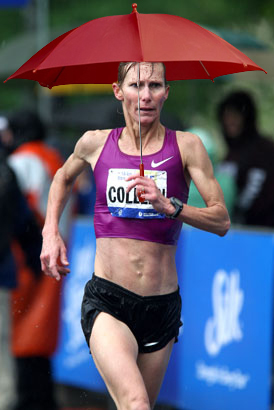
I briefly considered going into the city to watch the More Half in Central Park, and maybe do a run in the opposite direction as I did last year (so I could watch the elites, followed by the March on Washington). But, man, it was just miserable out there. My AG hero, Colleen De Reuck, didn’t win, as I’d hoped. She was in the lead until mile 9 when she succumbed to hypothermia (that’ll happen when you’ve got 14% body fat). From what I can gather, later in the race her pace cratered by at least 20 seconds per mile and she ultimately got handily beaten by Sally Meyerhoff (although I’m a fan of Sally’s too, owing to her having meaty thighs and a substantial badonkadonk, like mine).

Colleen with her jaunty red brolly.

I’ve had it in mind that I should do one hard workout this (meaning the current) week, preferably early in the week, then a minitaper for the Long Island Half on Sunday. I spoke with Coach Kevin over the weekend and he confirmed this plan. But he surprised me by giving me a doozy of a workout to do: a 12 miler with the last 8 alternating between 7:15 and 8:30.

I did this workout six weeks ago and, to be honest, it was difficult. I’m expecting it to be a bit easier this time around, primarily because I’m fitter now, although the fact that the wind is low this morning should also help. Now I just need the sun to come up so I can go out there and kick my own ass.

Spring Training: Weeks Twelve and Thirteen

With the crazy weather, insane workload and race-heavy weekends, I’ve neglected posting training.

A planet yawns.

Mileage has been very low the past couple of weeks, owing to all the racing. My pattern of one just one workout a week + race has continued. I had one very good race, one just so-so. Let’s review:

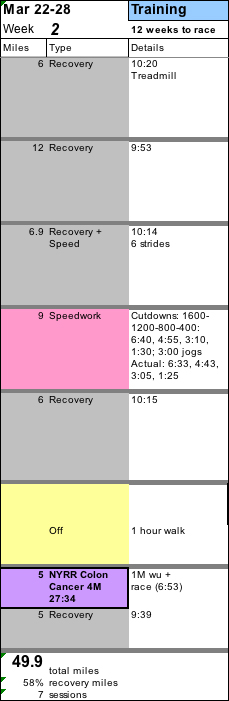
The last week of March featured just 50 miles (okay, 49.9, but who’s counting?) and was punctuated with a very good speed session on the track and then another good race on Sunday. Aside from feeling like crap that Saturday, primarily due to overindulgence the night before, I felt like a running god all week.

The following (last) week was a measly 35 miles. I took Monday off because my legs were totally shot from the race and I think it was a very busy work day too. Or maybe the weather sucked. I honestly can’t remember and I’ve been bad about filling in my training diary.

Since I was racing on Saturday, I did my speedwork on Wednesday evening. It went okay, but wasn’t anything to write home about like the previous week’s session. I probably should have seen it as a harbinger of things to come, but I figured I was just having a down day.

Saturday came and I struggled to break 45:30 in Central Park for a 10K. I’m somewhat inclined to blame it on hormones, since I tend to be very slow during the end of my cycle. Yeah, it’s the female troubles. This sort of thing has happened before (paragraphs 4-6).

Whatever. I’m glad it wasn’t a goal race. I took the day after off primarily because I had a monster work project to complete and after 10 hours of staring at a screen, then an abortive attempt to go shopping afterwards (stuff is closed on Easter; who knew?), I decided that I didn’t need the extra pressure of trying to get a run in before the sun went down.

Coach Kevin has been having major computer and connectivity issues lately so I’m winging it for the time being and just running however I feel like running from day to day.

I’ve got yet another race, a hilly 15K in Scarsdale, coming up on Sunday. Normally I’d be worried about not having a plan for the week. But like last week’s race, this isn’t one I care about particularly, so I’m not that concerned about what I do this coming week to prepare. It feels a bit like I’m coasting from week to week as it is.

Spring Training: Week Ten

I’m starting to feel like a real runner again.

Now that I’m plunging into a few months of frequent racing, my training has taken on a different structure and quality. The most noticeable change has been in the number of workouts per week. They have generally dropped from three (tempo + speed + easy long) to two (tempo or speed + hard long or race). The mileage is, by comparison to last year, also a lot lower most weeks, with last week in the mid-30s.

I was very tired on Monday, so I just took it off. At this point, I’m seeing lots of evidence that the training is resulting in steady improvements. So recovering from those workouts has become equally important. I don’t want to either fizzle in the workouts or races, or drive myself back into a ditch of overtraining. Not when things are going so well. So I won’t hesitate to take a day off if my ass is dragging.

We’re trying to put a minimum of two rest days between a hard session and a race. This week, since I skipped the Saturday “Manhattan Monsoon” race (the NYRR 8000), I got three recovery days. That extra day didn’t seem to make me stale.

The nature of the workouts is also changing. This week my speed session featured 800m repeats, but with a twist: I was to run the first 600m in 2:30 (6:40 pace), then drop the hammer for the last 200 and run that in 45 (6:00 pace). This was a tough workout, not the least of which was because I was sharing the track with the entire Bronxville High track team (and it was, as usual, windy). But it would have been tough on an empty, windless track. Running uncomfortably fast for a few minutes and then running even faster proved a challenge both physically and mentally. This was also the first workout that I can remember in awhile that I felt slightly pukeworthy at times. However, I managed the paces, more or less. But I was fried afterwards.

The next few days were very easy because I thought I was going to be racing on Saturday. When I realized I wasn’t, I nevertheless cut back the planned mileage for Saturday from 10 to 6. I reasoned that if I was going to make the 2 miler my focus now, I might as well be as fresh as possible for it.

My legs felt great for the 2 miler, and I ended up with a few extra miles around it for warmup and jog cooldowns.

This week the mileage is back up into the 60s and I did a very challenging workout on Wednesday — a new sort which Kevin referred to as a “rite of passage” workout. More on that coming up in this week’s training recap. Next week features another surprise: my first “cutdown” workout on the track (1600, 1200, 800, 400 — all getting progressively faster). Then the Colon Cancer 4 miler next Sunday, where I hope to break 7:00 over that distance at last.

I’m also once again attempting to shed some of the extra baggage I’ve acquired in the past few months. My scale tops 134 now. Twenty months ago I weighed 126 and I felt a lot more comfortable at that weight, especially when running fast. It was very difficult to lose weight while running high mileage last year. I don’t know what the hell happens metabolically when you’re doing 90 mile weeks, but losing weight was all but impossible for me. Now I’m figuring that with relatively low mileage demands at the moment, my need for fuel should be on more of an even keel and perhaps my metabolism won’t be so inclined to demand calories every 90 minutes and then store them so enthusiastically.

Unfortunately, a concerted effort to lose the flab means scaling back on my usual gluttonous birthday plans in a few weeks and teetotalling most evenings. Moreover, my day gig’s team status call has been moved from Monday afternoon to the cruel hour of 8AM on Monday morning. This means I can’t get moderately inebriated on Sunday nights anymore and count on having half the day Monday to let a mild hangover seep out of my system. This is probably a good development, although I wish I’d had some say in the matter.