Training: Nov 13 – 19

This week featured two workouts (planned) and two days off (one of them unplanned). I had to cut back on the first workout since my back was still iffy. I had planned to do 4×10 mins at tempo pace on Sunday, but it took me about 5 miles to feel good on the run. But by that time it was too late to start doing that much tempo work. So I slashed it in half. Doing some work is always better than doing no work.
I should note that last week’s back issues put the kibosh on doing any major weight work. Then an out of town guest (nephew Joe!) put paid to any plans to do gym visits while here’s here. So, with Thanksgiving and a race, I probably won’t get back to weights until after 11/26. But I will get back to it.

The next day, on Monday, I still had speed in my legs and ran a very zippy recovery run. Then I took Tuesday off, my planned rest day for the week. On Wednesday I was zippier still, ripping through a 7 mile recovery effort in 8:18 — a pace that was moderate effort run pace a mere 9 months ago or so. That felt great.

On Thursday I headed back up to Edgemont track, which I had mostly to myself for the first half of the workout, then just a few walkers who stayed out of my way. It was a tough day for a workout. Cold and quite windy. I had a bracing 20 mph wind that was a total to near-total headwind for about 150m of each 400m lap. The workout was a “ladder” session, with lots of 200s, some 400s, a single 800, then back down to the 400s and 200s. All repeats were at mile race pace (or, as was the case today, mile race effort).

I love running 200s, and this time around I arranged those so I had either a side- or tailwind. I had to adjust target times give the wind, but I didn’t do too badly. And things were very consistent. Splits:
40, 45, 42, 44, 90, 94, 3:15, 92, 91, 42, 44, 45, 41

Then I got a 90 minute massage, which revealed major problems in my neck, shoulders, calves and — no surprise here — lower back. I need to go back, but not until after a race on the Saturday after Thanksgiving. Naturally, I have Thanksgiving and, possibly, day after Thanksgiving social plans. It will take a steely discipline and extreme fortitude not to eat and drink myself silly. I do want to perform well on Saturday since it’s a flat 5K course. I have no clue how much speed endurance I have right now, but I’d be delighted if I could hold anything around a 6:40 pace, conditions permitting.

On Friday I was back doing slower recovery miles, 5 miles at a 9:45 crawl. Very tired.

Then on Friday evening I had my second experience with post-French cuisine gastrointestinal distress. Got home at 1 am, having felt not quite right driving home. By 2 am my bowels were rebelling. By 3 am the puking had begun. And so the tag teaming continued early into Saturday morning, finally easing off around 5:30, when I fell into a dead sleep for 3 hours. There was to be no running that day.

I suspect I’m allergic (or “food intolerant”) to either duck or escargot (“snails”). Both of these foods figured into my last expulsionfest in March as well as Friday’s technicolor extravaganza. I will, with some sadness, probably never eat either of these two foods again.

With the post-foodpocalypse day of rest, the week was a light one in terms of mileage. That’s fine. Despite a stomach feeling like it had been spindled, I went out and ran a fastish 9 miler, followed by an outstanding tempo session this morning. I’m feeling very good about my training these days. But we’ll truly see its value (or not) on Saturday, when I go out and run a race of the distance for which I’m training. If it doesn’t work where the rubber hits the road, then it’s back to the drawing board.

Just one gear note: I needed a new mid-layer, since my old Mountain Hardware zip-ups (which I love) are getting so faded and frayed. On a lark I bought this one, a wool/synthetic mix from Nike for $80. This shirt is fantastic. So many nice details. For one, it has a little zip pocket, which is useful. It also has robust hand warmers — little concealed finger-covering flaps that are hidden in the sleeves. Very effective for keeping hands warm a the start of a run. The neck closes and is comfortable. Plus the cut is just right; it’s formfitting without feeling tight or binding. You just feel snug. It also means it’s a great shirt to wear walking about, under a coat. You do have to hand wash it because it’s wool. And hand dry it. Totally worth it. I like the blue. May need to try one of the other colors…

Houston in January: Let’s put the “social” back in “social media”

It’s come to my attention that a lot of people whom I kind of — but don’t really, but would like to — know are going to be descending upon Houston over Olympic Marathon Trials weekend. Since I just got turned down for a media credential, plus I’m only racing the 5K (although I will have my semi-hysterial pre-marathon SO in tow, which means gettng there early to minimize travel stress), I’ll have free time on my hands.

Chances are good that I’ll arrive late Thursday and leave early in the day on Monday. Unless I decide to skulk around outside of the press events, which means I’ll probably be arrested for harrassment and/or loitering and thrown into jail, I should be fairly footloose and fancy free. I can’t get drunk, though. At least not after Friday night.

I would like to meet you if I can. Maybe even assemble in a group to watch the Trials with — I will be cheering for several actual people I sort of know. Or for the full/half marathon, if you’re not running those — after I race the 5K I’ll be out cheering for lots of people in those races too. Or have someone to say “Hi” to at the finish of the 5K — or perhaps even at the start. Dinner, drinks, brunch. Pom-poms. Making fun of Houston. The possibilities are truly endless.

If you’re going to be there and want to try to arrange a meetup or two, please let me know with a comment and/or email. I can’t keep track of who’s going and who’s running what when. I think I need to start building a spreadsheet or something.

Training: Nov 6 – 12

Last week was on the lighter side due to two very late nights and a violent 24 hours or so of back spasm. I returned to the Rockies on Sunday for another tempo session around Swan Lake. But I was not feeling the love this week. It was windy and I just seemed slow. I was slow. Times were about 15-20 seconds off the last session. It’s fine, though. Sometimes you just have a sub-par run. Afterwards we headed straight to the gym where we had lunch and avoided the blaring NYC Marathon coverage on the café’s television. That would have to wait until later. There were heavy objects to be lifted and boxes to be jumped up and down on and off of first.

The next day my legs were peppy as hell. I zipped along at sub 8:30 with nary a pant. Tuesday evening was the final evening of my storytelling class. That involved a performance. I went for a run early in the day, did a little work and then spent the rest of the day relaxing, meditating and even napping. This is a luxury I rarely allow myself. It was fun to do on a Tuesday.

The performance went well (or, at least, people told me it did), then we had dinner with some friends and then the evening’s second act began, as we discovered that our car had been towed. Everything turns into a pumpkin at 11pm, according to the NYPD. Since I’m rarely out that late (and we arrived at an empty parking space at 11:20), I forgot. So we walked about a mile and a half to the tow pound, calling on the way as they searched for our car. Eventually they found it and, after taking a sum of money from us that I’d rather not disclose, we had our car back. I will read street signs (and my watch) more carefully from now on.

We got to bed at about 2:00am. I was exhausted the next day. So I didn’t run.

Thursday was another speed session. This time around I departed from Jack Daniels’ assigned work(b)out and decided to do what Jonathan called a “classic 5K workout”: 1K repeats at goal 5K pace. Goal for the near future is 6:25. That would get me under 20:00. I went to the track and attempted these but found myself struggling. But I wasn’t struggling with running so much as I was struggling with math. I got home and realized I ran the repeats too fast by about 5 seconds per minute pace. That doesn’t sound like much, but, believe me, you feel it when you’re already pushing the effort. I could only do three of my planned five. I did what I’ve done before, which is to cut down the length of the repeats and up the speed for the last few. It wasn’t a terrible workout or anything.

I miss mile training. 5K training is so much harder.

Friday featured a slow recovery run and legs too tired to do strides. Then a long day in the city, capped off with a midnight showing of a concert film by Sigur Rós called INNI. That ended at 1:30am. And then. We managed to get ourselves caught in a traffic jam at 2:00am. Police had closed off a great swath of the West Side Highway, so traffic got diverted. We got to bed at around 3:00am.

I must have been sitting weird all day because I got out of the car, twisted slightly, and then my back went into a screaming, oh-god-what-the-fuck-is-that back spasm. That lasted through the next day. Moving around a lot helped. Sitting sent it back into spasm. So I’ve been moving around a lot.

What a week. I’m not built for late nights.

Sweet Tweets

Lately I’ve been enjoying using Twitter as a platform for very short-form comedy writing. I have ongoing series on various themes. It’s only recently that I started including a hashtag on these for easy retrieval (or for others to contribute to the theme, although they rarely do). There is something about being constrained by 140 characters (actually, it’s fewer now that I tack on a hashtag) that is invaluable to improving my writing skills. It’s a challenge to be funny in that format, just as it’s challenging to write a good haiku poem.

Anyway, recently I’ve had a few series that are running-related. The first was a series that explored the best reasons to drop out of the NYC Marathon. Last night I did another in response to a stupid article I read with tips from Kara Goucher and her sponsor, Amway. That one’s on tips for running your first marathon.

I write a lot of these during the weird mental twillight that happens in the 45 minutes between when I take an Ambien and when I fall asleep. I think there’s something about that drug that blows mung out of the cogs and lets absurdity flow.

I’ll probably do more of them since runners are such a dedicated crowd. And it’s not like there’s a ton of runner-specific comedy out there. Unless you count Toni Reavis’ violence-laden race commentary.

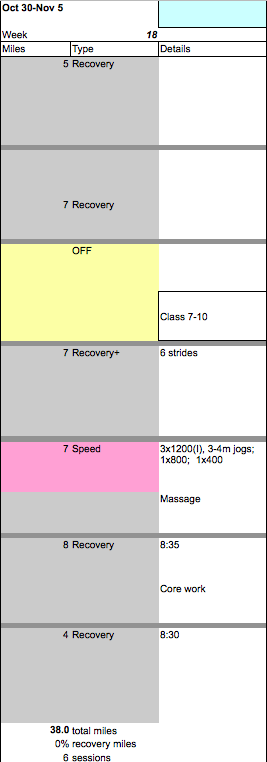
Training: Oct 30 – Nov 5

Welcome to winter! I wish I had a short memory because if I did:

  • I would forget that we had temperatures around 80 earlier in October
  • I would also forget that it snowed for 5 months last winter

We got about 6 inches of snow the day before Halloween. Much damage, to my training schedule and to my trees, resulted. I’m moving on. I need to be more flexible than my trees were.

Maybe the cancellation of my planned Sunday race was a blessing in disguise, though. I took it easy in terms of mileage early in the week. Then I had a monster day of driving and sitting around in conference rooms. I spent no less than 4 hours in the car. It was a 16 hour day. I was tired on Wednesday.

And yet. My legs were strangely peppy. My recovery runs are now consistently under 9:00 pace, often more like 8:30. This just shocks me. Also, with the exception of the day after a very hard run, I have plenty of energy for strides. While I’m sorry that it took me several years to realize that I do best on two workouts a week, not three, I’m happy to finally be flourishing by following this guideline.

Because of the cancelled race, this was a light week. But. Maybe also a good thing. Because I went to the track on Thursday. And. Sweet Jesus. I’m improving.

But first. About false starts…

We first went to the Edgemont High School track, but discovered something very important. There is a reason a Mondo surface track is better than rubber. When water freezes on rubber it turns into a sheet of ice. A good 50m of Edgemont, the part that gets no sun, was totally unrunnable due to ice. So this track will be largely useless in winter. That is a shame.

But at least we do have a Mondo track up here, and that’s at Bronxville. So we got back into the car and drove there, hoping we would not encounter another Circus of the Absurd. We did not.

My targets for the 1200s were 4:50. I flew through the first one in 4:40. Second one in 4:41. Wind picked up for the third one, yielding a 4:46. Hot damn. I’ve gotten faster. On the fourth one I got totally thrown off by crowds of children, so I cut it short at 800 (3:13). I decided to run a final 400 fast, just to see what my legs could do after this effort. I did an 84. That’s 5:38 pace for those of you following along at home.

Training: Oct 23 – 29

This week of training featured my first tempo run at Rockefeller State Park (aka “the Rockies”), and it was enjoyable. It’s a good park to run in once you figure out how not to get unspeakably lost. The last time we ran there one area in particular caught my eye: Swan Lake. This small lake has a trail (or, rather, several trails that connect) running around it. With the exception of a short little hill, it’s basically flat and it’s almost exactly a mile around. But since I’m running my tempos by time, that doesn’t matter. But it’s still worth noting.

The warmup to running includes a vigorous 3 miles that are mostly uphill. A long, steady grade on packed dirt or fine gravel. I like the uphill because it forces me to control my warmup pace but also feels like I’m getting a good little bit of hill work in. By the time I get to Swan Lake I’m ready to rumble.

This week’s tempo tacked on around another mile over last week’s. I wear my heart rate monitor for these so I’m running at the right effort. Paces have been right in line with what I’m guessing is my current VDOT of around 49: 6:55 per mile, give or take. Going to a newish place helps make tempo running, if not enjoyable, then at least a little more interesting. The lake is very pretty and there aren’t that many people walking around it if you get there early enough.

I had hoped to do weight work on Sunday but something took me away from it so I ended up moving it to Monday. I did a fairly big session, with the usual upper body work plus lots of leg stuff and plyometrics. I’m also back to doing core work consistently. But there was a price to pay for moving it to Monday. I went to Edgemont 36 hours later to do a speed workout and was just unbelievably slow, heavy-legged and tired. I struggled to hit 5:16 for the first 1200. Then, with a might effort, got down to 5:02 for the second one. My target was around 4:50. Clearly, I was wiped out from the tempo run plus weight work. So I threw in a couple of 400s just to see what I could do there and it was difficult to even hit 90 for those.

As (my former) Coach Sandra would say, I was “running like shit.”

So I went home. I took the next couple of days off, both because of work commitments and also because I had been scheduled to race a 5 miler in Central Park. But that was cancelled. Due. To. SNOW! Yes. We got a fucking snow storm in late October. But not just any snow storm. A snow storm that created massive damage to trees (the snow was heavy). So now our yard is full of giant downed branches that need to be professionally removed. The damage to trees in local parks is also impressive. Central and Prospect Parks were closed because it was so unsafe to walk around. New York is now down to two seasons. Thanks, Climate Change!

In anticipation of racing I did my little wimpy 2-3 miler with strides. Boy, was I ready to race. But it was not to be. But that was okay. Because my next week of training, which I will post about momentarily, featured a track workout that was nothing short of fantabulous.

Training: Oct 16 – 22

My foray into the virgin territory of dedicated training for the 5K continues. It was kind of a strange week.

I will eventually be doing tempo runs that are solid blocks of 30-45 minutes, but after months of no tempo work I need to ease into them. Fortunately, Jack Daniels agrees, so I’m following his workouts, which break up the tempo runs into segments with a few minutes of easy running (or strolling) between them. I did this week’s tempo run in Central Park. I have a 5 mile race there coming up and since I haven’t raced there since August thought I’d better do some harder running over its hills so racing there doesn’t come as a total shock.

That actually went very well, despite the strong winds that day. Average paces were 6:45-7:30. My tempo pace on flatland is around 7:05-7:10 these days, so I guess those ranges were reasonable. I wore a heart rate monitor, as I’m doing with all tempo runs — at least early in training as I reacquaint myself with how that effort should feel — and was running right around 89% of max most of the time.

I’ve gotten back to doing weight work a minimum of once per week, and core work has gotten re-prioritized as well. I hope to get back to doing that twice per week. The pictures of me in the Fifth Avenue Mile are proof that this was worth doing — I’m running upright, with my hips, shoulders and head in a straight line, even at the very end. The other thing I’ve added is some light plyometrics — mostly rapidly stepping up onto a platform while carrying a barbell, one-legged leaps up onto said platform. Plus balance work. It takes forever.

I’ve slacked off on doing strides, but my recovery run paces are decent these days (usually either around 9:00 or well under), so I’m not too worried about it.

The speed session this week was a disaster, through no fault of my own. This is the last trip I’ll make to the Bronxville High School track for awhile now that I’ve discovered the oasis that is the Edgemont High School track. Jonathan and I went together and, from the moment we arrived, we could tell that there would be distractions aplenty. The first thing we noticed were two men swerving around the lanes with leaf blowers. Those were both going at about 120 decibels. It was earsplitting. The men formed piles of leaves, twigs and other debris, which we had to run through, and always seemed to be in the lanes we were in as we rounded the track into the area in which they were lackadaisically working.

There was also a 30 mph wind. Flags were horizontal.

Then arrived the children. About 100 of them, tearing around the track in all lanes, stopping suddenly without warning. At least two repeats were fucked up by that issue. But they cleared out and assembled on the field finally.

Meanwhile, walkers were arriving and wandering in phalanxes of 3-4 across with no awareness of lanes.

To top things off with a nightmarish absurdism that only Italian directors can recreate, the tractors arrived. Yes, there were tractors. On the track. They drove around the track hauling floodlights. Sometimes they’d stop. We were trying to run around a track while tractors also drove around the track. Had a group of monster trucks, elephants and a dirigible arrived, I would not have been surprised.

I finally gave up and went home. Jonathan battled on. After all, I’m just training for a 5K. He’s training for a marathon.

Training: Sept 4 – Oct 15

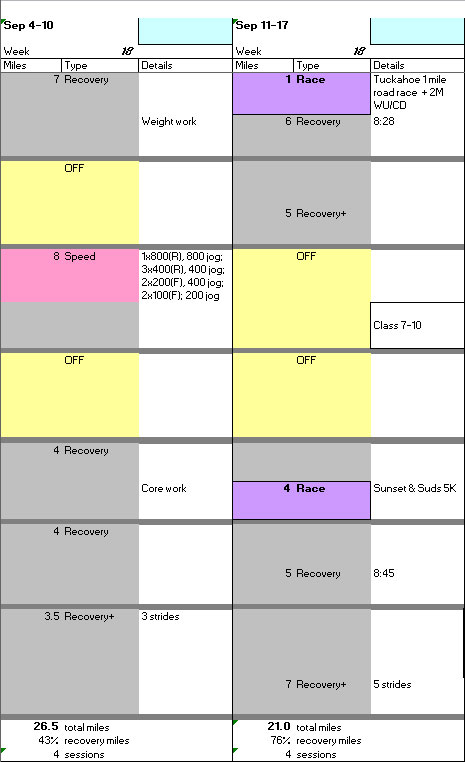
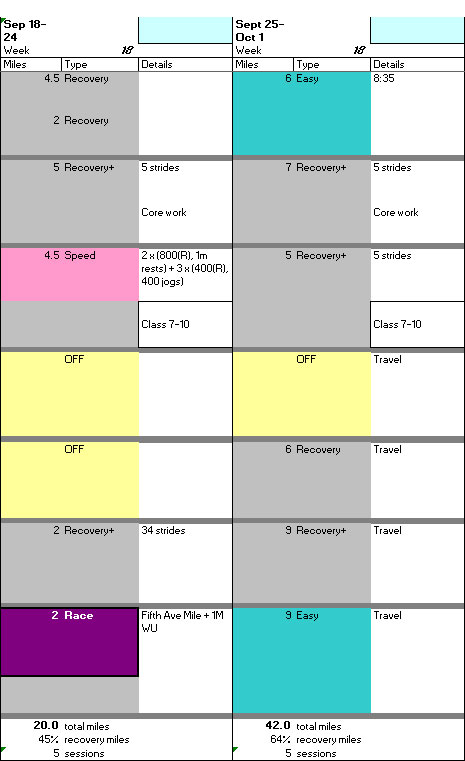
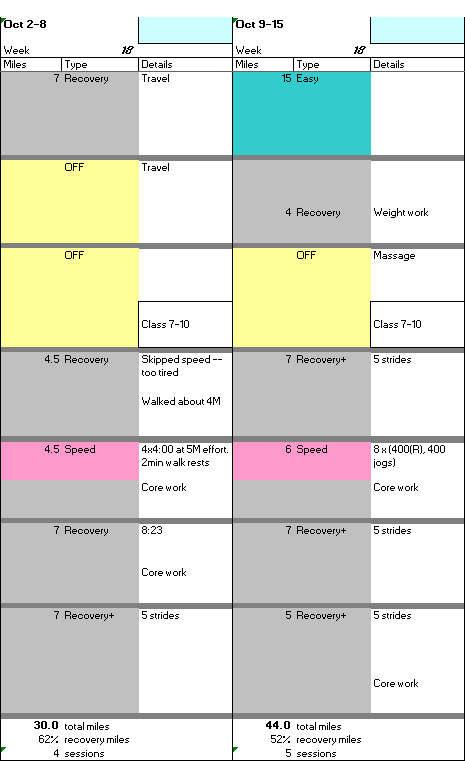
An extravaganza of catching up (or neglect, depending on how you look at it). I’ll skip the commentary. I’m mostly putting this up to satisfy any unlikely curiosity about what exactly I was doing training-wise leading up to the Fifth Avenue Mile, about which I was chuffed. Then things went all unstructured right after that with travel and just wanting to unwind a little from that training/racing experience.

I will note that I did not do 34 strides the day before that race. That is a typo that’s too labor intensive to fix. What do you think I am, crazy or something?

This week marked the start of 5K training, which will include more consistent mileage in the 40-50 mpw range, longer stuff on the track and the reintroduction of weekly tempo runs. Unlike many runners, I really don’t mind tempo runs and in fact enjoy them if I’m in the right mood. I’ve never been afraid of them. I don’t get that at all.

I have 13 weeks to prepare for the El Paso Corporation 5K in Houston over Olympic Marathon Trials weekend. My little running calculator says that based on my mile time of 5:57 I could conceivably race a 5K around 19:30 today. Yeah, right. I don’t think so. Not without a shit tonne of work. But I’ll be doing that work over the next three months.

Sub-20 is something I could not have conceived of for myself before. Now it doesn’t seem too crazy a goal to shoot for. I am now officially pumped, stoked and psyched to try. I’m also pretty excited.

Google Search Oddities

“are you old when you’re 46”

Yes.

And.

No.

A few minutes with Jenny Simpson

Jenny (Barringer) Simpson’s running résumé is so impressive that it’s difficult to choose among the highlights. A 2008 Olympian in the 3000m steeplechase, breaker of numerous collegiate records and one American record, and, most recently, gold medalist in the 1500m at worlds — the first American woman to win gold in that event since Mary Decker-Slaney won it in 1983. Needless to say, I was thrilled to get a chance to sit down with her. Incidentally, Simpson won the Fifth Avenue Mile this year.

When you win a gold medal and walk down the street in the event’s home city, do people recognize you?
That was one of the strangest things. I left the stadium to go to dinner that night. Even on the way to dinner there were people stopping us on the street for pictures. It wasn’t just Koreans, it was people visiting, all kinds of people.

Was that odd for you?
It was very strange. Of course, I’m very flattered and want to be accomodating  and take pictures with people. But it’s just so strange to be walking down the street and having people say, “Oh, my gosh! You won the gold medal. Can we have a picture?” Two or three days later, my husband and I were supposed to meet each other at a train station. We couldn’t find each other and once we finally did find each other we needed some help in order to make our train on time. The security guard was more than happy to accomodate us because he knew that I’d won a gold medal. It’s just so strange to have a security guard working in the train station know who we were.

When you watch a race, everyone’s wearing Nike kits. But you went with New Balance. How come? What did they offer you that someone like Nike didn’t?
I had the beautiful luxury of being in a situation where I had several different companies that I could visit and ultimately choose from. It ended up being a scenario very similar to college. If you’re good in high school and you get five full scholarship offers, at that point you’re deciding what the best fit is for you. I felt like I had full scholarships from all of these places and at the end of the day I was able to decide who was the best fit for who I am and what I want to try to accomplish.

What I found in New Balance was an incredible family. From the moment I met these people I felt that they genuinely wanted to be a part of making my career as great as it could be. I wasn’t necessarily simply a vehicle for their product. They were able to communicate that to me the best. I know that they have a lot of resources, but they keep their team relatively small. All those things were really attractive to me.

They seem to reward loyalty with loyalty. When you look at someone like Khalid Khannouchi, who’s been with them since the mid-nineties — they’ve supported him through eight years of injury. It’s really kind of amazing.
One of the main things I considered when I was looking for a college was how many people went on to compete professionally after going to there. What’s the success, the longevity of their runners? So when it came time to choose a sponsor, I wanted to compare the relative size of the company to the number of people that they sponsor. New Balance is impressive in that they are incredibly loyal to the people they sign. Through the good years and bad years they take ownership of the people they signed and who’ve been with them for years. I just think that’s a really honorable thing to do.

If you run for a shoe company like New Balance, but you can’t quite find a pair of shoes that works for you, will they customize shoes for you?
Absolutely. And with New Balance it’s even easier because their factory is in the US. It’s not like you go get fitted and then they send it out to China. You can walk to the factory in Lawrence, just outside of Boston, and they make your shoes for you there. It’s a beautiful thing to be able to walk to the factory and see the people working on your shoes and on your products. That’s a whole other inspiring side of the company. They’re true to their message in that they employ US workers and keep it US made. That meant a lot to me.

I’m interested in the fact that you moved down in distance. That’s unusual. You were an outstanding steeplechaser and then moved down to the 1500. What drove that decision?
I’ve always wondered if anyone else leaving college has ever moved down. I can’t think of anyone.

Well, there’s you and Anna Pierce.
That’s true. When I was racing in 2009, everyone remembers when I went to Prefontaine and broke four minutes in the 1500. That was really a game changer for me. In that moment we realized that there was a whole other part of middle distance racing that I had an aptitude for. I went on and finished my track and cross country seasons, just as we’d planned to do.

But I always knew in the back of my mind that I had this great ability in the middle distances. So when I no longer had the opportunity to stay in Boulder, I was looking for a coach. I know how to train for a steeplechase and for a 5k. What I really don’t know is the highly specialized skills for the 800 and 1500. I looked for a coach specifically for middle distances and found an incredible match in Juli (Benson) Henner at the Air Force Academy. She’s done exactly that: taken the things I’m already good at and made me so much better.

Do you miss the steeplechase?
I do miss it. I miss it because I was so familiar with it. I miss it because I had a lot of success in it. The 1500 can be a little bit of a crapshoot. You go out and know you have a certain ability, but tactics are so important in that race. A great example is Brussels. I ran 4:03 and that’s a really great time. But I was in back, near last. So it can be really trying in that sense. You can have a great time, but a poor performance. Or you can win, but people will accuse you of racing a slow time. So in that sense you have to hold your own, and just own that you’re good at this event and that you’re going to keep getting better.

The steeple is more consistent as far as running similar times, and the event itself is definitely not as deep as the 1500. So if you’re running around seventh in the world you’re always going to place somewhere between fifth and tenth in the world.at the world championships. It’s a very different dynamic in that sense. More predictable.

All I know is that every time I watch the steeplechase, I’m always afraid for the runners. It looks so hazardous, especially when you go over the water jump.
I know! It is. I used to say that the steeplechase is the NASCAR of track and field because everyone comes to watch the crashes.

Have you raced any road miles?
I’ve never run a road mile. This is my first one. I’m very excited.

How do you think it will differ for you from a tactical standpoint?
Everyone is going to be missing that comfort of knowing exactly where you are every step of the race. When you’re on the track, you know in every moment, “I have 520 meters to go, I have 150 meters to go.” We’re so comfortable running those curves and knowing where we are. So I think it’s going to miss that level of comfort. Given how deep the field is, how good the field is, this year, I think it’s going to turn into a really exciting race.

How will you warm up for this race?
I do the same warmup for every single race and workout. I start with a short run and some dynamic stretches. Then I’ll run really easy for 15 or 20 minutes and then start my drills and my strides. All of that is really standard and set in stone. The one thing that isn’t set in stone is when you put on your spikes. That’s determined by the event. If it’s something like the world championships, where we have to go through a lot of call rooms, I’ll wait until we get into the call rooms to put on my shoes. If it’s a really relaxed race like Rieti, I’ll put on my spikes while I’m still doing my warmup.

Is that a mental transition you’re making as well, when you put on your spikes?
Absolutely. You put on your spikes and everything from that moment on is faster, a little bit more explosive, more intense.

Here’s a fly on the wall question. Those of us who are amateur runners don’t know what happens in a championship race. Beforehand, are you all herded into the same room together? What’s actually happening before we see you all out on the track?
I’m kind of a nerd, probably. But I always thought it would be interesting to write a short story just on that process, going from the warmup area to the track.

We don’t know what happens. We see you come out…
Yeah, it’s kind of a black box thing.

Are you thrown together, or are you given some space?
It depends on the venue. I’ll use the last world championships as an example. We go into the call room around 45 minutes before we go to the start line. At a typical race, that’s usually not long after you would start your warmup. So we have a 50 minute warmup and then we have 45 minutes in these call rooms.

You have to sit around for 45 minutes?
Yeah. We go into the first call room and they have to check everything. They check your bibs on the front and on the back. They have to make sure that all your logos are in compliance. They have to make sure you don’t have anything in your bag that you can pull out that’s noncompliant. Then they check your spikes, they check your uniform. They go through all of this for every single person in the field. They divide all those jobs between call room one and call room two. When you’re in call room two, there’s typically a place for you to do some strides, run around, do some drills. Call room two is where we all put our spikes on.

But while you’re in the first call room, you’re literally sitting in a small room with all the people you’re going to be racing. It’s usually really quiet. It’s kind of tense. By the time you get to call room two people are kind of shaken out again, they’re doing their strides, putting their shoes on. At that point — this what you all see — in our warmups, with our backpacks, we all walk out onto the track. At the point we usually have about five minutes, just enough time to put in one or two strides before we have to take all of our clothes off and step to the line.

Well, you don’t take all of your clothes off.
I should say all of our warmups off.

If you took all of your clothes off it might increase track and field viewership.
[Laughs] That’s true!

I want to ask you about the 2009 race in which you broke the NCAA 5k indoor record*. It was the most bizarre video, because it looked like you were running the race alone. I remember wondering how you kept up that effort while running solo. How do you run like that when there’s no one else around you to push you?
That was such an unusual situation for two reasons. For one, I was racing by myself. The other other funny thing about that video is that no one knows that anything’s going on.

Right! There are guys wandering out on the track. No one knows what’s happening.
Exactly. Something else that was unusual about that race was the track. It was something like 308 meters. A really strange distance. So the splits are in different places all around the track. There’s no way for an athlete by themselves to know the splits for a 5k going around that track. They designate someone to run around the track and give splits. I’d separated myself from the group and so the guy giving splits had to decide, “Do I give splits to the girl that’s winning or to the rest of the group that’s racing?” He made the decision — and I applaud him for this — to give splits to the majority of the group and let me go and do my thing. But at this point I’m at 2k, not even halfway into the race, and I have no information about how I’m running.

The absence of knowing where I was in the race or how fast I was going actually made me run better. It made me run so much better. I think it was a combination of no knowing — the bliss of not knowing — and the fact that I had this little bit of fear. I set out that day wanting to run 15:20. I knew that was going to be difficult to do. So I had this feeling, “If I slow down I don’t know if I’m going to be on pace anymore.” So that drove me to keep picking it up every lap. It was funny, too — my coaches are very calm, collected people. But they started looking more and more frantic each time I came around. And I was thinking, “Oh, my gosh. Is this not going as well as I thought it was?” I felt really under control, really good.

Did they think you were running too fast?
No. They were so excited. They thought, “Man, she looks so good! She’s running every single lap better and better and better.” So I just misinterpreted their reaction. They were all excited about what was going on. So it was for reasons of ignorance that I kept running harder and harder and better and better. When I crossed the line and saw 15:01 I didn’t think that was right. When you’re racing out there by yourself, I think it’s so important — and I said this about the 1500 in Daegu — to focus on yourself and how you feel. People ask me all the time, “What are you thinking about?” I’m thinking about running, what I’m doing, how I’m feeling. If you focus on yourself and forget about the time or the people around you, you’ll get the most out of yourself. That’s how I run solo races.

*I can’t find the video for this race. If anyone out there has a link, please share it!