

A new podcast interview.
Filed under: coaching, elites, how to get faster, inspiration, resources | Tagged: interview, marathon, nate jenkins, podcast, running times, scott douglas, world championships | 1 Comment »
A new podcast interview.
Filed under: coaching, elites, how to get faster, inspiration, resources | Tagged: interview, marathon, nate jenkins, podcast, running times, scott douglas, world championships | 1 Comment »
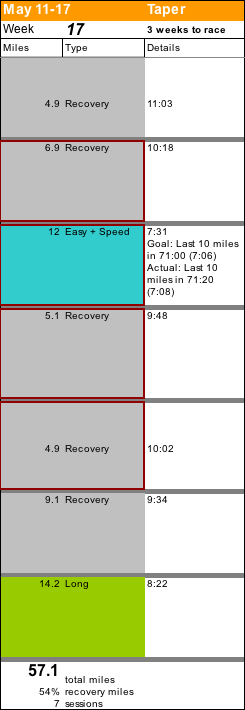 Welcome to my taper week. Won’t you come in and sit down? Because sitting down is what tapering’s all about. Sitting and resting. And thinking. Thinking about that big race you’ve been preparing for every day for the past six months. And trying not to worry.
Do try not to worry…
I’m a little worried. But that’s what coaches are for! Having hit Kevin with the latest data file and a barrage of questions, I’m waiting for his particular brand of “don’t worry” response.
So, yes, I’m a little worried. But I know the worry is irrational. The worry comes from the Wednesday workout, in which I again attempted (and failed) to hit marathon pace.
I almost did it, managing 7:08 average pace. But, shit, I was tired going in and had to take two rests during the 10 mile track opus. I had to remind myself that I’d run a huge workout over the weekend (22 miles with the last 12 at MPace). I was still carrying fatigue from that effort and, I suspect, the cumulative effort of weeks and weeks and months and months of running at an unprecedented level.
All of my diary entries up until yesterday contain a variation on “My legs are trashed! I am so tired!”
So, the rational part of me says, “Hey, it’s only two seconds off pace. You’ve been training like a Navy Seal. You’ll have no trouble after a few weeks of…”
“…tapering.”
So here we are, in taper week 1 of 3.
I did feel better starting yesterday, so much so that I had to be careful not to run too fast on yesterday’s recovery run. Because I wanted to run well today, as it’s my last long run before M Day.
Today’s run showed a glimmer of the taper effect. I decided to run by heart rate, not pace. My only requirement was that my average HR not exceed 73% of max over the course of the run. I could do whatever I wanted from mile to mile, but had to keep things easy overall. So the average stayed at 73%. And I averaged 8:22, a run which in the past few weeks has required an average effort more in the 75% range. What’s that I hear? The sound of energy returning? Sounds good.
Next week I anticipate that I’ll be climbing the walls. I have tomorrow and Thursday off. All the other days are recovery pace days. I have doubles on Friday. But I don’t even get to run a single stride. My mileage will top out at a whopping 40 miles. Seems like old times.
Before I go, congratulations go out to two runner acquaintances who raced their goal marathons today: Cowboy Hazel and “Joe Positive.” Cowboy had a great day in Maryland: He qualified for Boston and then some, set a huge PR, plus got second in his AG. And “Joe” ran a solid race in Ohio, also picking up third in her AG. Hooray!
Filed under: coaching, recovery, training | 4 Comments »
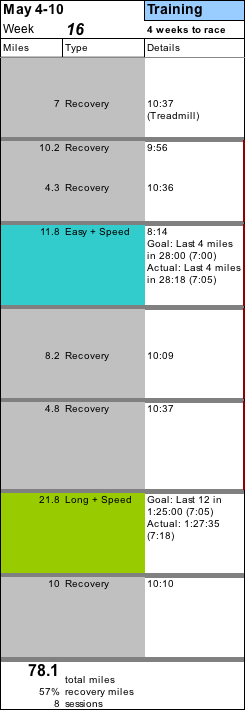 Well, this was it — the last week of real training. From here on out, it’s taper, taper, taper.
I took two days to recover from the half marathon last Sunday. Not surprisingly, I was still tired by Tuesday evening and after a conversation with Kevin, downgraded the Wednesday workout from 15 miles w/last 5 at 6:53 to a more doable 12 miles w/last 4 at 7:00. Wind and hills thwarted those plans slightly, but I was close enough at 7:05.
Thursday and Friday were not notable, although as the weekend drew near I needed to make a decision about the major 22 miler: Do it on Sunday as planned, despite a forecast of 20mph wind with gusts at 30? Or move it up to Saturday, with a 3-6mph wind, but extremely high humidity. I opted for Saturday despite the fact that it meant sacrificing one day of recovery (and running hard in sticky conditions). I just couldn’t look forward to running 48 laps on the track in energy-sapping wind.
So although it was uncomfortable running hard in 90% humidity, at 60F it was cool enough that it wasn’t horrible. I feel good about the effort, having done the “warmup” 10 at a respectable 9:20 pace (70% mhr) and managing an average 7:18 for the 12 on the track. I figured I’d “lose” 10-15 seconds due to conditions and residual fatigue, so I was mentally prepared for something slower than the goal pace of 7:05.
I finished up with a slow 10 miler this morning, also good for getting rid of a slight hangover.
I’m happy to report that all niggling injuries are gone at last. I tested carrying gels in my race shorts yesterday (which will require some modification with a needle and thread to better secure the gels in their special gel pockets), selected and tested race gel flavors and settled on which shoes I’ll wear.
Next week features another MPace run on Wednesday (just 2 easy + 10 at MPace, which I’ll again do on the track). Then a little 14 miler next Sunday. I think the total is under 60 miles. Then it’s all recovery running from there on out, save for one rehearsal run a few days before race day.
Excited. Nervous. Relieved. Take your pick. I’m feeling all three right now.
Filed under: coaching, drinking, injury, racing, training | 10 Comments »
Flo of Girl-in-Motion recently posted some questions regarding how certain aspects of this round of training (for the May 30 Newport, OR marathon) compare to the last round (for the Steamtown marathon in PA last October). If my training run paces are anything to go by (and I sure hope they are), then I’ve made tangible improvements in speed and endurance* during this training cycle. Put more simply: I’ve obviously improved more over the course of training this time around, relative to the level of improvement I made during the last cycle.
I had been meaning to do a comparison myself, and this was a great excuse to buckle down and look at the numbers.
Measurement
|
Newport Training
|
Steamtown Training
|
| Avg recovery run pace | 10:00 | 10:00 |
| Avg recovery run HR% | 65% | 65% |
| Avg weekly mileage | 84 | 80 |
| Mileage in peak week | 100 | 101 |
| % miles at recovery pace | 44% | 56% |
| Avg runs per week | 9 | 11 |
| Avg length of run | 8.15 miles | 7.50 miles |
| Frequency of full recovery weeks | Once every 3 weeks | Once every 4.5 weeks |
To the casual observer, it appears that I am a solid 100 mile-a-weeker. But in reality I’m only averaging a measly 4 mpw more than I was in the summer and fall. This is because more frequent recovery weeks bring the average mileage down.
Also note that despite an increase in fitness, my recovery pace has remained the same. There are wide swings from day to day (anywhere from the low 9:00 range all the way up toward 11:00). But it averages out to a ten minute mile. I would not be surprised if it stays in this range for the next cycle as well.
The three major differences are found in these areas: number of sessions per week, frequency of full recovery weeks and, perhaps most interestingly, percentage of miles run at recovery pace. Let’s look at each of these.
Number of sessions: Running shorter, more frequent runs works well for some people. I tried this for Steamtown and found that I was constantly tired. When Kevin put me on a basebuilding plan in November, I was surprised to see no doubles, but lots of recovery runs on the longer side. I followed the plan with some trepidation, yet quickly discovered that this arrangement works better for me.
If I run one 10 mile recovery run, I’m recovered and ready for a hard workout 24 hours later. If I instead do two runs (one in the morning and one about eight hours later in the afternoon), I’ll be tired the next morning, regardless of how the mileage is broken up between the two. What you don’t see in this comparitive table is the distribution of double days over the course of the Steamtown training. During recovery weeks they dropped off, obviously. But in peak weeks it was not unusual for me to be running 12-14 sessions per week.
Frequency of full recovery weeks: I took my cues from the frequency of recovery weeks in Pete Pfitzinger’s book Advanced Marathoning. Meaning they were few and far between. This may work for some people, but I recognize now that it wore me down. Why this is is anyone’s guess; perhaps it’s a side effect of being over 40, or maybe it’s an individual thing. The current arrangement (two high mileage/high intensity weeks followed by one lower mileage/high intensity week) has worked out well. With rare exception, I have emerged from the recovery week mentally ready and physically able to handle the demands of the next two “on” weeks.
Percentage of miles at recovery pace: This is the measurement that I find most interesting. The amount of time I’m spending running hard has increased by about 8%. I believe I have improved fitness as a result of that increased amount of time running harder miles (as well as the variation in workout types), and I believe the previous factor (recovery week frequency) is responsible for my being able to handle that increase.
It will be interesting to see if, with some tweaks to some of these factors, yet more improvement can be yielded. After I’ve run Newport and we’ve done the post mortem, perhaps we’ll make further adjustments. If I lowered mileage but increased intensity,** would that offer a bigger benefit? What if I reduced the doubles even more and did slightly longer runs? I suppose this is why runners are thought of as “experiments of one.”
*And, dare I say, running economy, although this is a bit harder to gauge outside a laboratory. Unfortunately, my laboratory is in the process of being redecorated at the moment.
**As recently suggested in some comments by “Coach Tom.”
Filed under: coaching, recovery, training | 5 Comments »
You asked for it, so here it is. The good, the bad and the ugly.
On Sunday I ran the New Jersey Half Marathon in Long Branch, NJ. This was my second go round for this race. Last year, I ran this half a month after a very good marathon. I was rested, but with a couple of tempo runs to my credit, and I obliterated not only my previous half marathon PR, but all of the sub-distance PRs as well. It was a magical race.
Alas, the magic did not last. Or at least, I had not properly set the stage for magic to happen.
Let’s examine what did happen. It’s pretty entertaining, and offers some object lessons in why all races are not created equal and why it’s sometimes very bad to be stubborn.
I’ve separated various individual miles or sets of miles into blocks. These sections of the race help tell the story of what went horribly wrong and why. But the story begins long before the miles shown on this chart. I carried into this race not four glorious weeks of recovery but 14 weeks of hard labor training, as well as 9 weeks of basebuilding before that, which also were nothing to sneeze at.
I didn’t know it at the time, but I was fatigued and not in the state required to run anywhere near even my outside goal time of 1:32ish. What’s ironic about this is that my confidence about this race was largely due to a week of stellar workouts in late April (training week 14) — a week of what Kevin calls “happy extravagance” — and which, when combined with the horrible following week (training week 15), served to knock the stuffing out of me and leave me in a semi-constant state of not-quite-recovered.
So here’s how the race unfolded:
Pre-race: After standing on concrete, shivering for a half an hour due to a late race start, they finally start the frigging race. I’m in row 3, behind two women in their underwear (they would come in 1st and 3rd, as well as a 48-year-old woman who would come in 2nd). They are chatting about their goal times (“Oh, we’re trying for around 1:23.”) and I am hanging my head in shame. I vow to run my own race, since I’m obviously going have my ass handed to me by these three. As it turns out, my own race would suck. Theirs would not.
1 (blue box): The horn blows and I take off so as not to get run over. I take five steps and immediately know that I am in trouble. My legs feel stiff and heavy and my calves and ankles are actually hurting. This is exactly how the Steamtown Marathon started out, and fans of this blog will recall that by mile 18 of that race I wished for a quick and merciful death.
My goal pace for this race was somewhere in the neighborhood of 6:52. I did my best, but after just one mile I was falling off pace. Miles 2 and 3 showed a slight decline, but I fought to stay in that range. Then we turned the corner into mile 4. And that was when I felt the headwind.
2 (purple box): Miles 4 through 6 show my personality — made up of equal parts determination and capacity for denial — shining through. I knew I was running into wind and that I was working too hard, but I ignored all consequences. When I got home and looked at the splits and saw that 93% heart rate, I knew that these were the miles in which I screwed myself. Had I simply accepted after mile 1 that I needed to slow down, well, I might have run a more even pace throughout and gotten a better time. But slowing down is for pussies!
3 (green box): The aerobic chickens came home to roost for mile 7. I felt physically ill, not quite barfworthy, but I made sure I had some space around me, let’s put it that way. A keen realization of the consequences of my tragic failure to run reasonably earlier on began to creep into my mind. This was the first point in the race when I considered dropping out.
4 (orange box): My stomach settled a bit toward the end of mile 7 and the general feeling of malaise began to pass. I rallied a bit and managed another faster mile, but then cratered again for mile 9, faced with the one real hill in the race.
5 (plum box): Mile 10 was the nadir (both in terms of course elevation and my mood). I probably spent half of this mile entertaining the idea of quitting. Bear in mind that for the last 50 minutes I’d been battling a headwind, anger, nausea, pain and suicidal despair. It all seemed so pointless. Then we turned another corner and the wind was suddenly behind us.
6 (yellow box): You’d think with a tailwind I’d have been able to speed up. But it was too late for that. I’d used up all my aerobic credits (or so I thought). Note how my heart rate goes up for miles 11 through 13, right along with my pace.
7 (red box): This was my Ron Howard movie moment. Here I’d thought I’d spent everything in miles 1 through 6. But look at my last quarter mile: I ran it at 6:41 pace. The fact that I could pull this out of my hat gave me one of the day’s few glimmers of hope. Expressed simply, “I can’t run fast when I’m tired, but I can sure run hard.” That has to be worth something for a marathoner.
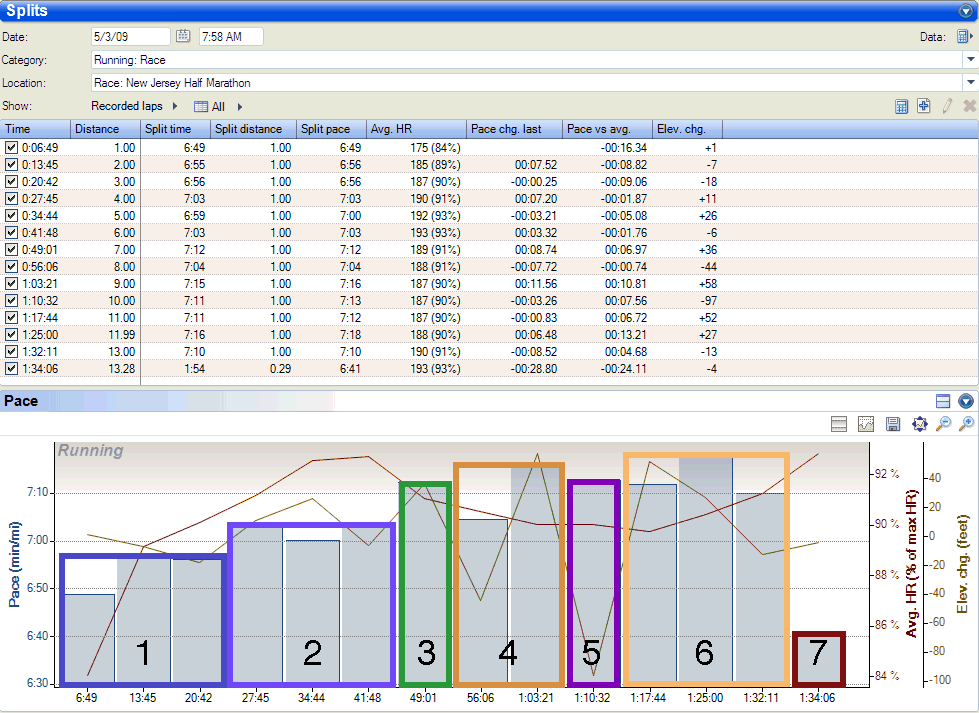
The data behind the drama. (Click to enlarge.)
I still managed to set a new PR of 24 seconds, along with new PRs for 5 miles, 10K and 15K.
What’s the big lesson in all of this? Well, there are several:
Finally, something interesting. I had a whole host of nagging physical issues going into this race: quad problems in my right leg, the lingering groin issue from all the way back to January, some left foot pain. All of that went away after the race. Sometimes I think a good, hard race can knock everything back into place.
Filed under: coaching, injury, racing, recovery, training | 13 Comments »
 The report is a bit late this week on account of my being in mourning over my loss in New Jersey. I’ll post a race report, along with some insights, this evening. But to summarize, the funk has lifted, with reason and logic prevailing at last.
Last week consisted of a “mini taper” for the half, with just one hard workout rather than two. This probably would have been fine if we hadn’t had a freak heatwave Saturday of the previous week through Wednesday of last week.
My legs were totally trashed on Monday from Sunday’s hot, hilly 20 miler in Central Park. I wasn’t much better on Tuesday, during which I experienced what felt like a pre-flu state: nausea, exhaustion and feeling feverish. I didn’t have a fever (although I do wonder if I had a bit of sun poisoning from Sunday), so I went out and attempted a hard run in high heat and full sun.
In retrospect, this was a stupid thing to do. I probably should have cut the run short when it was clear that doing mile intervals in such conditions wasn’t going to be productive. I wish I weren’t so stubborn, as this is a quality that truly is a double edged sword. When it works for you, it’s a great help. But it can also result in foolhardy moves that sabotage larger goals.
Anyway, suffice it to say that Tuesday’s run is probably what screwed the pooch for Sunday. I never really recovered from it, although my recovery runs were slow enough to fake me out and think that I had. But there were clues I could have heeded if I’d looked hard enough:
The kicker was Sunday’s race, of course. I knew from the moment the horn blew that I was going to have a bad race and be very unhappy for the next 90+ minutes of my life. More on that later.
Unfortunately, Kevin’s computer died during the lead-up to this race, so he was unable to look at my training logs (which include HR information, reports of sleep quality, etc.). While he had my blog reports on how things were going, they didn’t tell the whole story. With the full view, he says he would have told me to scale back expectations (but still run the race). As it stands, we’re making adjustments going forward to help ensure that I’m recovered to do the remaining key workouts, the biggest of which is on Sunday: a 22 miler with the last 12 at MPace.
So there you have it. Despite the race disappointment (which I now have some perspective on), I still feel really good about the training I’ve done and confident about my fitness. The recent track work in particular has gone very well. I’m not as worried about Sunday’s big MPace run as I thought I’d be. Ironically, I have to credit the race experience on Sunday for some of that relaxation of expectations. I’ve been banging away, doing 100 mile weeks for several months now. What matters most is the overall quality of my training, not whether I hit exact paces in one particular workout — there are just too many variables that can throw that off.
It’s bizarre to look at my training plan and see so few weeks left. Next week is my last real training week. Then it’s three full taper weeks, including three (three!) days off in there.
Filed under: central park, coaching, eating, racing, recovery, training | 9 Comments »
Interesting interview by Scott Douglas via Running Times Online. McMillan makes some good points, particularly with regard to not lumping all masters runners together, and how the differences in background, rates of adaptation and recovery, and other factors influence how he coaches them.
Filed under: coaching, racing, resources, training | 2 Comments »

I’m fast approaching the sixth month mark of being on a “2 weeks on, 1 week off” training schedule. This arrangement has worked out remarkably well for me. I’m fresh and peppy for the two hard weeks, but by the time I get to the recovery week I really, really need it.

I had another great week. It’s starting to feel a little creepy. Or foreboding. Or something. Unnatural. I keep waiting for the giant 16 ton Monty Python weight to come crashing down, but it never does.
This week was, like the previous few recovery weeks, marked by insane hunger and terrible insomnia. I have no clue why these issues feature so prominently in what should be a “down” week, but they do. I’d be interested to know if others out in blogland experience these two things during recovery weeks too.
Despite last Sunday’s semi-epic fast finish 22 miler, I felt full of energy on Monday, and my fairly fast recovery pace reflects that.
Tuesday was basically a shortened version of what I did on Sunday — a mid-length general aerobic run with three miles at 6:50 tacked on at the end. This version of the run went a bit better than Sunday’s, as there was less wind to contend with (and seven fewer miles) and I was able to work harder during the last miles. On Sunday, I was just too fatigued to run 6:50 at the end and couldn’t get my legs moving (nor my HR above about 86%). In contrast, on Tuesday I had no trouble meeting (and, in fact, slightly exceeding) the required paces, and the run overall was on the quicker side, averaging 8:14.
Wednesday and Thursday each had two short recovery runs. Unfortunately, the right groin issue (that dates all the way back to late January) has returned, probably as a result of whaling on it Sunday and Tuesday. It’s not bad, though. Just annoying, especially on downhills.
Thursday’s PM run was, as it so often is, the low point of the week. I just felt like shit, especially after attempting strides in the morning. The pace is only as quick as it is (“quick” being a relative term when referring to 10:16 pace) because I wanted to get the run over with.
As usually happens, I recovered overnight and awoke a new woman on Friday morning. Since I seem to run at my best at about 7AM, I hit the track early and pulled another fabulous speed session out of my hat. Despite a steadily increasing wind, I managed to average 3:08s (right on target) for my half mile repeats, doing the second three faster than the first three. I even royally fucked up repeat #3 by pressing the wrong watch buttons. That repeat was somewhat comical, with my hitting “stop” instead of “lap,” then hitting “lap” instead of “start,” then running 200m with the watch off, then stopping and cursing…
Saturday was another down day, with a very high RHR of 56(!) and an exhausted run featuring lots of walking, sitting on benches and stopping to look at ducks.
Today’s run was supposed to be “very easy.” I was instructed to run this in the “low 9:00s,” which I did. Technically. I guess 9:01 average pace is about as low as you can go without running 9:00. I just couldn’t run any slower than this. But since I averaged 71% MHR, I figure that was okay.
This weekend felt like spring for the first time. While I’ve loved the warmer temperatures, the spring flowers and enthusiastic songbirds, the flipside is that everyone comes out on the weekend and clogs the path. I don’t know why morons are so attracted to bike ownership, but the combination of obliviousness and wheeled conveyance makes for some, uh, challenging encounters on the path. That and the dog walkers with 30 ft long leashes (with black cording, no less, so you can’t see them), ready to clothesline the unsuspecting runner.
And today I had my first bonafide smackdown with a male goose. He came charging at me, hissing and tongue-wagging. I couldn’t find a stick in time (my usual defensive move, stick waving). So I threw my arms akimbo, ran straight at the goose and screamed, “Fuck off!” Goose reversed course and scurried away. Unfortunately, there were no witnesses to capture the moment for YouTube posterity.
Coming up in week 14: Another plain vanilla 16 miler on Tuesday, 3 x 1 mile intervals on Friday (whee!) and a reasonably paced 20 miler (8:20ish) on Sunday.
Filed under: coaching, everyday life, humor, recovery, training, westchester | 8 Comments »
Anyone watching the Rotterdam Marathon this year saw one of the closest finishes in marathon history, with Duncan Kibet nipping James Kwambai in a finish so close that they were both credited with a time of 2:04:27. But, perhaps more important, we witnessed two of the fastest times in history — just third behind Haile Gebrselassie’s two world records at the distance.
With this race a new era has dawned, at least in men’s marathoning. The bar has been raised and, as so often happens, it’s a good bet that runners will rise to the challenge in the coming months and years.
What’s also notable about the two performances in this race is that both men are coached by the same man, Claudio Berardelli. His fellow Italian coach, Renato Canova, is a frequent (and eagerly received) contributor to LetsRun.com. In this recent thread he provides insight into the training that Kibet and Kwambai are doing. Unfortunately, English is not Canova’s strong point, so understanding his posts takes some effort and reading between the lines. But it’s mental work worth doing.
Jonathan was so curious about how these training concepts translated into his own race goals that he created this basic spreadsheet [updated 4/19/09]. Using the examples that Canova provided as a source for calculations and ratios, the spreadsheet can be used to calculate workout paces for any marathon goal. I refined it to make it a little more user friendly.
I had to rename the extension from “xls” to “doc” in order to upload to WordPress. So you may need to change it back to “xls” in order for it to open in Excel. To use, enter your goal time in the blue box at top left — you actually update it in Excel’s formula bar, with (x, y, z) being hours (x), minutes (y), seconds (z). Your paces will be calculated automatically. In order to understand the sets of workouts (Fundamental, Special, Specific), you should read through the thread linked above. You should read through it anyway, actually, as it’s full of interesting ideas and, unfortunately, lots of unanswered questions.
The usual caveats apply: This was created by a couple of amateur schlubs using information off a message board. So you get what you pay for.
It is amazing to think that these guys are doing workouts like these (4 x 7K intervals?). But they apparently work.
Have fun!
Filed under: coaching, elites, how to get faster, racing, resources, training | 3 Comments »

Two months out from race day and things are still going well. This was another high mileage week with three hard workouts as usual, one of them a big, scary track session that loomed large over the past few weeks.
One update before I get to the blow by blow: The foot problem is gone. No pain and no more unsightly bump. Cortisone is an amazing substance indeed. One of my favorite comedians, Patton Oswalt, has referred to alcohol as “pain go bye bye juice,” but I’ve begun to think that term is more aptly applied to cortisone.
Last Sunday was a huge effort and it took its toll on Monday. I felt fine in the morning but as the day wore on I felt progressively tired, culminating in total sleepiness at 5PM, which necessitated a two hour nap.
Tuesday was sort of a crappy day. I had terrible insomnia on Monday due to an upset stomach. The run was slower than I’d wanted and my stomach was still iffy during the run. I wonder if it had anything to do with all the crap I ate on my birthday on Sunday. Ya think?
Even though Wednesday and Thursday were recovery days, they nevertheless featured a lot of miles. I walked a lot in the city on Wednesday (and cut short one run by two miles as a result). I was completely fried by Thursday afternoon, which featured a terribly windy PM run.
Friday was a day of reckoning, featuring a speed workout that I’ve mentioned in at least one previous post. Fortunately, the weather was near perfect — almost no wind, with cool temps and somewhat overcast. I hit the track early in the morning to beat the crowds (and schoolchildren) and had what I can only describe as a dream session.
The first few intervals were slightly slow (1:38-1:40), as I didn’t want to run them too fast. By the fifth, I’d hit my groove and was running most of them at 1:37 or within a second either way. The last four were 2-3 seconds faster each than goal time, something I’d planned to try. I felt so good that I was tempted to do four more (to make it 20), but decided that I’d been assigned 16 for a good reason and not to push things. Heart rate topped out at 90%, which was lower than I’d expected. They didn’t feel easy, but they didn’t feel particularly hard either.
Saturday’s recovery effort was another ass-dragging run, when I had to remind myself that I usually snap back in time for the big run on Sunday. I’d also taken care to eat a lot of carbs during Friday and Saturday and hydrate properly so I’d be fueled up.
This morning I headed out for another big run — a 22 mile long run with three fast miles at the end. It was, as usual, horrendously windy. The wind was primarily coming from the N-NW, at a steady clip of 15-20mph. I drove to the halfway point and ran the first six south, so I’d at least have the wind at my back for the early miles. Then I turned around and spent the next 11 miles running straight into a headwind. At Valhalla Dam I turned around and found that the wind had turned to a swirling, shifting wind. It was at my back for much of the time, a side- or headwind at others.
I managed just over 7:00 pace for three miles. My watch goes completely wacky in the wind (explain that one to me — it’s a GPS watch, not a windsock), so I had no idea how fast I was running. Sometimes it would say 8:20, others 5:40. And everything inbetween.
I did my best, doing my three miles in 21:04 (34 seconds off pace). I ran a half mile easy and then decided to tack on another fast half mile to justify the beer I’d planned to have later on. I managed that in 3:30. In all, I’m pretty happy with the run today, even if it wasn’t quite the pace I wanted. 22 miles at any pace is only going to help. I averaged 8:21, which is not bad in windy conditions. As a side note, I hit the 22 mile mark in 3:04. According to Pete Pfitzinger, this is a pretty good indicator of one’s achievable marathon time.
I’ve received the remaining weeks (plus taper) of my training plan for the Newport race. There are four more weeks of quality running to go, followed by a fairly radical cutdown in both mileage and intensity during the taper weeks. Next week, a recovery week, features another cut at longish run plus 3 miles in 20:30 at the end (Tuesday), some fast 800s on the track, and a mere 16 miles on Sunday with nothing special.
Filed under: coaching, humor, injury, recovery, training | 6 Comments »


 Races Like a Girl