

I think I’ll make this one into a series. Today someone found my blog by searching on “rapturous legs.”
Oh, if only.
Filed under: humor | 1 Comment »
I think I’ll make this one into a series. Today someone found my blog by searching on “rapturous legs.”
Oh, if only.
Filed under: humor | 1 Comment »
If by “recovery” you mean light running combined with heavy drinking.
I’m still working on my race debacle post-mortem (which may get thrown out the window after I get my blood tested next week). I still have one area (the nine week basebuilding period) to pore over before putting that together. For now, here’s what I did in the three weeks post-race.
This is more for me than for anyone else. Just so I’ve got a record somewhere that I can get to easily. Feel free to stop reading now if you have something more interesting to do such as, say, flossing.
June 1-7
Overall mileage for the week: 25 miles
Notes: I don’t know why I ran the first two after the Newport race so hard. I think I was testing myself to see if was still running weirdly slow as I was on race day. It was hard to tell given that I was running at elevation and up and down significant hills in Ashland.
The remaining runs were a little faster that I’d normally do for recovery runs. But I was running with Jonathan, who runs faster than I do, so we compromised on pace. They were also more or less flat, so I haven’t noted elevation change.
June 2: Ashland, OR. 5.5 miles at 9:09 pace. HR 75%.
This was a run from Iowa St. down to Lithia Park and back up again. Climb: +426/-452. 1,900 above sea level.
June 3: Ashland, OR. 5.2 miles at 8:15 pace. HR 77%.
Pretty much identical to previous day’s run, but done in the opposite direction so I could finish with the downhill portion (I’m no dummy).
June 4: Bend, OR. 3.4 miles at 9:33 pace. HR 71%.
Crap run in Bend, probably because I was at 3,600 feet above sea level. Bend’s maps could use some work too, as they reflect future plans more than today’s reality.
June 6: Eugene, OR. 4.2 miles at 9:20. HR 71%.
Ran a loop along Pre’s Trail, which is very pretty and chock full of other runners, many speedy and/or practically nekkid. Enjoyed this run a lot, even if it was a bit windy (and I a bit winded).
June 7: Corvallis, OR. 6.7 miles at 9:15. HR 70%.
Lovely run taking us out along cow and sheep pastures and then through the campus of OSU. I liked this town. Weather was perfect.
June 8-14
Overall mileage for the week: 15 miles
Notes: Just two runs this week, although I should note that I did a grueling seven hour hike on Wednesday which featured a climb up 5,000, then down 5,000 over a total distance of around eight miles. So my legs were destroyed for the following few days.
June 8: Troutdale, OR. 5.8 miles at 9:26. HR 71%.
One of the most unpleasant places to run I’ve ever encountered. I’m never going back to Troutdale.
June 14: Portland, OR. 9.2 miles at 9:19. HR unknown (forgot the strap).
This was a tough run in Forest Park, an enormous park that runs northwest along the NW and SW areas of town. Like the Ashland runs, this was a significant up and down course: Climb: +887/-928.
June 15-21
Overall mileage for the week: 35 miles
Notes: Back home again, so no locations are noted. Monday was a long travel day followed by a Tuesday of catching up on shopping, unpacking, laundry and work. I was tired and jetlagged anyway.
June 17: 4.7 miles at 10:09. HR 72%.
First run in the summer heat (unless you count the horrible freak heat wave in late April). Felt terrible and slow. Was also coming off of several days of intense travel and not enough sleep, so I didn’t expect to do well.I know this will pass as I get acclimated.
June 18: 5.0 miles at 9:55. HR 67%.
Pouring rain sent me inside to the treadmill. Felt better on this run, having caught up on sleep.
June 19: 4.7 miles at 9:15. HR 81%.
I’m experimenting with running hard on these “comeback” runs. Can I speed the process of acclimating to the heat and humidity by pushing myself in those conditions? We shall see.
June 20: 8.1 miles at 9:42. HR 76%.
Forecast for Sunday was steady rain so I decided to do a slightly longer run today in case I had to do Sunday’s on the treadmill. Probably ran too hard, but I couldn’t stand crawling along to keep my HR closer to 70%.
June 21: 12.2 miles at 9:25. HR 79%.
At this point 12 miles is a “long run” so I did it at long run effort. It was quite humid out in addition to being warm. I sweated out around 20 ounces of water. This is just a taste of what’s to come.
Filed under: recovery, travel | Tagged: marathon, newport, oregon | 2 Comments »
Last installment, I promise.
While downloading photos from my camera I was not surprised to find that I’d taken zero pictures in Bend. Bend was, to me, like nonfat plain yogurt: something you buy because you think you should. Then, because it lacks any obvious appeal, you let it lay moldering in the back of your refrigerator and eventually throw it away. Bend left the same impression. First it was nondescript. Then it evolved into an irritating place: semi-desert (I don’t like the desert), weird downtown, sterile neighborhoods and a terrible place to run. Let’s move on.
Edited: I just realized that I’ve already forgotten the sequence of places we visited. Bend was, in fact, before Eugene (covered in an earlier post). I guess Bend annoyed me so much that I had to take yet another swipe at it.
The next stop after Eugene was Corvallis, a place we had no preconceptions about and no expectations of. What a pleasant surprise Corvallis turned out to be! Lovely weather and scenery (it’s in the Willamette Valley, in the heart of the wine country, and rural), cute town, exceedingly friendly people, nice downtown to wander around, and pretty good running. We did a run that started out just a few blocks from downtown and within about 10 minutes we were running with an audience of cows. It reminded me a lot of running in Iowa.
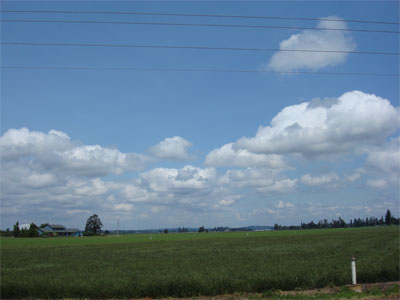
Heading toward Corvallis
Corvallis is distinguished as having one of the most concentrated collections of highly educated people in the country among its citizenry. Oregon State University students make up nearly half the population (20,000 out of about 50,000), and obviously university professors, adjuncts and other academic types make up a large part of the population as well. The people who ran our B&B (Harrison House — excellent place to stay) were both former academics. Yet it (and its people) were approachable and exuding a warm, relaxed vibe. We really liked Corvallis and were sorry to leave. But leave we did, to make our way to Mt. Hood.
But not before a stay overnight in Troutdale. About the only thing to recommend Troutdale is the fact that there is a McMenamins Hotel there. The rest of it is a dump. We attempted to run there (actually, we did run, but suffered through every step). It was horrible. We spent most of the time running in a bike lane or on concrete sidewalks, with heavy 40-50mph traffic roaring by us mere feet away. It was also hot, humid and windy. And, to top things off, our lungs were burning from the plane exhaust, as Troutdale is in the flightpath of not one but two airports. I imagine that if you run there for more than a few months you’ll probably suffer from hearing loss and respiratory health problems.
For those not unfamiliar with McMenamins, they are a chain of hotels around Oregon (and I think they may be in WA too, but I’m too lazy to look). They are also a brewery. Their hotels are more like mini resorts, little compounds typically consisting of a set of refurbished buildings that once had some other use. In the case of the Troutdale location (McMenamins Edgefield), it used to be a “poor farm” (presumably from the days when being in debt was grounds for imprisonment, as the old “rules” posted refer to “inmates”), then later it was a nursing home.
Their hotels typically feature a movie theater, a restaurant or two, a spa and a handful of places to get drunk either on beer, wine, cocktails — or all of them. This one distinguished itself by being the single best meal we had on this trip, out of at least 15 eaten out. The food was outstanding, as was their wine list. Alas, their martinis fell short. But nobody’s perfect.
McMenamins is also known for its whimsical decor, the heart of which are elaborate (and ubiquitous) painted murals.

Water pipe in our shower at McMenamins Edgefield
After a night in Troutdale, it was on to Hood River. But not before a drive south to Mt. Hood. As we learned in Crater Lake, early June isn’t the time to visit Oregon if you want to see anything above about 5,000. We had a couple of great hikes picked out to do around the base of Mt. Hood, but the local ranger’s office gave us the bad news: everything was still under many feet of snow. But they did offer us the Ramona Falls hike. It wasn’t the challenge we wanted, but it did provide a decent payoff.

This is the last waterfall picture I'll inflict on you
With Mt. Hood hiking a disappointment (and lesson for the future), we headed north to Hood River, where we’d booked a crappy little efficiency with what turned out to be a spectacular view of the Columbia River. Interesting fact: Hood River is a mecca of sorts for wind surfers in the late spring and early summer. A constant winds blows eastward up the river and is apparently at its strongest around Hood River. Wind surfers come from all over the world to take advantage of perfect conditions. No matter how early we got up, if it was daylight, there were mad surfers out there.
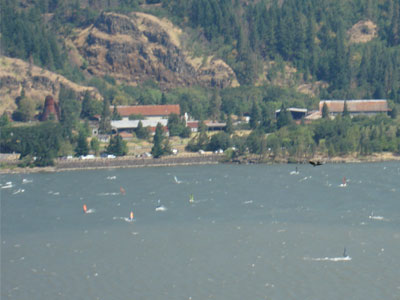
What you don't see were the outrageous stunts these people were doing in high winds -- full somersaults, taking flight or just screaming along the surface at top speed.
Hood River was where we found our hiking nirvana. Jonathan felt reasonably recovered from the marathon 11 days before and I wanted to make some good use of my marathon training since my race was such a bust. So we looked at our hiking books and found not one but two hikes graded “difficult.” In doing some online research we further learned one (Mt. Defiance) was considered the toughest hike in Oregon, with the other (Starvation Ridge) a close second. We were in!
Starvation Ridge runs up the side of Mt. Defiance, so we decided to take that up, then try to ascend to the peak of Defiance, then go down the Mt. Defiance trail. The combined hike was predicted to be 10-11 hours. We did it in under 7. Booyah! Camp over night for an 8 mile hike? That’s for pussies! The reviews of these hikes were not joking. They were tough. Going up, Starvation Ridge started out as challenging (elevation gain via switchbacks) and then became very difficult, climbing nearly 3,800 feet in under 3 miles. That’s steep.
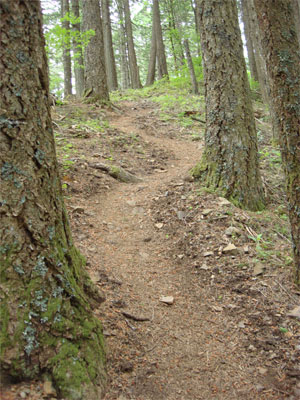
A relentless uphill climb along Starvation Ridge
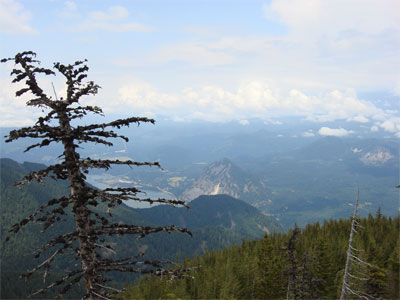
A trail with a view: looking westward along the Columbia River
We couldn’t go all the way to the top of Mt. Defiance because we lost the trail in the snow. But we were probably about .2 miles from the top. The way down was in some ways worse than the way up. It was steeper and shorter. We trashed our legs and, with the exception of the Steamtown race, my thighs were as destroyed as they’ve been after any marathon. We needed two days to recover until we could think about running again.
This was fine, as we were next headed down the Columbia River to Astoria, the westernmost point on the Oregon coast and where river meets ocean. Astoria was another place we visited because we thought we should and, like Corvallis, immediately took to it. It’s a port town and a bit sprawling. There’s a broken-down quality to it, but full of charm. The place feels thrown together, which this picture illustrates. Check out the mix of houses and buildings: you’ve got Victorians, Craftsmen…and those weird 60s multicolored box houses. But somehow it works.
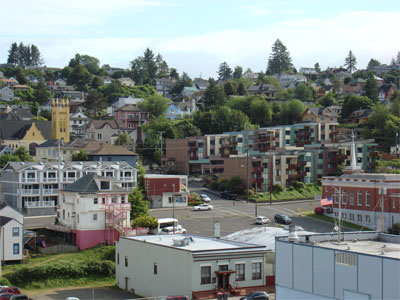
The hills of Astoria
We took a drive over the Astoria-Megler Bridge to Washington State, up the coast a bit to see where the river opens out into ocean. As with most of the stunning things to see on this trip, there was hardly anyone else around.
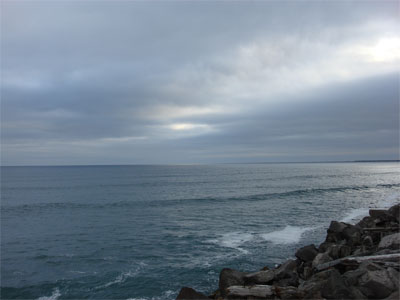
Looking west from the coast of Washington State
Before taking off for Cannon Beach and the rest of the northern coast, we paid a visit to Fort Clatsop, where Lewis and Clark concluded their famous expedition and where there is a recreation of the soggy, dark and cramped log structure they shared with Sacagawea and family and about 12 men.
But first, this photo:

I wonder what the ACLU did to rouse Clem's ire so
Last, but not least, some snaps of Cannon Beach even though there are much better ones out there by professional photographers. Cannon Beach goes on for miles, as do many of the beaches along the coast. But it’s also a pretty town, as is its smaller sister to the south, Manzanita. Oh, to wake up every morning and go running on this beach.

* sigh *
Like Bend, I took no photos of Portland. We were pretty exhausted by the time we got there and spent one day staggering around the Japanese Garden in a sleep-deprived state. The second day was spent driving all around Portland and its suburbs to check out the neighborhoods. I forgot I even had a camera. We did manage one fairly grueling run in Forest Park: a 9 mile run with 900 feet of elevation over rocky terrain. (We even spotted an Ethiopian runner.) Just when our legs were almost recovered from the Hood River hike, we whaled on them again in Portland. It was fine, though; the trip was over and it felt good to go out with a bang.
Filed under: travel | 5 Comments »
For those who want to know every detail of my running: I did 5 miles inside on the treadmill in a hot room last evening. Felt fine and even ran a fast last half mile or so (7:30ish). The difference yesterday was that I actually wanted to go running (even if it was inside). The last week or so I’ve wanted to do anything but (and have).
I’ll try again today and tomorrow. Will probably do a longish run on Sunday (12?) if weather permits.
I’m awaiting a new maintenance/base-rebuilding plan that should start on Monday. I’ll probably still go get blood tested, but I’m yet again unconvinced that therein lies the problem.
I’ve also dropped 2.5 of the 5 lbs gained already. So most of it was water weight.
Kevin was scheduled to chat with Lorraine Moller yesterday. So I’ve been awaiting his web updates with (as our more illiterate web posters like to say) “baited breath.” In the meantime, I’ve posted a review of her book on Amazon.
Now. Would you like to know what I had for breakfast?
Filed under: basebuilding, coaching, eating, elites, everyday life, olympics, reading, recovery | Tagged: kevin beck, lorraine moller | 3 Comments »
Just when I’d convinced myself that my poor marathon run was due to overtraining (in the loose rather than clinical sense of the word), I’m now swinging back to the theory that there’s something wrong with me physiologically (never mind psychologically; we won’t go there). I went out today to do a simple 4-5 mile run and found myself working in the low 70%s of max HR just to run a 10 minute mile. What gives?
I did some runs in Oregon, but they were tough. I chalked them up to various conditions (altitude, running uphill, being hungover or tired from driving). But this morning I was back in familiar territory, on a lovely, cool morning run. And I sucked. I’ll try again this week and see if the suckage persists.
Now I’m trying to scrape up all the information on ferritin, iron depletion, hematocrit and hemoglobin numbers I can find in order to summarize them for my non-running doctor to then facilitate some tests that will actually provide useful information.
I’m not sure what will be worse: Finding out that I’ve got a blood/thyroid issue (and having to possibly spend weeks or months correcting it) or finding out that I don’t and not having that to conveniently blame everything on.
Filed under: physiology, recovery, training | 10 Comments »
I’m back at work today after a 15 hour travel odyssey that involved screaming toddlers, cranky fellow passengers, glacially paced baggage handling and a lost taxi driver further impeded by inexplicable police action at Newark Airport. Then up half the night being batted about the head by a needy cat. And now the past three weeks of non-workdom are rearing their ugly little heads. 200+ emails? Save me.
Go running this evening? Hah! I have bills to pay, groceries to buy and laundry to do (although with my 5 lb. weight gain, there’s very little that I can actually wear). But I hope to go for a spin tomorrow and catch up on the blogging soon, which will include more boring vacation photos and a full post-mortem of the possible why’s behind my disastrous marathon.
For those who just can’t get enough of runners talking about running, Coach Kevin is in Boulder, CO on a whirlwind tour of interviews of runners and coaches, including more than one of my idols, for a book project. You can follow his daily reports here.
I will say for now that Oregon is an interesting, beautiful and fun place. And despite the May 30 meltdown, I’m looking forward to working toward the next big one in Sacramento in December.
Filed under: coaching, eating, elites, everyday life, reading, travel | Tagged: boulder, coaching, colorado, elite, kevin beck, running, training | 3 Comments »
After the relative calm of Ashland, it was on to some high drama at Crater Lake. Or not. We did learn one fact fairly quickly: the snow sticks around at Crater Lake for quite awhile. The lodge had only been open for about two weeks when we arrived and there was not only nowhere to go hiking, there was nowhere to walk either. Snow was still piled up 12+ feet around the parking lot. So about all we could do at Crater Lake was gawk and drink. And that was fine.

The Crater Lake Lodge

The view from our room
So, here’s the deal on the Lodge. It’s a weird place. Not really an old lodge, but more a rebuilt approximation of someone’s idea of an old lodge. Apparently, the original lodge that was built around the turn of the century was put together by monkeys using knives and forks. Between shoddy construction and a lack of insulation, the place had a terrible reputation and eventually fell into such a state of disrepair (and structural risk) that it was slated for leveling.
Then it went through a refurbishing around 1990. There were no original plans, so the owners (then the Parks Dept) redid the place to have an original “look and feel,” which, unfortunately, means tiny bathrooms, and hideous furniture and bedding, apparently. The net effect is that one feels no desire to spend time in one’s room, and, since everything outside is covered in snow, the only other option is to head downstairs to the lounge and dining room.
Fortunately, the lounge features a decent selection of beers, wine and cocktails. And dinner at the lodge makes up for the crappy room. I had duck; Jonathan had venison. Both were outstanding. Score one for the lodge restaurant.

Cinder cone atop Lava Butte
Oregon has a rich volcanic history. That sentence alone sends me into such a profound state of torpor that I won’t pursue that thought any further.

Koosah Falls, between Crater Lake and Bend. The water is really that color of blue.
Our next overnight stop after Crater Lake was Bend. I have no idea how to describe Bend, since I couldn’t find a distinct identity for it while we were there. The B&B proprietor was a bit uptight, which wasn’t a great start. Then we attempted a run and discovered that “map” in Bend is more of a representation of future urban planning than current geographic status. We attempted to go to the Deschutes Brewery, but it was as noisy as any Manhattan pub, so we instead opted for a Thai restaurant, which was good, although they mixed up the order and gave us an order of Drunken Noodles that was so hot that it may have been spiked with hydrochloric acid.
So, Bend was no great shakes and we were glad to leave after a night.
The next stop was Eugene, for two nights. Eugene is a college town, and we were staying in a rented bungalow in College Hill (close to Washington Park), which was actually pretty charming. While there, we visited the Raptor Center (a home for raptors who can’t survive in the wild for one reason or another), did a hike, and then spent Sunday morning at Hayward Field watching the 2009 Prefontaine Classic.

Looking down on Eugene from some random viewpoint

A hapless bald eagle at the Raptor Center. This was a wonderful place, and we ended up hanging around the birds for close to three hours.
I won’t go into exhaustive details as far as the Prefontaine Classic is concerned. I’m sure there are plenty of excellent recaps out there in the usual places, such as LetsRun and Flotrack. But I do have some shots worth sharing.
Hayward Field is interesting. It’s set up for world-class track meet activity, with this taking the form of huge “warm up” areas. They have a special warmup tracks (both a loop and a straightaway), as well as a giant warmup “field” including open space and areas for privacy tents and massage tables. The back of the stands overlooks this area and it’s a bit like going to the track zoo. You can stand over the warm up area and gaze upon the track stars doing their little pre-race routines.
I have to admit that I felt a little sorry for the meet participants, having to suffer the indignity of being scrutinized by loser douchebags like ourselves. But it was fascinating to be on the observing douchebag side of things.

Here's Christin Wurth-Thomas doing some dynamic stretches.
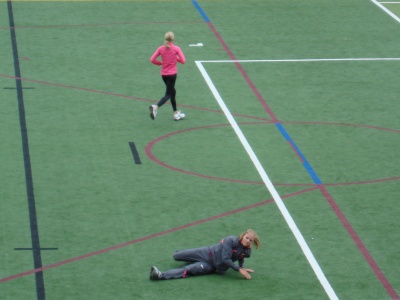
Shalane Flanagan and Erin Donohue warming up. Both would go on to run badly. Flanagan looked tense and unhappy (we wondered if she was injured). Donohue just looked serious.
The meet featured some great performances and races. For me, the highlight was the women’s 1500m race, which was loaded with great names. I was rooting for Jenny Barringer, the college phenom who I think will continue to do great things during her professional career. She did not disappoint in this race. Here’s a shot of her late in the race, hanging back in ninth place, right behing her 3000m steeplechase rival Anna Willard.

Barringer bides her time on lap number three.
And here she is during the last few seconds of the race, during which she rocketed forward in an attempt to nip the winner, Ethiopian Gelete Burka, at the line. She missed by just .01 of a second. But in the process ran the third fastest time ever for an American woman at that distance, breaking 4:00 and slashing 8 seconds off her PR and nearly 6.5 seconds off the college record. Go, Jenny, go.

Just .01 seconds shy of the win for Jenny B.
That’s all for now. Next up: Corvallis and the Hood River area.
Filed under: elites, meets, olympics, travel | 10 Comments »
There’s nothing like a little beautiful scenery to take the edge off one’s post-DNF despair.
After Newport, we skipped down the coast to Coos Bay, where we spent a night in the horrible Red Lion Inn and had a surprisingly good meal at the Blue Heron Bistro. The Blue Heron is the most schizoid place I’ve ever eaten in. While the name evokes, well, a bistro, it is in fact a German restaurant with pizza and seafood thrown in. It also featured what was probably the most valuable collection of WW1 memorabilia I’ve seen assembled in one place outside of a museum. I hope that stuff is insured! I went for the beef stroganoff and Jonathan had der weiner schnitzel. Washed down with an Abbey Brown Ale from Belgium, both were excellent.
That’s about the only good thing I have to say about Coos Bay. The place is a total tip and we couldn’t get out of there fast enough. Sorry, no pictures of Coos Bay. But here are some of the sights along the way.

Seal Rock, near Waldport. Great place for tidepools and kite flying.

Another shot of the beach at Seal Rock, Waldport.
Then is was on to Cape Perpetua and the Sea Lion Caves. Lordy, what a ripoff that was. Eleven bucks each to take an elevator down a few hundred feet into a dank cave to gawk at a bunch of stroppy sea lions. At least the views of Heceta Head were good.

Cape Perpetua, near Yachats (yah-HOTS).

Heceta Head lighthouse. Million dollar view? Or $22? You decide.
The highlight of the day was Florence, which features sand dunes. Not just any sand dune. Huge fucking sand dunes that are 300 ft. high and go on for miles. It was like something out of … “Dune.”
But first: Here are two of Florence’s fine retail establishments.

"BJ's" isn't just one unfortunate retail naming mistake. It's a chain of franchises!

"Dog Style." Are people really this naive?
Okay, here are the dunes.
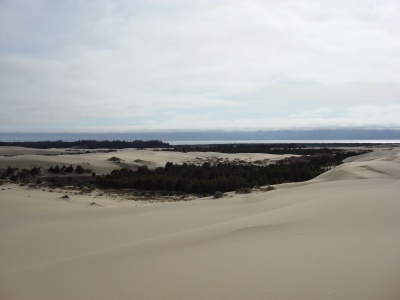
It's two miles from the beach to the ocean.

No. Seriously. It is two miles to the ocean from here. See?

That tiny figure is Jonathan. Tinier than usual.

"You take a picture of me."
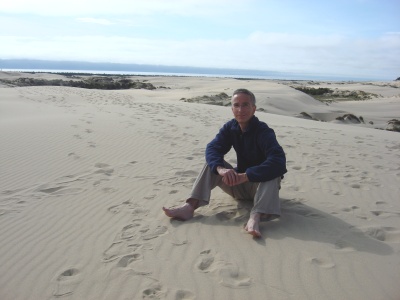
"Now I'll take a picture of you."
After our Germanic night in Coos Bay, followed by a fry up at the Pancake Mill, it was on to Ashland. (On the way, I got hollered at by a gas station attendant for attempting to pump my own gas. Just checking!) But not before taking a six hour detour north and east to sample the Umpqua-Rogue scenic byway. And scenic it was. Look!

Along the way to Susan Creek Falls

Your hostess. I still look sort of depressed, don't I?
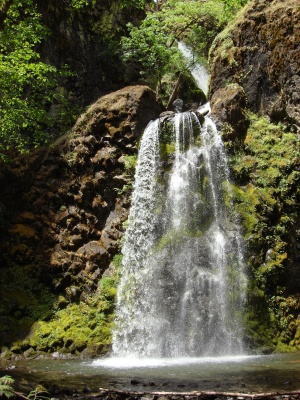
Falls gone wild. Featuring hot "falls on falls" action.

Mt. Bailey, along the Umpqua Highway, Central Oregon
Finally, after nine solid hours of driving and oohing and aahing, we arrived in Ashland. This was one of our self-catering rentals, a lovely little 1BR/1BA craftsman high on a hill and just minutes from a trail leading down to Lithia Park. I did two runs here, both around 5.5 miles, and both very pretty (although hilly and with the added challenge of 1900′ altitude, which my sea level lungs didn’t like).
We spent a few hours with Annie McIntyre, a friend from childhood whom I haven’t seen since high school, which means roughly 25 years. We didn’t know each other that well growing up (although we did play together as very young children, then drifted into different circles after about third grade). But it felt, as Annie put it, very natural to see each other again. Annie and her husband, Jeff, gave us the insider’s view of life in Ashland, both good and bad, as well as an extensive tour of the place. They also turned us on to Chozu, a bath and tea garden where we wiled away the evening in various saunas and pools, under a beautiful sky and completely mosquito free.
We were too busy to take many photos of Ashland. Here’s the only one.

Backyard vermin in Ashland
Having properly recovered from our scenic drive opus, is was time for the next leg: Crater Lake. That drive took us through Klamath Falls, which I also took no pictures of. But let me say this: If you ever want to disappear from the face of the earth, go to Klamath Falls. There is nothing there, and the streets are teeming with what we’ve come to call “Oregon guys.” These are men who have cultivated the Unabomber look: scraggly beard, emaciated figure, rags and bad limp. We saw loads of them in Springfield as well, darting across traffic (which might explain the limps). From a distance they look like extras from a zombie film.
I had a great espresso in Klamath Falls. That’s about all I can find to say about the place.
Next post: Crater Lake.
Filed under: drinking, eating, everyday life, humor, travel | Tagged: ashland, blue heron bistro, cape perpectua, chozu, coos bay, dunes, espresso, florence, heceta head, klamath falls, lithia park, oregon, pancake mill, red lion inn, sand, sea lion caves, seal rock, unabomber, zombie | 11 Comments »
I wanted to acknowledge all the kind comments here. I’m in vacation mode now, doing a lot of sightseeing and not thinking about running (or the marathon whose name shall not be spoken).
Even though the last thing I feel like doing right now is running, I hope to get a “runner’s tour” of Medford from a friend of a friend today. Failing that, I may go out on my own through the streets of Ashland, just to see if I suck as much on an easy run as I did on Saturday.
As an interesting side note, I do feel sort of crappy and my RHR was 60 this morning, about 15 beats higher than it should be. Although that may be owing to 9+ hours of driving yesterday, pie a la mode, and copious amounts of wine in the evening.
Happy running and, really, thank you. I’m touched by the kindness of strangers, acquaintances and friends here.
Filed under: Uncategorized | 10 Comments »
Where on Earth do I begin? Hmm.
Well, the gist is this: I was running around 40 seconds slower than intended marathon pace, but at marathon effort, for the first 15 miles or so. Then, after the turnaround, my pace began to degrade further (while my effort increased). After some consideration (and mental math) I decided to cut my losses and drop out just before the 18 mile mark.
That’s the dry, fact-based summary. The more interesting dimension to this event is the one that featured a constant give and take between my emotional side and my rational side. The rational side won out and, while I’m obviously disappointed, I know I did the right thing by deciding to drop out. Or, rather, I am at peace with having dropped out, because I know I did it for the right reasons.
There was obviously something very wrong going on today. It was as though I was transported back a year into the body I had then. The mile-by-mile lowdown provides more detail, but the big picture is that I was just terribly, inexplicably (and consistently) slow from the moment the horn blew. There is either some training-related issue to address (Residual fatigue? Loss of fitness/early peak?), or a medical one (Anemia/low ferritin? A sub-clinical illness or infection?). Either that or my chakras are out of whack or I am being punished for a past life transgression. Who knows?
So here’s the narrative of how the race played out:
My plan was to run the first 4.2 miles completely by effort and not pay attention to pace. That’s because the first miles of this race are nuts. They snake through the streets of Nye Beach and feature hairpin turns, running on gravel or rough sub-pavement surfaces, and some short but very steep uphills. So I promised that I’d keep things in the 87% MHR range and not even look at pace.
During these early miles I felt not just good, but great. I truly thought I was going to have a bang-up day and had set myself up for the sort of race I wanted to run: well-paced and featuring a negative split, as well as a big PR.
Then I looked at my watch for the first time and had the initial big shock of the day. As I approached the 5 mile mark, merrily running along at 88-89% I saw that my average pace was around 30-40 seconds off my desired pace of 7:05-7:10. So I had a deficit of 2-3 minutes already. What should I do?
First I questioned the watch. Was it giving me accurate speed data? Apparently so, since someone else with a Garmin nearby called out a mile split that was in line with my own. So that data was correct. Next, I questioned the heart rate monitor. But I know what “marathon effort” should feel like – even without an HRM telling me – and this was it. I was applying myself to the right degree, but my legs were moving much slower than they should have been.
So this was my new reality: I was running at marathon effort, but for some reason that translated into a marathon pace that had me on track for around a 3:20 race. In the past, my response would be to deny this fact and start running faster, even if it meant going to half marathon or tempo effort. But I promised myself I wouldn’t do stupid things in this race, so I kept on the current pace and kept thinking. What else could be going on?
The miles went by as I pondered. I also tried some little experiments: How fast could I go if I picked it up to 90% effort? I could swing around 7:30 at that pace. But I knew I’d be done for if I tried to run the early miles at 90%. So I split the difference between my goal effort level of 88% and somewhat improved prospects of 90% and decided to see what I could manage at 89%. If I could make it to the halfway point still feeling reasonably fresh, it might be feasible to salvage things (meaning at least not do worse than my last marathon time).
I also managed to convince myself that the problem was external. It simply had to be a headwind. What else could explain the disparity between my training paces and today’s race pace? Around mile 10, I’d started to make peace with the fact that there was no way I’d get close to 3:06 or even 3:15. But I could keep racing, still get a PR and perhaps pick up an award.
I plodded on, alternating between 89% and 90% now, but still feeling good. Then I hit the halfway mark at 13.1. My watch read 1:40:59. I started doing the math. Double that and you get 3:22. Slower than Steamtown’s 3:19. Plus there was the stark reality of the last two miles, which are a steady slog uphill. So I might be lucky to make 3:24 at this rate.
Still, I reasoned, I was running into a headwind. I’d be hitting the turnaround point at mile 15.4. Surely with the wind at my back I could count on an easier time and perhaps at least even splits.
At the turnaround I got the second shock of the day. Rounding the pylon I was hit with a full on headwind of more than 10mph. So for the last 11 miles or so I’d been running this badly with the aid of a tailwind. Holy shit. I was done for. Now I was thinking I’d be lucky to run 3:34. This would be a giant step backward. Not just six months of training down the drain, but a leap back to 14 months ago.
I watched in horror as, predictably, my pace slowed and my effort level increased. The thought that rang into my head, clear as a bell, was this: “I have a choice between two failures. I can either finish the race with a shit time or I can DNF.”
I had no physical issues with finishing. I knew I could. There was no question about that. But the idea of looking at a 3:30 or whatever it was going to be instilled a sense of demoralization that overwhelmed me. I’ve never dropped out of a race, even when I should have. When I’ve wanted to, it’s always been because of discomfort. This time, though, it was because I didn’t see the point in finishing when the reward was an indelible record of this mysteriously terrible performance. A DNF is indelible too, but at least it’s abstract. So I decided to drop out.
Having never DNF’d, I had no idea what a production it can be. First of all, I had to be able to talk to race volunteers without bursting into tears, which was a big challenge. Then I had to deal with all the volunteers thinking I was still running and saying, “You’re halfway there! You can do it! Great job!” and wanting to throttle them, nice as they were. Finally, it took over half an hour for the sweep van to show up. So, in the meantime, after wandering the periphery and moping for five minutes, I decided to rejoin humanity and take a chair next to the pickup from which they were grabbing water and cups.
There was a very sweet dog on a blanket next to me, a boxer named Dexter. I have never been so happy to see a dog in my life. Dexter didn’t give a rat’s ass that I’d just DNF’d. He just wanted to lick all the salt off me and have his back rubbed. I got the love and comfort I needed for the 20 minutes I sat with Dexter. Finally the van showed up and in it were three locals, two of them runners. We chatted a bit, but they could tell I was in a somewhat fragile emotional state, so they only spoke when I spoke to them. Nice people and perfect for manning a sweep van.
We picked up two other struggling runners on the way, one of whom I ran with for about a mile early on. His explanation was the same as my own: “I’m not injured or sick. Just having a really bad day.” The other guy had back problems which flared up in the home stretch at mile 24. He was dead silent for the entire ride.
Finally, an hour after my decision to drop I got let out near the finish and found Jonathan in the crowd, searching for me on the course so intently that he didn’t notice me until I was a foot away.
He had a rough day out there too, although not anywhere near as bad as mine. He was off pace for the first 15 miles by about 10 seconds per mile. Once he hit the headwind, he was running a good 40-60 seconds per miles slower than intended, having also thrown in the towel mentally and turned the finish into a training run. He’s in the host hotel right now attempting to collect whatever AG award he won as I sit here composing. I couldn’t bear to join him, for obvious reasons.
I’m trying not to get totally depressed and discouraged. It’s not the DNF that’s bothering me. It’s not knowing why things went so wrong.
Filed under: racing | 24 Comments »


 Races Like a Girl