Steamtown ‘08 vs. Newport ‘09: A training comparison

Flo of Girl-in-Motion recently posted some questions regarding how certain aspects of this round of training (for the May 30 Newport, OR marathon) compare to the last round (for the Steamtown marathon in PA last October). If my training run paces are anything to go by (and I sure hope they are), then I’ve made tangible improvements in speed and endurance* during this training cycle. Put more simply: I’ve obviously improved more over the course of training this time around, relative to the level of improvement I made during the last cycle.

I had been meaning to do a comparison myself, and this was a great excuse to buckle down and look at the numbers.

Measurement

Newport Training

Steamtown Training

Avg recovery run pace 10:00 10:00
Avg recovery run HR% 65% 65%
Avg weekly mileage 84 80
Mileage in peak week 100 101
% miles at recovery pace 44% 56%
Avg runs per week 9 11
Avg length of run 8.15 miles 7.50 miles
Frequency of full recovery weeks Once every 3 weeks Once every 4.5 weeks

To the casual observer, it appears that I am a solid 100 mile-a-weeker. But in reality I’m only averaging a measly 4 mpw more than I was in the summer and fall. This is because more frequent recovery weeks bring the average mileage down.

Also note that despite an increase in fitness, my recovery pace has remained the same. There are wide swings from day to day (anywhere from the low 9:00 range all the way up toward 11:00). But it averages out to a ten minute mile. I would not be surprised if it stays in this range for the next cycle as well.

The three major differences are found in these areas: number of sessions per week, frequency of full recovery weeks and, perhaps most interestingly, percentage of miles run at recovery pace. Let’s look at each of these.

Number of sessions: Running shorter, more frequent runs works well for some people. I tried this for Steamtown and found that I was constantly tired. When Kevin put me on a basebuilding plan in November, I was surprised to see no doubles, but lots of recovery runs on the longer side. I followed the plan with some trepidation, yet quickly discovered that this arrangement works better for me.

If I run one 10 mile recovery run, I’m recovered and ready for a hard workout 24 hours later. If I instead do two runs (one in the morning and one about eight hours later in the afternoon), I’ll be tired the next morning, regardless of how the mileage is broken up between the two. What you don’t see in this comparitive table is the distribution of double days over the course of the Steamtown training. During recovery weeks they dropped off, obviously. But in peak weeks it was not unusual for me to be running 12-14 sessions per week.

Frequency of full recovery weeks: I took my cues from the frequency of recovery weeks in Pete Pfitzinger’s book Advanced Marathoning. Meaning they were few and far between. This may work for some people, but I recognize now that it wore me down. Why this is is anyone’s guess; perhaps it’s a side effect of being over 40, or maybe it’s an individual thing. The current arrangement (two high mileage/high intensity weeks followed by one lower mileage/high intensity week) has worked out well. With rare exception, I have emerged from the recovery week mentally ready and physically able to handle the demands of the next two “on” weeks.

Percentage of miles at recovery pace: This is the measurement that I find most interesting. The amount of time I’m spending running hard has increased by about 8%. I believe I have improved fitness as a result of that increased amount of time running harder miles (as well as the variation in workout types), and I believe the previous factor (recovery week frequency) is responsible for my being able to handle that increase.

It will be interesting to see if, with some tweaks to some of these factors, yet more improvement can be yielded. After I’ve run Newport and we’ve done the post mortem, perhaps we’ll make further adjustments. If I lowered mileage but increased intensity,** would that offer a bigger benefit? What if I reduced the doubles even more and did slightly longer runs? I suppose this is why runners are thought of as “experiments of one.”

*And, dare I say, running economy, although this is a bit harder to gauge outside a laboratory. Unfortunately, my laboratory is in the process of being redecorated at the moment.

**As recently suggested in some comments by “Coach Tom.”

Race Report: 2009 New Jersey Half Marathon

You asked for it, so here it is. The good, the bad and the ugly.

On Sunday I ran the New Jersey Half Marathon in Long Branch, NJ. This was my second go round for this race. Last year, I ran this half a month after a very good marathon. I was rested, but with a couple of tempo runs to my credit, and I obliterated not only my previous half marathon PR, but all of the sub-distance PRs as well. It was a magical race.

Alas, the magic did not last. Or at least, I had not properly set the stage for magic to happen.

Let’s examine what did happen. It’s pretty entertaining, and offers some object lessons in why all races are not created equal and why it’s sometimes very bad to be stubborn.

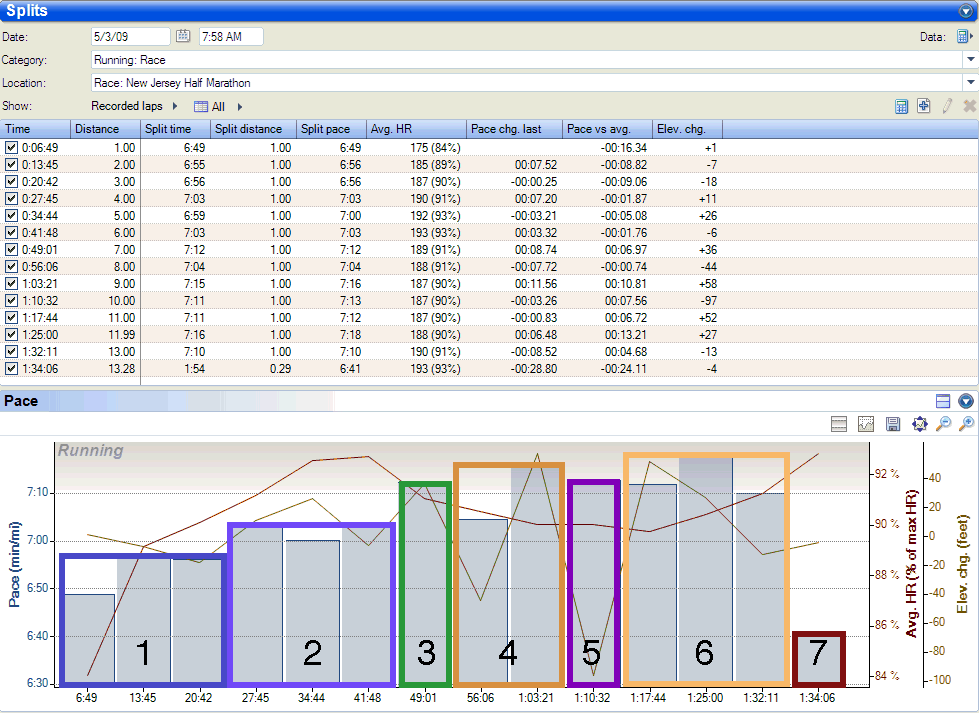
I’ve separated various individual miles or sets of miles into blocks. These sections of the race help tell the story of what went horribly wrong and why. But the story begins long before the miles shown on this chart. I carried into this race not four glorious weeks of recovery but 14 weeks of hard labor training, as well as 9 weeks of basebuilding before that, which also were nothing to sneeze at.

I didn’t know it at the time, but I was fatigued and not in the state required to run anywhere near even my outside goal time of 1:32ish. What’s ironic about this is that my confidence about this race was largely due to a week of stellar workouts in late April (training week 14) — a week of what Kevin calls “happy extravagance” — and which, when combined with the horrible following week (training week 15), served to knock the stuffing out of me and leave me in a semi-constant state of not-quite-recovered.

So here’s how the race unfolded:

Pre-race: After standing on concrete, shivering for a half an hour due to a late race start, they finally start the frigging race. I’m in row 3, behind two women in their underwear (they would come in 1st and 3rd, as well as a 48-year-old woman who would come in 2nd). They are chatting about their goal times (“Oh, we’re trying for around 1:23.”) and I am hanging my head in shame. I vow to run my own race, since I’m obviously going have my ass handed to me by these three. As it turns out, my own race would suck. Theirs would not.

1 (blue box): The horn blows and I take off so as not to get run over. I take five steps and immediately know that I am in trouble. My legs feel stiff and heavy and my calves and ankles are actually hurting. This is exactly how the Steamtown Marathon started out, and fans of this blog will recall that by mile 18 of that race I wished for a quick and merciful death.

My goal pace for this race was somewhere in the neighborhood of 6:52. I did my best, but after just one mile I was falling off pace. Miles 2 and 3 showed a slight decline, but I fought to stay in that range. Then we turned the corner into mile 4. And that was when I felt the headwind.

2 (purple box): Miles 4 through 6 show my personality — made up of equal parts determination and capacity for denial — shining through. I knew I was running into wind and that I was working too hard, but I ignored all consequences. When I got home and looked at the splits and saw that 93% heart rate, I knew that these were the miles in which I screwed myself. Had I simply accepted after mile 1 that I needed to slow down, well, I might have run a more even pace throughout and gotten a better time. But slowing down is for pussies!

3 (green box): The aerobic chickens came home to roost for mile 7. I felt physically ill, not quite barfworthy, but I made sure I had some space around me, let’s put it that way. A keen realization of the consequences of my tragic failure to run reasonably earlier on began to creep into my mind. This was the first point in the race when I considered dropping out.

4 (orange box): My stomach settled a bit toward the end of mile 7 and the general feeling of malaise began to pass. I rallied a bit and managed another faster mile, but then cratered again for mile 9, faced with the one real hill in the race.

5 (plum box): Mile 10 was the nadir (both in terms of course elevation and my mood). I probably spent half of this mile entertaining the idea of quitting. Bear in mind that for the last 50 minutes I’d been battling a headwind, anger, nausea, pain and suicidal despair. It all seemed so pointless. Then we turned another corner and the wind was suddenly behind us.

6 (yellow box): You’d think with a tailwind I’d have been able to speed up. But it was too late for that. I’d used up all my aerobic credits (or so I thought). Note how my heart rate goes up for miles 11 through 13, right along with my pace.

7 (red box): This was my Ron Howard movie moment. Here I’d thought I’d spent everything in miles 1 through 6. But look at my last quarter mile: I ran it at 6:41 pace. The fact that I could pull this out of my hat gave me one of the day’s few glimmers of hope. Expressed simply, “I can’t run fast when I’m tired, but I can sure run hard.” That has to be worth something for a marathoner.

The data behind the drama. (Click to enlarge.)

The data behind the drama. (Click to enlarge.)

I still managed to set a new PR of 24 seconds, along with new PRs for 5 miles, 10K and 15K.

What’s the big lesson in all of this? Well, there are several:

  • If you’re going to race during marathon training, then you’ve got to lower your expectations. This is especially true if you are racing at the peak of marathon training. (Duh.)
  • If a race isn’t going well, then for god’s sake just accept it and adjust your plan as soon as possible. Hoping won’t make it so.
  • Pay attention to signs of pre-race fatigue. They were all there, but they were subtle. Or maybe I just didn’t want to see them.
  • Running a half marathon as a MPace run isn’t the worst thing in the world. I got a great workout and, once I recogized what went wrong, it was not a huge blow to my confidence.

Finally, something interesting. I had a whole host of nagging physical issues going into this race: quad problems in my right leg, the lingering groin issue from all the way back to January, some left foot pain. All of that went away after the race. Sometimes I think a good, hard race can knock everything back into place.

Spring Race Training: Week 15

09spr-training-15The report is a bit late this week on account of my being in mourning over my loss in New Jersey. I’ll post a race report, along with some insights, this evening. But to summarize, the funk has lifted, with reason and logic prevailing at last.

Last week consisted of a “mini taper” for the half, with just one hard workout rather than two. This probably would have been fine if we hadn’t had a freak heatwave Saturday of the previous week through Wednesday of last week.

My legs were totally trashed on Monday from Sunday’s hot, hilly 20 miler in Central Park. I wasn’t much better on Tuesday, during which I experienced what felt like a pre-flu state: nausea, exhaustion and feeling feverish. I didn’t have a fever (although I do wonder if I had a bit of sun poisoning from Sunday), so I went out and attempted a hard run in high heat and full sun.

In retrospect, this was a stupid thing to do. I probably should have cut the run short when it was clear that doing mile intervals in such conditions wasn’t going to be productive. I wish I weren’t so stubborn, as this is a quality that truly is a double edged sword. When it works for you, it’s a great help. But it can also result in foolhardy moves that sabotage larger goals.

Anyway, suffice it to say that Tuesday’s run is probably what screwed the pooch for Sunday. I never really recovered from it, although my recovery runs were slow enough to fake me out and think that I had. But there were clues I could have heeded if I’d looked hard enough:

  • I was still completely exhausted on Wednesday. Normally, I’d expect some residual tiredness after a hard run on Tuesday, but this was flat out, kicked in the ass exhaustion of the highest order. A lingering problem with my right quads also was intensifying.
  • I was starving all day on Thursday, meaning I’d eat something and an hour later I had to eat again. I think I spent more time in the kitchen than in my home office. I was even doing teleconferences in the kitchen, standing at the fridge eating with the phone on mute.
  • I needed a two hour nap on Friday afternoon. This is very unusual. I might need a nap on Sunday after a very hard long run or a race, but rarely during the week.
  • Saturday morning my resting HR was still elevated by about 20%.

The kicker was Sunday’s race, of course. I knew from the moment the horn blew that I was going to have a bad race and be very unhappy for the next 90+ minutes of my life. More on that later.

Unfortunately, Kevin’s computer died during the lead-up to this race, so he was unable to look at my training logs (which include HR information, reports of sleep quality, etc.). While he had my blog reports on how things were going, they didn’t tell the whole story. With the full view, he says he would have told me to scale back expectations (but still run the race). As it stands, we’re making adjustments going forward to help ensure that I’m recovered to do the remaining key workouts, the biggest of which is on Sunday: a 22 miler with the last 12 at MPace.

So there you have it. Despite the race disappointment (which I now have some perspective on), I still feel really good about the training I’ve done and confident about my fitness. The recent track work in particular has gone very well. I’m not as worried about Sunday’s big MPace run as I thought I’d be. Ironically, I have to credit the race experience on Sunday for some of that relaxation of expectations. I’ve been banging away, doing 100 mile weeks for several months now. What matters most is the overall quality of my training, not whether I hit exact paces in one particular workout — there are just too many variables that can throw that off.

It’s bizarre to look at my training plan and see so few weeks left. Next week is my last real training week. Then it’s three full taper weeks, including three (three!) days off in there.

In praise of the training diary

I reported a few weeks back that I’d been diagnosed as having either a cyst or “thickening of the sheath” of a major ligament on the top of my left foot. I got a cortisone shot and the problem went away. Until the other day, when it cropped up again after a fast 16 miler.

Enter the training diary. I looked back over my notes concerning when the problem first appeared (10 miles into another fast mid-length run), and when it had flared up over subsequent runs. The common factor turned out to be a certain model of shoe: the Asics Speedstar. I have two pairs of these that I don’t wear all that often, as they are just “okay” shoes. I have other lightweight models that I prefer (the current favorite being the Pearl Izumi Streak) for faster running, so the Speedstar tends to be the neglected stepsister who only grudgingly gets taken out every few weeks.

I hadn’t worn them since the cortisone shot until the other day, after which — wouldn’t you know it — my top of foot pain was back. So I’m going to stop wearing them until after the marathon, and even then I may retire them if they aren’t suitable for shorter recovery runs either (I hate to throw away perfectly good shoes before their time).

I track everything: resting HR, running HR, distance, speed, weather, calories, weight, sleep hours (and quality of sleep), mood, shoes worn (and mileage on each pair), pains/niggles, and the quality of every run. Some may say this is overkill but it truly pays off at times like this.

Coach Greg McMillan on training for masters runners

Interesting interview by Scott Douglas via Running Times Online. McMillan makes some good points, particularly with regard to not lumping all masters runners together, and how the differences in background, rates of adaptation and recovery, and other factors influence how he coaches them.

Listen to the interview.

Welcome to Hell

Today was my only tough run of the week, as I prepare for the New Jersey Half Marathon on Sunday. The assignment was 10 miles at general aerobic pace + 4 miles at MPace (7:00).

Oh, my God. What a horrible run! Today was the perfect storm of bad runs: I woke up still fatigued from Sunday, with an upset stomach and bad allergies. Did I mention my right quads have been giving me grief too? I spent a couple of hours waiting for my stomach to calm down, only making it out the door at 8AM. By that time, it was already 75F.

I dutifully ran my 10 miles at the lowest HR I could that would still count as “general aerobic,” or 72% of max. The pace? 9:17. Lordy. That’s a recovery run pace on most days.

I got to the track to find full sun and a steady 8mph wind. By this time, it was 82F. Which means it felt like about 100F while running. I’d told myself not to look at paces, but instead focus on effort. I ran 1 mile and peeked at the time at the end: 7:13. Okay, not bad. But it was unsustainable. On the next lap, my HR was up to 89%, my pace down to 7:43.

I lay down in the shade for five minutes, debating whether or not to abandon the run. I’ve not yet abandoned any workout this season, so I didn’t want to start now. I ran another mile (7:52 at 88% HR) and lucked upon an abandoned, unopened bottle of water in the grass, amongst the dozen or so half consumed bottles. (Can’t be too careful with swine flu and cooties going around.) After a good guzzle I set out for the final mile: 7:49 at 93% HR).

I knew an MPace workout was not to be from the moment I woke up this morning. But it is always a shock to see just how much the heat can affect me. I was running tempo effort at the end at nearly a minute off MPace. It is what it is. But that degradation in performance, coupled with the extreme discomfort of running in high heat, has me dreading summer training already.

At least I get to relax for the next four days.

Spring Race Training: Week 14

09spr-training-14Crikey. I’ve been in serious training now for well over three months and I’m still standing, albeit at a slight lean some mornings.

Coming off of a recovery week, I was bursting with energy starting on Monday morning. Tuesday’s run was a big surprise, with my having planned to average 8:00 pace, but getting carried away and running nearly 16 miles at an average of 11% slower than MPace. For this, I have to lay blame where it’s due: squarely on Colleen De Reuck’s shoulders.

With yet more energy to spare, I ran Wednesday’s recovery runs too fast. The AM run because it was just so darned pleasant outside; the PM run because it was pouring and I was freezing and just wanted the damned thing over with.

I paid for my folly on Thursday. At least I was smart enough to swap runs and put the longer one in the morning, since the pattern is that I’m drop dead exhausted on Thursday evenings. This week was no exception. Actually, it was exceptional in that Thursday’s PM recovery run was one of the worst runs in recent memory. The image of myself resembling a shuffling, scowling reanimated corpse haunted me throughout. Even the ducks were laughing at me.

I have learned to have faith in a night’s recovery and Friday morning confirmed that this faith was not misplaced. The morning presented a rare combination of ideally cool temperatures and a mere 3-4mph wind on the track. I ripped through my 3 x 1 mile intervals at about the same pace as the half mile intervals just a week before. From reanimated corpse to Wonder Woman in just 12 hours, although my pride was tempered by the fact that there was no way I could have done a fourth. But the good news was, I didn’t have to!

Our freak heat wave moved in on Saturday. It was still cool on Saturday morning, but by the afternoon it was 85F out. I was in such a heat-induced stupor that I got all the way down to the running path before realizing that I’d forgotten to put my watch on. I can’t remember the last time I ran without a watch. It was liberating and relaxing. Something I’ll probably do a little more often on some recovery runs.

Sunday called for a “time on my feet” long run with nothing special. I’d been told to try to run at 8:20 pace. But since I was running in Central Park in very high heat (91F at the peak), I ran by the HR equivalent of 8:20 lately, which is around 76% max. I managed 8:46 pace at 77% MHR. It was not fun. But being in the park with water, ice cream and the odd Olympian nearby was a much more appealing proposition than slogging all the way up to the Valhalla Dam all by my lonesome.

The sun and hills did a number on me, though, necessitating my longest post-run nap ever: around three hours in la la land. I haven’t even slept for that long after a full marathon.

For week 15 I do just one hard workout on Tuesday (14 miles with the last 4 at MPace), followed by a short taper to get ready for the New Jersey Half Marathon on Sunday. So far, the weather forecast looks good: 50s at the start and overcast. But it’s only Monday…

The long, hot summer (run)

Is it summer? It sure feels like it. Today the “real feel” temperature topped out at 91F in Central Park. I know because I was there to combine a long run with spectating the More Marathon/Half Marathon event.

Well, half an event, as it turned out. They canceled the full marathon and declared the half as a non-timed “fun run.” There weren’t even any clocks on the course.

I have mixed feelings about the cancelation of the full distance event. The marathoners in that event get short shrift anyway, which is why there are typically about 150 women running the full, compared to 9,000+ (I shit you not) in the half. Had I spent six months preparing for this race…well, I honestly don’t know what I would have done given the freak weather. I probably would have not have bothered to race it (since I am terrible at hot weather racing) — which means writing it off and looking for a backup in cooler climes that still had open registrations.

But bagging a race should be my choice, not NYRR’s. On the other hand, with lots of marathon runners taking 5+ hours to finish, that would have had them out there in full sun, full heat. After the debacles in Chicago and elsewhere in 2007, I do understand the impulse to protect people from themselves.

My feelings about the downgrading of the half to a fun run are not ambivalent, however. NYRR did this with the Ted Corbitt 15K in the winter and it was annoying, to say the least. I simply don’t believe that removing the trappings of a race (meaning recording performances) makes a lot of difference to the runners who are there to compete. I still saw a lot of women pushing themselves and running surprisingly fast given the conditions. They should at least have the opportunity to see how they stack up against local competition, especially if they’ve been training for many months, after which an appreciable advancement in relative racing fitness can be measured.

Okay, I’ll get off my soapbox now.

So it was a weird event. There were five invited elites there, three of whom I recognized: 2008 Olympian Magdalena Lewy-Boulet, who ran with one person I didn’t recognize, Katerina Janosikova.  A few minutes behind them were three-time course winner (and record holder) Susan Loken, Susie Meyers-Kennedy (second in the full race last year), and Christine Glockenmeier (fast runner from NJ, another new face).

I ran the opposite direction for 18 of my 20 miles. It was a little thrill to see Magda and the others go speeding by, and I cheered on the faster “regular Janes” behind them. It was surprising how many people showed up, despite the weather. Despite the miles long stream of people, the numbers did seem lower than the 9,600 registered.

The medical tally was, fortunately, not too grim. I saw two women being loaded into ambulances and another two on the ground being attended to. Most people ran a reasonable pace* and adjusted to the rising mercury (myself included). After sitting under a shaded tree for a few moments at the top of Cat Hill, I ran the last two miles going with the flow of runners. That was actually sort of fun. A few had their names on their backs and, as they were within half a mile of the finish, I gave some words of encouragement and ran with a few of them. Everyone looked so beaten up by the weather; I supposed I must have as well.

I finished up with a Good Humor ice cream sandwich and 1.5 liters of water. Then a three hour nap at home.

I am grateful for two things:

  1. I didn’t make the More 2009 Marathon my goal marathon for this year. What a colossal disappointment that would have been. The fact that we can have a severe heat wave in late April convinces me that I need to select and register for a backup race every season.
  2. I’m also glad I didn’t make the Half my tuneup race. Having had such bad luck with the weather this winter for virtually all of my races, this would have been the miserable cherry on top. This weather is supposed to clear out by Tuesday evening, leaving us back down to normal early spring temperatures for next weekend’s tuneup race in New Jersey.

The usual report on this week’s training (which, yet again, went exceedingly well) will follow once I recover a bit from today’s effort.

Including Lewy-Boulet and Janosikova, who ran around a 1:18. Why, that’s practically a crawl for Magda, who won the US Half Marathon Championships in sub-1:12 in January.

Gina Kolata states the bleedin’ obvious

This article appeared in yesterday’s New York Times: Proper Training Is Critical to Athletic Success

No disrespect to Ms. Kolata is intended. The sad thing is that this needs to be stated at all. And yet, it does!

For the past couple of years I have followed the online exploits of several runners who claim to want to qualify for the Boston Marathon. Yet, year after year, they fail to do so. Not only that, but they never get any closer. Sometimes they get farther away. And they seem to find their lack of progress a huge mystery.

What are they doing wrong? Well, perhaps most critically, they’re failing to train properly. Many are “training” in the sense that they are following some sort of plan. But they’re running the same speeds they ran three years ago, for example, and wondering why they’re not getting any faster. Or they’re running the same low mileage and bare minimum number of long runs and wondering why they bonked at 18 miles again.

Kolata’s article (which perhaps should be thought of as a public service announcement for runners) is just a longer way of stating one of my all-time favorite running quotes, which comes from Kathrine Switzer: “Training works.” But it goes a step further and says “Consistent, rigorous, event-specific training works.”

I’m not sure that I buy the idea that one necessarily needs to join a training group or hire a coach in order to approach one’s running potential. But if your problem is chronic lack of progress, then it sure can’t hurt. What’s most important is working hard, working hard often and regularly, and working progressively harder with each new training cycle.

Now is that such rocket science?

More Marathon, Half Marathon course changes

[Edited 4/22]

The More Marathon, site of my first and third full marathons, takes place this Sunday in Central Park.

The good news is: NYRR seems to have taken some steps to reduce the crowd clog issue, at least for the first lap — I predict the usual chaos once the full marathoners hit the half marathon crowd on their second loop. They’ve also tried to simplify what was a complicated course: two outside loops, then three inside loops, then a fourth that rounds the bottom of the park. Just try to keep that straight when you’re already “loopy” from a lack of glycogen.

The bad news is: Marathoners now have to run four full outside loops of the park — hitting the hills at the north and south end four times. Killer course. I know because I did one training run there that featured four times around and it was quite an effort. Moreover (*cough*), even faster runners in future events can probably kiss their chances of breaking the course record (2:45:35) goodbye now too. [Or maybe not, as becomes clear in this press release.]

I’m somewhat tempted to do my 20 miler in the park on Sunday, to soak up the racing vibe and relive some pleasant memories. But that would probably be insane. What’s worse: Doing battle with vicious geese and idiots on bikes up here, or running alongside [7,000] 9,600 runners and walkers down there? [The following is a poor attempt at humor] At least I could score some free water, probably. Hmm.