Ran today. Hated it.

Today was my second attempt at running since the last attempt, which was roughly two weeks ago. That last run’s discomfort was largely obscured by the oh my god I’m actually running novelty. It’s been over three months since I’ve run, after all. But I knew based on that experience that today’s run wouldn’t be a good run. I figured it would be mediocre. I didn’t expect to actually hate the experience.

I understand now why most people who take up recreational running don’t get beyond January 7th. Being a new runner sucks. That’s essentially what I am now: a new runner. I can imagine someone thinking, “People do this for fun? They find it gives them pleasure? But how?”

I know that my aerobic system is in great shape, but when it comes to running I’m like a jet engine attached to a Radio Flyer. My body is not used to running and everything else I’ve been doing does not translate, at least at this point in time. I feel like I weigh a thousand pounds and it’s like running on stilts. (Plus my legs, which have been permanently browned since 2007, have gone all Johnny Winter on me in just three months of sunless existence. Thank goodness tights season is on the way.)

I ran around a baseball field again. Nice, soft grass. Jonathan and I went together and he was eager to run with me, despite my foul mood. I’m shocked he hasn’t left me, since I complain basically all the time. He told me his second run back (I think he’s on his fourth or fifth) was the worst one. It will get better. Jeez, I hope so.

I had to remind myself that I’d already done two hours of hard exercise just a few hours before, on top of hard work in the pool yesterday, on top of whaling on my legs with 90 minutes of weight work on Tuesday.

I managed 25 minutes. I’ll try 30 next time. Probably on Sunday or Monday.

We did see a man who appeared to be drunk chasing some Canadian geese around at the edge of the field. That was funny.

Diagnosis, prognosis and status

“Oy, my bursitis!” Listening to people talk about their medical ailments is about as much fun as walking up a broken escalator. So I’ll make this brief (brief for me, that is). I’ve seen two orthopedists (whom I’ll call Ortho 1 and Ortho 2 in the Seussian tradition). Ortho 1 is my primary giver of treatment, Ortho 2 is…well…I’ll get into that.

Diagnosis: Make that diagnoses: stress fracture of the right sacrum; osteistis pubis. The first item is a bone crack. The second one is inflammation of the tendon that attaches one of my adductor muscles to the area of bone that is cracked.

Prognosis: Good to excellent. I will run again, even if I’ll never play the violin again. The fracture is healing up nicely and the tendon problem is getting better, although it’s taking its own sweet time in calming down.

Status: Ortho 1 says I can start running for 30 minutes every other day, but they must be very easy runs. And no hills. Coach Sandra says the plan will be for 1 day running with 2 days no running for two weeks, then every other day running for the following two weeks. She’s being conservative and that’s fine with me. I also need to do strengthening work on hips/glutes/core and stretch the hell out of the adductors going forward. I started that yesterday. I haven’t done lunges or leg presses since July. They were easier — my legs have gotten quite strong from all the other stuff.

I may also be getting a steroid shot to the tendon if its pokey recovery continues. That was a source of major confusion. Ortho 1 said last week, “I’m sending you to Ortho 2 for the injection since it’s in such a specific place and may require special equipment to pinpoint.” For weeks and weeks, “injection” has meant “platelet rich plasma injection.” So I went to Ortho 2 and said, “I’m here for a PRP injection.” He said that wasn’t what I needed (because that’s for the bone, not the tendon). So I felt like an idiot.

It turns out that communication between Ortho 1 and Ortho 2 was garbled (or perhaps non-existent) and I’m just the dumb patient trundling between their Manhattan offices brandishing my MRI images, my checkbook, and lots of misinformation. The upshot is that Monday’s 10 minutes with Ortho 2 were a total waste of time and money. When I told all this to Ortho 1 yesterday, he was a little dismayed and said he’d clear things up.

But, quite honestly, I’m disinclined to go back and get the stupid shot. I have run with adductor pain much worse than this (for 10 weeks about two years ago), and as long as I know it’s not harmful to do so, I can live with it. Also, Ortho 2 (and his facility) does not take our insurance and he is Expensive with a capital e. Monday’s adventure cost me $300 plus parking. This is on top of the $517.23 I pay per month for my Totally Fucking Useless health insurance policy from HIP. Did I mention that Ortho 1 does not take our insurance either? But these are supposed to be two of the best sports orthos in the country. So I pay. And laugh at everyone who gushes about how great a hobby running is, because it’s so inexpensive.

Ortho 1 mentioned that he used me and my MRI in a lecture he gave over the weekend. So if any of you were at a talk about running injuries and a “45-year-old woman with a sacral fracture and osteitis pubis” was mentioned, that was my hoohaa up there on the big screen.

In the meantime, I’m borrowing an Exogen 400 bone stimulator machine from my stepmother. I’m to use that for 20 minutes a day for two months. I’m getting a new training plan this week which will incorporate road miles, but all my hard running workouts will stay in the pool. I ran into Sandra at the gym yesterday and asked if I could possibly run the Joe Kleinerman 10K early next month. She looked doubtful — and wondered again how I can enjoy running in sub-freezing temps so much; but her blood’s Caribbean and mine’s Norwegian — and would only offer that we’d see how things go.

Coaches are there, in part, to keep you from doing stupid things. Racing a road 10K on hills in a month is a stupid idea. Still, it’s an appealing one…

Houston, we have a problem

I’m scratching the Houston half marathon (which already represented a compromised scratch of the Houston full). At this point I’ll be lucky to get 4-5 weeks of training in for it. So now I’m setting my sights on the Napa full marathon. If I get injured again before then I’m slitting my wrists.

Abbreviations

My days are packed with running-related journo stuff, cross-training sessions, medical appointments and the work I have to do in order to pay the bills, of which there is a lot these days. But it’s bad timing.

Here’s the rundown for anyone following along at home:

Injury: Yesterday I got my diagnosis: osteitis pubis (inflammed adductor tendon) and sacral stress fracture (break in my lower pelvis). The latter is healing on its own. The former needs some help. I didn’t want to ask when I can start running again. I didn’t want to hear the answer. I’ll ask next week. I was initially glad to get the news — at least it’s not a tear that requires surgery — but plunged into a few hours of despair later on. I’m better now. But I’m not thinking about it too much. I just plow through my gym workouts and ignore the big picture.

Partay: Tonight I go to the Runner’s World party in mid-town. I’m not a party person, but I would like to meet some people I only know by name, byline or email. My date is Coach Sandra, who is generously chauffering us both there in her leaf-green Volkswagon bug.

Mi Familia: Tonight my sister also blows into town, but I’ll miss her. But tomorrow I meet up with her, my dad and my stepmother for some good old-fashioned steakhouse fun in the Meatpacking District. Then we all head downtown (way downtown) and hotel it overnight.

Gawk and Talk: On Sunday I arise at 5:30AM 8:00AM and, if anyone in my family is actually awake, bid them adieu. Then I train it back uptown and spend the morning watching the elites run the marathon. That’s the gawk part — comfy tables to sit at with appropiate eating utensils so they can gawk at the onscreen access’ on three giant television screens with a bunch of other losers. We’ll be getting real-time splits and probably all kinds of other statistics. Then around 1:30 I will wander out to the Post-Finish area, meet up with RW photog. Stacey Cramp and force myself to be extroverted and loud for around an hour and half. I feel bad accosting people right after they’ve raced 26.2 miles (I know I often want to kill anyone who tries to talk to me during that time), but I’ll try to look for people who don’t look homicidal or suicidal.

Impose and Collapse: Then I go to a friend’s place nearby to borrow her office in order to transcribe, edit and send off my interviews later in the afternoon. The rest of the day is unscheduled. What’s left of it.

Healing is Expensive and Tedious: On Monday at 9:15 I go to the office of an orthopedist whose services I can’t afford. But I’m paying for them anyway. He’ll give me a Platelet Rich Plasma (PRP) injection in my adductor tendon to jump start its healing. I also hope to get hold of a bone stimulator machine (no giggling) from the first doc. Another friend recommended Bone Up (again, stop giggling) supplements, which are speeding their way to me via Amazon.com right now.

Lassoing the To Do List: I won’t be able to exercise Mon, Tue, Wed of next week, which is good because I’m slammed with work again. My “real” work and my “fun” work. The real work is under control, but the fun work is so far behind I can’t stand it. I’ve lost all momentum with Houston Hopefuls and need to pick that work up again soon. I have two major interviews with Big Running Names on the horizon that I need to prepare for, along with numerous other little projects. One of the interviews is of a backward-looking nature, the other forward-looking. That’s all I’ll say for now. But I think they’ll both be good if I don’t screw them up.

Busman’s Holiday: No trip to the Dominican Republic later this month to report on a 10K there. They didn’t want to foot the bill. I’m disappointed, but a little relieved too as the travel would be a new source of stress and interruption in training. We’ll be working through Thanksgiving to hit other project deadlines, and that’s fine because preparing a huge Thanksgiving dinner for two people is kind of pointless. Especially when one of them’s a Brit.

“Guess My Injury” Reader Contest: And the winner is…

Little Jaymee Marty of Sacramento, California! Jaymee was among three astute readers who guessed my injury correctly — a stress fracture of the pelvis. A random drawing among the three (talk about good odds) revealed Jaymee as my contest‘s winner. The prize? A whopping $25 in BarnesandNoble.com loot! Your codes are on the way…

Injury Shminjury. Let’s get going.

Naturally, now that I’ve found a doctor who I need to pay upwards of $200 per visit to…and I’ve had an MRI…my injury has receded rapidly. Once the ass and hip pain subsided in mid-to-late September, it was replaced with chronic adductor pain. That was enough to keep me from running (along with fear of a stress fracture) up until now.

I ran for 20 minutes around a baseball/soccer field on Sunday. I had bad adductor pain all morning and while walking there. But I figured it had been 12 weeks. Even if I did or do have a stress fracture, I’d served my requisite time off. And if it wasn’t — meaning it was a strain or a tear — I probably couldn’t do much more damage by trying. The typical idiot runner logic.

The pain did not get worse during or after the run. And, aside from a lot of leg soreness yesterday (much of which I attribute to a very hard pool run on Friday and heavy duty weight work on Saturday), there was no obvious fallout from that run. In fact, the adductor felt almost good today. I overnighted my MRI images to new Dr. to read today. I go see him for a diagnosis on Thursday morning. I’ll tell him that I ran and see what he says.

I will say that running felt very weird. It’s been 12 weeks. I haven’t taken more than a week off (before this, obviously) since 2006. I was aerobically fit and wanted to run faster. But it was difficult from a muscular standpoint. It was like starting all over again in that regard. I was not ready for that sensation and it was kind of a blow mentally. I won’t be able to just go out and run 10 miles again immediately. I’ll need to build up. I also know that every twinge will make me nervous.

But, hey, at least I ran for 20 minutes (18:34, actually). I haven’t lost sight of that. It makes me happy to know I can get back to it soon. I should add that Jonathan ran with me and had no pain in his foot. I think he’s going to be training hard before I am.

I ran about 90 seconds less than he did because at one point I ran up a hill. I wanted to try running down it to see if the glute pain would return. Walking downhill was excruciating right after my injury occurred, so I thought a run downhill would be the real test. While I was at the top, I met a friendly black cat. It was Hallowe’en. The cat crossed my path, but then came back to say hello. Nice kitty. The run downhill that followed was fine. Thanks, kitty.

I will be switching my Houston registration in January to the half marathon. I don’t want to try to run a marathon on 8-10 weeks training. But that is enough time to get ready for a good half marathon. I’ve got the plane tickets and the room reserved, and we got work through the end of the year that I wasn’t expecting, so we’ll enjoy it and not think about the fact that we’re spending a shit-tonne of money to fly to Texas to run 13.1 miles.

Assuming I am training again without injury soon, the plan is to train properly for a good race at the Napa Marathon in early March. Houston is five weeks before that. It’s not ideal timing, but after the last three months, I’m not looking for “ideal” anymore.

The MRI experience

Imagine a 50 foot tall wasp humming selections from Laurie Anderson’s album Big Science while operating a jackhammer as rhythm accompaniment. That’s kind of what an MRI sounds like.

Jonathan tried to prepare me for the experience, as did others. But it’s nearly impossible to fully impart what such a visceral experience is like.

After swearing that I had no shrapnel, rods or tattooed eyeliner (?), I was told to strip, put on my gown and wait. Shortly thereafter I was ushered into the MRI room. I need to buy stock in General Electric, because that company makes all these diagnostic machines. It was smaller than I’d expected, which wasn’t necessarily a good thing.

I’d been given the choice of either the radio or plain old earplugs. I figured chances were good that I’d get stuck listening to Cristina Aguilera and 30 second spots for Ovaltine on Hot 97 if I went with the radio option. So I chose the earplugs and my own thoughts. I was given a little ball to squeeze as an “alarm” if I needed them to stop. In a way, being handed this device made me even more nervous. What were these people about to do to me?

Zoom. Whirrrr. In I slid. The technicians hurredly left the room. One of them crackled into being over the intercom, “We’re just going to do a short one to start.” Pause, fiddle. “Here we go.”

A series of three low buzzes, less than a second each, sounded. I came to think of those as the “Okay, it’s show time, folks!” intro sequence, as they featured before each new round of buzzing and banging that accompanied the creation of each new image, which typically took about 3-4 minutes.

I really was not ready for what happened next. I can’t explain it, but when the loud noises and vibrations started, I suddenly felt awful. My heart rate shot up and I started to mildly hyperventilate. This lasted only for about 15 seconds or so, but it was bad. It passed, probably because I just tried to focus on the rhythm of this sequence’s particular banging and bring my breathing in line with it. I also did not want to screw it up and have to start all over again.

After about 10-15 minutes of sitting through repeated rounds of banging, buzzing and whirring, I got used to it and was able to relax a little. I thought a lot about how powerful sound is. I remembered once reading a chapter in the book Pranks (page 72-74), an interview with an artist named Monte Cazazza who did a lot of, um, interesting things with ultra-low and ultra-high frequency sound. In it, he describes an experiment he did on himself using ultra-low frequency sound. He basically made himself ill:

“You felt bad. If low frequency sounds get to a certain level, the molecules in your organs start rubbing together, and your cell walls could eventually break down and turn to mush. At lesser levels you’d lose control of your bowels…People don’t realize how much sound physiologically affects them — it can make people sick, and it does in their jobs. It’s dangerous to work in a really noisy environment. Of course, some frequencies bother you more than others.”

Another thing I remembered during the cacophony was a former girlfriend of Jonathan’s who claimed she’d once had a spontaneous, totally hands-free climax at a Led Zeppelin concert. Having inexplicably burst into tears myself at more than one classical concert, I was inclined to believe that story.

The power of sound to affect us physically and psychologically has not escaped the private sector. Nor has it gone unnoticed by the military. That second link is a particularly fascinating read and worth the time.

With all this on my mind, the time flew by. As I was slid back out I asked one of the technicians if people ever experience a lot of anxiety during the procedure. Actually, the term I wanted to use was get totally freaked out. She nodded. “Oh, yeah. We have people we can’t do this with.”

On my way out they gave me a CD with the images, since that’s what the doctor ordered. They will not mail one, so I have to mail or bring it in myself. I am tempted to open them up in Photoshop. But I don’t want to break the seal. I’m sure he’ll show them to me while I’m there anyway.

Epiphany? Or a big steaming pile of obvious?

Today I was thinking about the cross-training session I did yesterday. It was two hours in the pool at a steady effort equal to a general aerobic run (75-82%), but with a very tough 20 minutes of short intervals/short recoveries toward the end. At the 45 minute mark I seriously flagged in energy and attitude. I thought, “I don’t know if I can keep up this effort for another 1:15.”

Around that time Coach Sandra appeared, quite unexpectedly, and, as she often does, cheerfully suggested that I make things harder. In this case, by throwing in 20 minutes of very hard running. I couldn’t say no without looking like a slouch. So I did the intervals when she said to do them, even though she was on her way out when it was time to start. Still, I did them as if she was there. Meaning I did them as hard as I could. Somewhere, I found the physical energy to do them. But, perhaps more surprisingly, I found the mental will to do them too.

Therein lies the epiphany that took me about 30 hours to have. The cross-training sessions are hard. I tend to come away with them focused on how hard they are physically. Yesterday, even as I rested on a bench afterwards — patiently waiting for my heart to stop going “Bang! Bang! Bang! Bang!” — I felt the mental effort. Not just the mental effort required for that particular session. No, it’s the cumulative nature of cross-training that hit me. Unlike running outside, there is no sensual pleasure in cross-training in the gym. I bear with it by telling myself this is an investment that will pay off. But it’s like throwing money in the bank rather than frittering it away on fun stuff from day to day. It’s hard to do. But it adds up over time and you’ve got something you can use. You skipped the new shoes and now…now you can go to Switzerland for two weeks.

This is a sloppy post. Here’s my point: all this cross-training isn’t really physical training. It is. But that’s incidental. This is, at its core, mental training. It’s the best mental training I’ve done. I have had to find my own gratification in this work, to have faith and to maintain my optimism; otherwise it’s all just suffering. But, mostly, the fact that I can do this day after day, indefinitely, is proving to me that I care a whole lot about becoming a better runner.

A few minutes with Shannon Rowbury

Shannon Rowbury, 26, is one of the better known American middle distancers. You’ll mostly see her running the 1500 (where she placed 7th in the 2008 Beijing Olympics) or the mile; although she’s done well at the 3000 (winning the National Indoor Championships at that distance in 2008) and 5000 distances too, as well as the 800. Personal records of note include: 2:00.47 for the 800, 4:00.33 for the 1500 and 4:20.34 for the mile. I hired my former coach, Kevin Beck, partially on the basis of a 2008 Running Times article he wrote about Rowbury (and her then teammates Erin Donohue and Shalane Flanagan). I figured anyone who could connect that well with his article subjects and write as intelligently as he did about them and about running would probably be a good person to work with as a coach too. Kevin has described Rowbury as a “sweetheart” — and she is. I enjoyed talking with her about her running and other things — and even received the bonus of getting some injury advice from a real, live Olympian.

On your blog, maybe about a year and a half ago, you had a couple of posts — they were kind of poignant — about the difficulty of adhering to drug testing requirements? Has anything improved since then?
After I’d made those posts, and there was some talk about that problem, the US Anti-Doping Agency (USADA) came out with a list of “suggested” supplements. There’s still a lot of work to do. They still say to use things at your own discretion. But they said, “These are some things that are a little bit more…”

It was crazy, because they were saying “You can use this kind of Midol, but you can’t use that kind”…
Exactly. I felt, and I still feel, that it’s so naive to say, “Just don’t use anything. Don’t take any vitamins. We can’t guarantee that any of them are good. You can get everything from your food.” I wish that were true. There have been times when I’ve tried to do that. But when you’re training five or six hours a day, when you’re trying to get a workout every other day — you’re asking your body to do these things that are somewhat unhuman, and then expecting that you can eat a good sized salad to get all the vitamins that you need. It’s just not practical.

Would you ever want to get involved in influencing the drug testing policies to make them a little more doable for runners?
My goal when I finish running is I’d love to be involved with the sport in another capacity. Taking what I’ve learned and taking my experiences and trying to help future athletes to have better opportunities and a better situation. Because I think it’s so important for the athletes who’ve lived through it to then go on to share their experiences and help shape the direction that the sports heads in. So I’m hopeful.

You’re kind of already involved now in that way with the Bay Area Track Club. What are you practically contributing to that club?
For the club right now I’m involved with David Torrence, Magdalena Lewy-Boulet, Bolota Asmerom, Tony Kauke and Crosby Freeman. We’re the founder’s committee, if you will. So we meet to talk about what we want to do with the BATC and what direction we want to head in. For me, specifically, I manage the blog that we have for the website. We’ve also got a cross country race that we’re putting on. So I’ll get on different committees we create to try and help with specific projects. But across the board the six of us are just doing whatever we need to do to make things happen. We’ve been around for a little bit more than a year now, but all of us are still working for free because we’re passionate [about it]. So if something needs to be done, it’s like, “Okay! I’ve got the time! I’ll do it!”

Do you ever get sick of wearing the same Nike racing kit? Are you ever tempted to “customize” it?
[Laughs] You know, I don’t get sick of wearing the same thing. I’m a product of the “uniform system” growing up, from elementary school, and I kind of liked the consistency. “This is what I wear.” But I do wish — and I have shared this with some other friends — I think it would be really cool if the Nike athletes could ID their uniforms. Because in, like, the women’s 1500, in a field of 20 athletes, 15 will be wearing the same exact uniform.

Right. Sometimes you can’t actually pick out the individual athletes.
Yeah. Nike already has the Nike ID set up for shoes. I wish they would have, maybe, a small color scheme of, say, five colors that are allowed and then let each athlete go in and ID their uniform the way that they wanted. That would be cool. And then I’d wear that all the time.

This one is from my friend Joe: Have you ever finished a workout and thought, “I should really go back to stepdancing.”?
[Laughs] Sometimes I do think that after some of those monotonous, really boring workouts. I think, “It would be so fun to be dancing again.” You get to learn a routine and have music, and it’s so energetic and lively. So there are times when I miss that creative aspect. But not so much from workouts where I’ve been so trashed that I didn’t want to run anymore. Usually after that I just go home and melt into my bed.

You struggled with injury a few years ago. What were the details of that?
I was diagnosed in April of 2007 with a stress fracture in my left femoral neck.

Hmm. What were your symptoms?
It first started with tightness on the side of my hip. Then it went back into the glute. Then, with that kind of injury, you’ll feel it in your groin, kind of in your adductor.

That’s what I have…
Uh, oh.

I have an injury and I’m convinced that’s what it is. It’s been seven weeks, so I think it’s healing.
I would suggest getting some really good massages and chiropractic work — when I was diagnosed I started getting that twice a week, every week, for, like, three months. In order for me to even get that injury in the first place, all my muscles had just gotten so knotted up and were misfiring. So one of the biggest things for me was getting everything back in alignment so that, once I was healed, I wouldn’t have that same bad pattern.

How long were you unable to run?
After six weeks I started running on an Alter-G treadmill. It was about three months until I ran on the ground.

Did you do any other cross-training during that time?
Yes. I first did swimming, then biking and then elliptical/Alter-G — my doctor kind of saw them as synonymous. That was mainly it. Primarily either bike workouts or Alter-G.

Did you do speedwork equivalents when you were doing elliptical or just steady paces?
I did do workouts. The pool, not so much — it’s more for recovery, like jogging. For the bike, I would do interval workouts there that were harder than some of my running workouts. And then on Alter-G I would do uptempo stuff. The highest intensity work was on the bike, just because there wasn’t the impact or the danger of reinjury.

Did you have trouble accepting the injury mentally?
It was weird, because I’d had a period from late February into March where I was injured and unable to run “right,” but was being told by my trainer that it was just tendonitis or something. So I should be able to run, but I couldn’t. So once I was diagnosed it was actually a relief. “Okay, I’m not crazy. I’m not a wimp.” So once I had that diagnosis and a plan of attack, I was so focused on getting healthy. It never crossed my mind that I wouldn’t be running again, that I wouldn’t be back by the fall, training. So I just powered forward — cautiously — but kept making progress in small steps.

Did you feel that you lost any fitness, or did the cross-training help you maintain — or even gain — fitness?
It was one of the best things that could have ever happened to me. It was extremely hard emotionally. But it gave me a separation from college. It pushed me towards my new coach. It forced me to sit down and study where my weaknesses were biomechanically and across the board — and really fix all of those problems. It really set the foundation from which I could move forward in my professional career. Maybe I lost a little bit of fitness base from not running for that many months. But I think I gained general strength that I’d never had before.

A lot of the European races this year were ridiculously crowded.
Yes.

I’m curious to know how you deal mentally and strategically with a race of, say, 20 people vs. something more manageable in size.
It is a little bit frustrating. It’s crazy, the difference that even three extra athletes can make. That being said, I have no control over the entries in a race, so when it is a really packed field, I just try and do my best to get out, get into a good position, and just be very aware of what’s going on. I fell once at Worlds last year, which was more of a trip than a stumble. I think my dancing background helps me stay on me feet. I try to just defend my space and get myself into a good, clear position. Also, I think it’s important to be relaxed when you’re in these big crowds. Because if you start getting frantic, then that’s when falls happen, that’s when you get into trouble. So I usually just try to “go to a Zen space” or something [Laughs].

It seems like a lot can go wrong very quickly at those speeds.
There were falls in multiple races this year. It definitely was not a clean season. It was frustrating with the 1500. I would always get so jealous of the men’s races because they would have David Krummenacker perfectly pacing every single 1500 that was raced. [In our races] every single rabbit would go out in 61 and then run 66 for the second lap or something. So, it was kind of challenging for that race to have a good one. But it’s good practice, because the Championship races are always tactical, so getting better and better at that [is important]. And you can really only get good at that through practice.

And they’re rough races sometimes.
Yeah, they’re also good practice for that. I try to, in general, be a nice, friendly person. But the more I get into these tactical races, the more I can get good at just defending my space. Not being a jerk, not being aggressive just to be aggressive — but learning how to keep other people from taking advantage of me. As I’ve gotten more adjusted to it, I think I’ve developed more confidence in myself to not let other people push you around, like when they try to guide you or take over your space. Usually you can see ahead of time if it looks like someone’s going to impede your space, and you can just tap them or make a little noise to let them know that you’re there. But it’s about protecting the little space that you’re in.

Have agents complained to the organizers about the size of the fields?
I think a lot of the field sizes come as a result of the agents. A lot of the agents are pushing to get a dollar or two out of having one or two more of their athletes in a race. They’re hoping to get something from the prize purse. So there’s still some work to be done to figure out how to make these races a little bit more fair in size.

How do you get yourself through really tough workouts?
I remember a workout in Mexico — a tempo run at altitude in the hot sun — where I was making a deal with myself in my own head as I was finishing the workout and feeling exhausted. “Okay, body, just get through this and I will give you a great lunch afterwards, we’ll take an ice bath…” Bizarre, neurotic deals you make with yourself.

It sounds like, from a professional standpoint, you want to stay involved in running once you finish your competitive career.
When I studied film I was really interested in the production aspect of things. Had I not gone into running I think I would have done further schooling to try and get an MFA to work in film production. But because film and running are mutually exclusive, that’s kind of taken a backseat. But I enjoy multimedia and media — and being a distance runner, you’re kind of Type A — I enjoy being involved in a project from many angles. And so I think when I finish with competition [I’d like to] be involved in some sort of role of helping to promote the sport and getting to have a hand in many things.

Do you see yourself as a “behind the scenes” person or someone who’s out front, like a spokesperson?
I could see myself doing either or both. I like the behind the scenes, organization, making things happen [role]. But I also really enjoy getting out and getting to talk to people and hearing from them. That interaction is really important. So ideally I’d get to do a little bit of both.

I know last night you co-hosted a fundraising event by the Young Professionals to raise money for the youth programs that NYRR runs.
It’s a group in their late-twenties to mid-thirties. It was so cool to walk into a fundraising event and see a crowd that was so young — see my peers already starting to “give back.” I think that’s really important and it was really neat to see that.

You seem like a fairly outgoing person. Are you comfortable playing that role? The public aspect of competitive running is something that you wouldn’t necessarily think of when you start out.
You know, I’m excited by it. When I first started — you know, I came from a dancing background, where you had to learn a routine, and then practice it and get it down. In high school and college, we had to do some extra stuff, but it was pretty straightforward [running]. I found it not very stimulating mentally. Once I started with Coach [John] Cook, there were more drills and things like that to work on that I enjoyed. And finally, as I’ve been doing this, to have more opportunities to speak to people, to challenge myself mentally — I fell in love with the sport even more, because the mental aspect comes into it. I feel like I can be doing my career and being a complete person rather than just a runner.

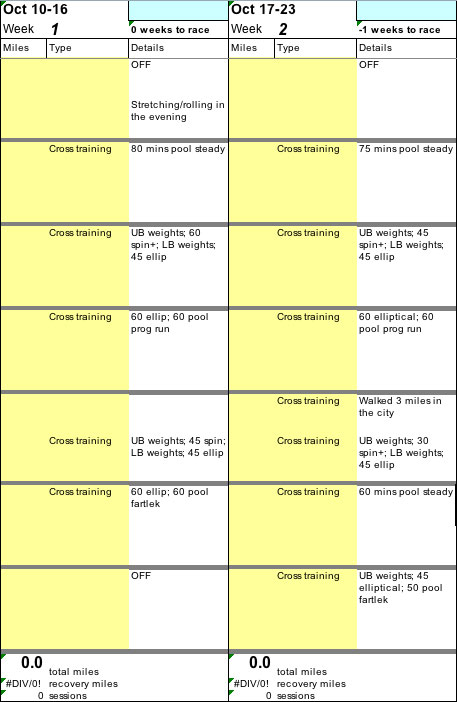
Training: Oct 10-23

The grind continues. Today marks 11 weeks since someone or something gave my running the stinkeye.

I continue to train hard using alternate methods. To break up the monotony, and make sure I’m working hard enough, I’ve started getting creative with cross-training:

Spinning: I naturally tend to work harder in a spin class than when I’m on my own. Unfortunately, my schedule does not always mesh with the gym’s, so I’m doing a lot of spinning on my own these days. I focus on getting my heart rate up, evidenced by a) a high heart rate and b) getting myself to sweat like a pig. I achieve this with lots of standing up while pedaling alternated with 2 minutes of pedaling like I’m being chased by a mob of zombies — the fast kind, not the slow kind.

Elliptical: You can do speedwork on the elliptical. You can also do hillwork, but I’ve been told to stay away from doing that because it could aggravate whatever my injury is — plus the focus for us distance runners is high turnover, strength and endurance, not being able to do the equivalent of running up stairs carrying a dishwasher. So I do surges here too, getting my reps up to 210 (and making sure I’m pouring off sweat) for 2-3 mins with 1 min recoveries. In the case of both spinning and elliptical, I note the days I’m doing intervals with a plus sign.

Weights: I have yet to have found a way to make this work creative. Although I do enjoy the fact that I’m usually the only woman in the weights area. I feel so special. Let’s move on.

Pool: I’m beginning to not mind the pool so much. For one, I’ve developed some mind games to play. But when I’ve got an entire lane to myself for upwards of an hour and a half, there are no distractions and the act of running in circles becomes meditative. Pool running is the priority among all these gym activities, so it’s where I work the hardest. I tend to “save my strength” for the pool — meaning I am conscious of not trashing my legs in whatever I’m doing before I hit the pool for a hard session, meaning anything harder than an hour’s steady effort of 72-75%. What are hard sessions? Right now it means three things: long run (80-90 mins at 75%+), fartlek session (around 18-25 minutes of short and long intervals with very short recoveries), progression run (I start at 65% and work up to 85% in 10 minute increments). Once I’m back to regular running training, I’ll still be hitting the pool 3x a week as well as doing 3 sessions of spinning and frequent weight work.

I met up with Sandra a couple days this week at the gym. She was doing a little training, but as she’s dealing with a knee problem, couldn’t do everything with me. Still, she hadn’t seen me at work in a few weeks and she seemed surprised at the effort I was putting into it. I also sent her my training log and her reaction was that I’m probably training a lot harder than I was when I was “just running.” She swears I’ll be faster when I hit the roads again as a result of this conditioning work. I hope she’s right. At least I’m getting a nice pair of legs out of the deal.

So, where do things stand right now? An MRI should provide some clues this week. If it’s a stress fracture then I guess I’m sidelined according to how serious it is. I would be very surprised if it needs surgery, but what do I know? The other possibility to be ruled out is a hamstring tear. I have not looked into what that involves because I’ve already wasted so much time Googling injury-related information. I can’t do it anymore. I’m sincerely hoping it’s merely inflammation in the joint that can be treated fairly quickly so I’m back on the road next month.

As for training and racing plans, there will probably be adjustments. In the training realm, one piece of news is that Sandra and Khalid are moving to Colorado Springs next month to pursue some opportunities she has out there, live at altitude and leave the high cost of living in New York State (and horrible weather) behind. It’s also a quicker trip to Mexico, where they spend a fair amount of time every year.

I knew when I started working with Sandra in July that this was their plan, but now it’s really happening, which has not been easy to accept. I got a mere month of road/track training in before I got injured. So that’s been a source of disappointment. But I have to acknowledge that I learned a lot about training in that month — and in the “injury months” since then in terms of how to apply cross-training (both while injured and as a supplement to regular training). Sandra and I communicate well, so I’m feeling confident that we can keep up the good work using the various modern tools at our disposal — Skype, Google docs and email. I was also encouraged to discover that the majority of the Houston Hopefuls are successfully working remotely with their coaches.

As for racing, I have no idea whether I’m going to Houston in January. If I can start marathon training in, say, two weeks, it’s probably enough time — around 12 weeks — to get me in shape to run a good marathon, if not a great one. If it’s a longer wait, another option is to train for and race the Houston half instead. I love the half and working toward a PR there would be a good stepping stone to returning to the marathon, so that’s a compromise I could live with. And if I’m completely screwed for a January race, one idea I’ve proposed is switching my plane ticket and targeting the Napa marathon in early March.

Nearer term, I would love to race something, anything, as soon as possible. Watching the Fifth Avenue Mile last month — not just watching, but limping around as a volunteer — was enormously depressing for me, as will be watching the New York Marathon next month. I don’t want to get greedy and demand a race when I should feel lucky to be able to run anywhere for any distance, which I still can’t. But I’ve appreciated in the past couple of months that, while I enjoy training, the racing is what the training’s all for. I have it my head to try to run the Joe Kleinerman 10K in Central Park in early December. It’s a carrot to chase after mentally. But, ultimately, my body’s going to be the one calling the shots.

At least I’m not living alone in Injury Land. And I have a reliable cross-training partner most days, although he recently had to drop out for a bit while battling an infection. Anyway, here’s yesterday’s quote of the day, triggered by the arrival in our mailbox of an entry form for the Marisa Fund 5 Mile Turkey Trot.

“It’s amazing to think that just five months ago, I won their 10K on that course. And now I couldn’t even win a snail street-crossing contest.”
— Jonathan Sumpter