Fall Training: Week 11

Interesting week. Not quite the one I wanted. But I’m learning that I can’t control everything, and that can’t be a bad thing.
First side tangent about control: I was reading a book about adventure travel (Robert Young Pelton’s Guide to the World’s Most Dangerous Places) recently. There’s a chapter on adventure racing and it’s noted that marathon runners usually make lousy adventure racers. We’re control freaks, apparently (who knew?). In an adventure race, everything is constantly going wrong and you have to deal with it, adapt and change plans along the way. Compare not having the right flavor of gel to losing two of your kayaks on a four person team, or watching helplessly as all of your camping equipment slips into a deep ice crevasse, and you get the picture.

Second side tangent about control: I’ll preface this paragraph with the caveat that everything I’m about to say is completely speculative in nature; my personal observations and opinions only. This year’s NCAA Cross-Country Championships featured one of the most bizarre races I’ve ever seen. College phenom (and Olympian) Jenny Barringer, initially in the lead, but with Susan Kuijken right on her tail, not only faltered at several times in the race but actually appeared to pass out for a moment. She rallied, but with all those stops along the way ended up way back in the field.

I suspect she had a panic attack midrace (timely, given my recent post). Why? Besides the enormous pressure on her, as the favorite, to win, she just looked uncomfortable from the very start. Kuijken was right behind or alongside her for the start and you could see how aware of her Barringer was. Barringer’s facial expression and physical demeanor changed dramatically in the moment that Kuijken passed her (8:00) and things when rapidly downhill. You could see Barringer, looking distressed, talking to herself. Her form was shot and she didn’t look good. Then, a bit farther along, she wobbled, dropped to her knees, and collapsed (0:54, 1:42).

Where was her coach? Even if it wasn’t a panic attack, she clearly wasn’t in racing shape and belonged in the med tent. Even more disturbing than watching her struggle to her feet to finish the race was that she allowed herself to be interviewed right afterwards. On camera, she was clearly upset and shaken from the experience. I saw her doing everything other than taking care of herself. It struck me as profoundly sad, because she seemed so utterly alone.

Updated: Here’s an extended interview with Barringer after the race in which she discusses the incident and the confluence of pressures, transitions and expectations that may have contributed. I’ve also added links to the video above, along with where you can see the key meltdowns.

Anyway, back to my week. My big run on Sunday of Week 10, as I’d suspected it might, pushed my foot into a whole new world of pain. My ankle and foot also blew up overnight, resembling a Virginia ham. My sports doc couldn’t even determine which tendon was the source of the issue, so I spent the week taking NSAIDs (oral and topical) and the swelling and pain improved enough that I could run easy on the treadmill. My one run outside on Saturday caused the problem tendon to flare up, though, so I went back to my sports med guy yesterday, who (surprise!) gave me a cortisone shot.

Needless to say, I didn’t run my 4 mile race in Central Park on Sunday as that would have qualified as Doing Something Stupid. While I’m disappointed that I didn’t get to try for that first corral bib, I gotta keep my eyes on the prize, which is December 6 in Sacramento. Doc gave me the all clear to run and race as much as I like, starting today, with the warning that my race may hurt a little (and possibly a lot afterwards). But I won’t be doing any further damage to myself by running it.

Ankle and foot look and feel better this morning thanks this miracle drug. I had a planned 12 miler with 9 at just below marathon effort. I’m going to go attempt this on the track right now.

Exercise and anxiety

I used to suffer from chronic anxiety. This illness took many forms, the most pervasive of which was my compulsion to worry constantly, envisioning the worst possible outcome of any situation or endeavor. I would also brood, spending hours, days or weeks blowing up the smallest negative interaction into some sort of globally applicable proof of all that was wrong with me, my life and the world. Another delightful side effect was periodic hypochondria. But the crowning feature was the full blown panic attacks I’d suffer every few years, often with several clustered in a short period of time. If you’ve ever had one of these, you’ll know that they are intensely frightening, uncomfortable and exhausting experiences.

For years I attempted to treat this problem through traditional talk therapy. Years. Well over 10. In hindsight, I probably should have tried a more practical variety, such as cognitive behavioral therapy, but, despite rejecting many of its theories (Oedipal complex? please, spare me) I bought the psychoanalytic approach hook, line and sinker.

I don’t feel that those years I spent in the chair were a total waste of time and money. Insofar as I had a sympathetic ear once or twice a week, I think that I was helped in some ways during those years in terms of getting some perspective. But the issue that brought me there in the first place — horrendous anxiety — remained, sometimes abating for a few years at a time, and in the process convincing me that I was over the problem. But it was always a matter of time before it came roaring right back.

I’d been running 15-20 miles per week since the age of 34. Then I started upping the mileage and effort at 39 in training for my first major race, a half marathon. Shortly after I started running more, and running harder, I noticed subtle yet unmistakable changes in mood. Not just the cessation of anxiety attacks (I’d seen that before), but a lifting of the constant dread and chorus of negativity that permeated my inner mental world.

So I ran more, and I ran harder. I got better, both as a runner and in my head. The daily devil of nagging anxiety had at last been banished. I felt so much better that I finally quit therapy, a decision I’d been struggling with for several years. I didn’t need it anymore. That was about four and a half years ago. Not coincidentally, that is the longest I’ve gone between anxiety attacks since I started having them in my preteen years.

I decided to post about this after reading this article in the NY Times, which seems to bring some scientific evidence to bear on my anecdotal experience.

Of course, what this means is that I can probably never stop running. I can live with that.

Fall Training: Week 10

09fall-training-10This week started out well but rapidly nosedived as a new injury emerged. On Tuesday, toward the end of a midlength run, the top of my left foot suddenly started hurting. A lot.

With icing it seemed to get better overnight and I felt good enough to go do my tempo run at the track on Wednesday. That went very well until the penultimate fast mile when the pain started to come back. I could still run fast, but it wasn’t a pleasant experience. The recovery run later that day was a bit better and I was encouraged to find that the more I ran, the better the foot felt.

Then on Thursday I did a nine mile recovery run with the same expectation, but ended up with a completely different experience. My foot hurt like hell for the entire run. Aside from one incredibly hot and humid half marathon in which I had a small…um…”accident” in my shorts just past mile 4, these were the longest 9 miles I can recall ever having gritted my teeth through.

After that run the pain started to migrate upward from the top of my foot to the lateral side of my ankle. There was no obvious inflammation, which I suppose was a good sign, although the area was tender.

As much as I hated to do so, I backed off for the rest of Thursday, as well as Friday and Saturday, chopping my mileage by close to 30 miles in the process. I’m upset that it came to this, but what could I do? After Thursday’s sufferfest I felt that running on it further would only delay the process of healing.

Fortunately, I have a stationary bike for just such occasions, so I whaled away on that for a couple of days. At the risk of offending duathletes and triathletes, biking is not that hard. I averaged 16mph at 60-63% MHR with a resistance setting of 5 (on a scale of 1-10). Maybe I need to put these monster legs onto some pedals one day, since I know I’ve got the running nailed.

Last night I did a 20 minute run test on the treadmill, scooting from 11:00 pace down to 8:00, just to see what my tendon would do. It didn’t get worse, which was good enough for me. Hardly the best test, since 20 minutes on a flat treadmill at a slow pace does not equal 20 miles in Central Park at a fast pace.

Since I take some measure of pride in being an honest blogger, even when it makes me look like an idiot (see shorts shitting episode above), I’ll confess that I took a serious painkiller for this run: 500mg of Hydrocodone (prescription only!). I resorted to this measure only because OTC meds had no effect on the pain over the preceding days. I took half one hour before the run and kept the other half in my shorts. I took that at the 13.5 mile mark when my ankle was starting to whine.

I know that it’s generally not a great idea to include narcotics in one’s training plan, for the usual reasons: they mask pain, they can have unpredictable physiological effects when mixed with high effort, one can become overly reliant on them as a “band aid” of sorts, yadda yadda. But I’m a big girl and know the risks. I knew going in that my tendon was inflamed and would hurt. I knew I didn’t have a stress fracture. I knew that 500mg of something in my system during a few faster miles wasn’t going to wreak havoc. I used to be alarmist about such things, but I’m not anymore.

The run went well. I did 5 miles at around 10:00 and then picked it up to average 7:35 per mile 7:50 per mile (I can’t do math properly) for the faster 15. This is a very good decent pace for me in Central Park, which is constant ups and downs. I avoided the huge hills at the top of the park, opting to go clockwise along the 4+ mile “inner loop” (utilizing the two major transverses at 72nd and 102nd streets) for most of the run. It was also around 60F and 92% humidity. Add in that I was running on a bum ankle and I’m happy with today’s performance. I know I worked hard because I came home and slept for 2+ hours.

Random fun facts: I counted four people who were running faster than I was today and they were all guys in their 20s and 30s; that always makes me feel good. Also, there was an ice cream cart on the corner of the 72nd street transverse and West Side Drive, but no one was buying ice cream. I bought one at the end of the run and it took the guy about five minutes to excavate the desired item from the bowels of his cart. I wondered if it had been buried in there since September.

Next week is the transition from training to taper. I’ve got my last speed session (I skipped the one planned for Friday of this week) and a 4 mile race in the park on Sunday, in which I will make my second attempt to garner a NYRR First Corral bib. As for my tendon, regardless of what it does overnight I’ll go see the orthopedist this week for a cortisone shot. It wouldn’t be marathon season without one.

Mixes: Accelerate

I’ve got another 20 miler today. I’ve been listening to the same playlists for months, so it was time to build a new one. Since my run will start off easy for 5 miles and then work up to slightly below marathon effort for 15 (gulp), I wanted a mix that reflected that pattern.

There’s a lot of uptempo stuff in here, but I’ve thrown in a calmer tune every so often to remind myself to relax when I’m running fast. I find that if I listen to too much relaxing music while running fast, my mind drifts and I get complacent (and I slow down). There will be none of that nonsense today.

Here’s what I’ll be serenading myself with this morning.

More Than This – Roxy Music
Dance Away – Roxy Music
Same Old Scene – Roxy Music
You Should Be Dancing – Bee Gees
Friend – Christine McVie
Shade And Honey – Sparklehorse
Traffic and Weather – Fountains of Wayne
WannaBe in L.A. – Eagles Of Death Metal
The Laws Have Changed – New Pornographers
You Look So Fine – Garbage
Blue Morning, Blue Day – Foreigner
Lust For Life – Girls
Black Albino Bones – F*ck*d Up
Pretend That You’re Alone – Keane
Technicolor Health – The Harlem Shakes
I’m Throwing My Arms Around Paris – Morrissey
Say You Love Me – Fleetwood Mac
21st Century Breakdown – Green Day
Girlfriend – Phoenix
Sitting Still – R.E.M.
We Started Nothing – The Ting Tings
Let Down – Radiohead
Planet Telex – Radiohead
Freeway – Aimee Mann
The Shock Of The Lightning – Oasis
Her Voice Is Beyond Her Years – Mew
White Riot (Alternate Demo Mix) – The Clash
Oliver’s Army – Elvis Costello
Something In The Air – Thunderclap Newman
Little Favours – KT Tunstall
Switch On – Paul Oakenfold
Oxford Comma – Vampire Weekend
Wave Of Mutilation – Superdrag
I Thought About You – The Beautiful Girls
Holiday Road (Live) – Lindsey Buckingham
Cannonball (LP Version) – The Breeders
Come On/Let’s Go – Paul Weller
Radiation Vibe (LP Version) – Fountains of Wayne
Day After Day (2009 Remastered) – Pretenders
My Lucky Day – Jason Falkner
F*ck and Run – Liz Phair
Pathfinder – Gay Dad
The Warrior – Scandal
I See You Baby (Fatboy Slim Mix) – Groove Armada
Jumpin’ Jack Flash – The Rolling Stones
Gimme Animosity – Superdrag
The Nude – Catherine Wheel

Listen here.

In praise of pets

Long before there were these strange things known as blogs, I would sometimes write up a little essay to commemorate something important that had happened in my life and send it to people who I knew would appreciate it.

Coach Kevin is coming to terms with the imminent loss of his parents’ nine-year-old golden retriever. His posts about the experience prompted me to dig out what 10 years ago would have been a blog post. Here it is.

Saturday, 10 July 1999

We have suffered a great loss today. Our cat, Stumpy, died this morning. On Wednesday evening he suffered something called a “thrombosis,” or a blood clot which lodged at the base of his spine, paralyzing his back legs, and sending him into shock. He spent the next few days at the vet’s office, where he recovered from his shock and even very briefly regained a bit of strength and sensation in his legs, but they almost immediately returned to full paralysis.

The vet took him out of his cage early this morning and exercised his back legs a little, looking for signs of improvement, but found none. Stumpy went back to sleep upon being returned to his cage, and died sometime later this morning, in his sleep, presumably by the formation of another blood clot.

Unfortunately (or perhaps fortunately), we hadn’t seen him since bringing him in Wednesday night, since we were told that he would probably be further traumatized if he were to see us and then be abandoned by us again. A part of me thinks that Stumpy may have somehow chosen to spare us from having to make the decision to end his life if his condition wasn’t ever going to improve. Or maybe he simply couldn’t abide by it himself and gave up.

I wrote the following in an effort to cope with the sudden shock of losing him.

I have only good memories of Stumpy. In fact, I still clearly remember the day I discovered him. The art department I worked in on Madison and 32nd had an adjacent open roof area, a little 30 foot square patch of grimy tarmac braced by three walls and our window, in the middle of which sat an ominous, blackened piece of building machinery illuminated by a narrow, creeping shaft of sunlight.

One afternoon, someone pointed out that there was a black and white cat playing on the roof. Peering out the window, I could see the cat batting a scrap of paper around the perimeter of the square with great enthusiasm. He happened to look up and see me staring at him, at which point he ran over and hopped up onto the window ledge to peer back at me through the glass. He then began to strut back and forth along the ledge, rubbing against the glass and wedging a paw under the crack of the open window in an effort to touch me.

At such close range, I could see that he had a serious injury: all but the first four inches of his tail was gone, and the remaining span was a gangrenous, bloody mess. I suspected the giant piece of machinery of having initially served as a warm place to sleep, only to prove itself a massive Cuisinart as far as the cat’s tail was concerned. Yet, he seemed oblivious to the injury. I reached my fingers under the window and he happily rubbed his face against them. He was purring so loudly, I could hear him through the thick glass. When I pulled my fingers back in, the tips were coated with soot and grease.

For the rest of the day, I couldn’t keep my eyes off the window. Every time anyone went to look at the cat, he would leap up to the ledge and engage in the same campaign for attention and affection. Since he lacked a collar (and a tail), it was pretty clear that he was in need of help.

That evening I went home and engaged in my own campaign with Jonathan, which I began with by saying, “You see, there’s this cat…”

The cat was on his way home with me the next day, after a quick trip to the ASPCA in Manhattan, where a staff vet declared him “a fixed female, about three years old. She’s had some kittens.” Stumpy must have made a trip to Sweden at some point because, in actual fact, he was a neutered male, about a year and a half old. Whatever he was, he really seemed to enjoy the ride home on the Staten Island ferry at sunset.

After a few hundred dollars for a garden-variety tail amputation and industrial strength shampoo and blow dry at a Staten Island vet’s office, the cat was good as new thanks to me and MasterCard. Since his new stub of a tail was his most notable feature, we took to calling him “Stumpy” affectionately while we debated on a “real” name. Eventually, the nickname stuck.

Stumpy was the most unique cat I’ve ever known. I’ve had three other cats, and Stumpy was the best of the lot. I think this is mostly attributable to his being so atypical of a cat. Cats are emotionally aloof; Stumpy was constantly giving and asking for affection. Cats often prefer to spend their time alone, elsewhere in the house; Stumpy always wanted to be around me, and would follow me from room to room, settling down to sleep wherever I happened to be. Cats do not often come when called; Stumpy always did. When I came in the door, he would run up to greet me. When I drove into our driveway, he would be sitting on our walk, waiting to say hello. For all intents and purposes, this cat was a dog.

He absolutely loved people. We recently held a birthday party for our friend Adele, in which there were close to 25 people in our living room. I assumed Stumpy would be afraid of all the noise and bodies and would surely spend the evening under the bed in the guest room, his traditional hiding place from thunderstorms and vacuum cleaners. But at one point during the evening, I noticed him sauntering around the room, mingling with the guests and moving from lap to lap, settling on the lap of whoever would have him, for as long as they’d have him. In his own mind, he seemed to consider himself as having equal stature to anyone else in the room, and may have even assumed the party was for him, had the cake not read “Happy Birthday Adele.”

Stumpy was the sole daily constant who persisted through Jonathan’s and my years together as a couple. Part of the reason losing him has proven to be so devastating to both of us is that adopting Stumpy was the first really important thing I asked for from Jonathan, and he gave it to me without hesitation, despite the fact the he had no desire to own a cat, and in fact had never even had a pet. I moved in with Jonathan in November of 1990. Stumpy joined us in the early spring of ’91 and has accompanied us through every terrible and wonderful ripple and wave of the past eight or so years.

Over those eight years, Jonathan’s affection for Stumpy grew to equal my own, even though he would still occasionally sternly mumble exclusionary observations such as, “Your cat wants to go out.” But we both knew he was our cat, not just mine anymore.

When we both began to work together at home, Stumpy became an even more attached to us, and we to him; he spent as much time in our studio as we did, often stealing my chair if I left the room for a few moments, or sleeping on our sunny window sill, waking indignantly at the sound of crows or squirrels who dared tread on his property. If we insisted, he would allow us to put him outside during the day, but he would sit just outside the front door, ready to leap back inside the house to be with us again if we let him.

Stumpy’s love of people extended through all facets of his behavior. He wanted to meet everyone who came into the house. He was amazingly sensitive to moods, comforting us if we were upset or sick, getting distressed when we were angry, wanting to be in the middle of things if we were laughing.

When our vet first met Stumpy he couldn’t help but comment on how gentle and friendly a cat he was, how he’d obviously been the recipient of a lot of love over the years. Most cats are totally uncooperative on the vet’s table, squirming and scratching and meowing. But Stumpy was acquiescent and amenable, calmly allowing his temperature to be taken in that most unpleasant manner, resigned to accepting shots and all the other necessary annual pokings and proddings. Like all animals, he wasn’t happy at the vet’s, but by all accounts he wasn’t unhappy there either.

He was such an innate charmer. I found out recently that over the years he was regularly given preferential treatment there, where he was also boarded. While we were away on vacation, agonizing and feeling guilty about shutting Stumpy off in a tiny cage in a room full of other imprisoned cats all day, the reality of how he spent that time was actually quite different. In fact, he spent the majority of his days wandering freely around the vet’s rooms, most of the time hanging out in the reception area where the action was. Somehow it seems appropriate that if he couldn’t be with us when he died, that he was there, where he was equally appreciated and cared for.

One of the worst things about losing someone suddenly is the fear that your primary memory of them will always be the final, overwhelmingly negative one. I do hold a horrific memory of my last hour with Stumpy in which he, Jonathan and I are all equally distressed. But minutes before Stumpy became ill, I was sitting with him out on the driveway (where he liked to spend cool summer evenings, lying on the warm pavement), talking to him and helping him stalk a tiny green grasshopper. And so I’ll choose to hold those five minutes of our last hour together as the very last of thousands of memories that began to accumulate on that lovely spring day in Manhattan in 1991.

Happy trails, Runs Like a Girl

The former incarnation of this blog, Runs Like a Girl, has been sitting around on Blogger for well over a year since I moved over here and underwent a name change. Since I’m getting sick of moderating comments submitted to a dead blog, I’ve pulled the plug on the old Girl.

Just so you know.

My left foot

Oh, you poor thing.

I know why you’re so unhappy. I forced you to run 18 miles in a newish pair of Adidas Adizero Tempos, which, with their slightly too-narrow toebox, pinched your award-winning bunion. You were also probably working hard to compensate for the right leg’s compromised hamstring.

Then I took you on a 22 mile spin along the Central Park hills despite the fact that you were still iffy in the bunion department. You let your displeasure be known on Tuesday, at mile 11 of a 14 miler, again after numerous ups and downs on the way to White Plains and back. “Here’s a little tendonitis for you,” you muttered ruefully and then added, more ominously, “Or maybe it’s a stress fracture.”

Oh, sure, I made a show of caring about your needs, wrapping you in ice for 20 minutes several times on Tuesday and feeding you horsepill-sized anti-inflammatories. But then what did I do? I frogmarched you to the track on Wednesday morning and forced you to run 6 miles at around 7:10 pace, with another 4.4 miles around those. You did your best, stifling your dismay until the penultimate tempo mile, during which you shouted in no uncertain terms, “No more! Can’t you see I’m in pain?”

Yes, I could. Because you shared your pain. Your pain became my pain. And now we’re in a lot of pain together.

But not so much pain that I didn’t make you run another 4.6 yesterday afternoon, mere hours after our abusive session at the track. Nor did I spare you 9 miles this morning. You’re probably wondering if we have another run later today. I’m not answering that question.

I’m sorry. I’ve given you the painkillers (Hydrocodone) that we save for special occasions. And I’ll offer you more ice throughout the day and evening. Perhaps even some Swedish vodka.

Forgive me.

I’ve seen this sort of thing before

It’s the last month or so before my goal race and, as typically happens, a host of physical issues are suddenly emerging on the horizon like thunderclouds only to recede just as quickly and mysteriously, having spared me from a soaking, or worse, a lightning strike.

Where have I seen this before? Oh, right. During every single previous training season. Looking over my logs of the past few years (you do keep detailed logs, don’t you?), I see that this is something that happens like clockwork in the 4-6 weeks prior to each marathon.

In the spring of 2007, it was chronic shinsplints. In the spring of 2008 it was a torn fascia in my right calf. In the fall of 2008 it was a general malaise that I couldn’t shake for days at a time, almost as if I was on the verge of getting the flu. In the spring of 2009 it was a twofer: a cyst on one of my left foot’s ligaments accompanied by a mysterious pain in my right quads that migrated from quad muscle to quad muscle for a few weeks. (Ironically, the iron/vitamin deficiency and/or overtraining — which eventually did me in — was the one thing I wasn’t accutely aware of.)

This time around is no different, although I’ve learned not to be completely freaked out by each new complaint. Two weeks ago, it was a hamstring pull. Yesterday, it was some sort of odd, painful ligament or tendon issue on the top of my left foot.

I dutifully take my anti-inflammatories, ice and massage the sucker, and hope for the best. If something persists, I go to the orthopedist, who at this point can probably set his watch by my twice-yearly appearances. After a completely unnecessary, “defensive medicine” x-ray, I usually leave with a good dose of cortisone surging through the area in question and a “good luck” on my next race. Did I see him rolling his eyes too?

I’m like a car that starts to belch black smoke from beneath its hood at the tail end of a drive through Death Valley in July. As long as I can make it to Sacramento on December 6 with my radiator, suspension and transmission intact, I’ll be happy.

Fall Training: Week 9

09fall-training-09
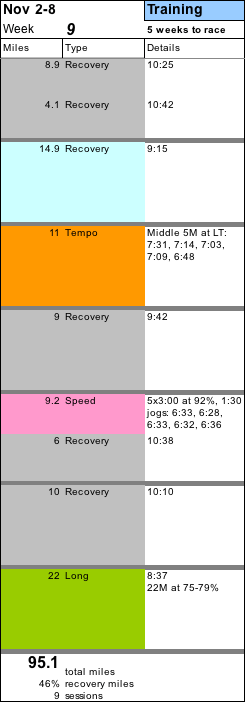
This was by far one of my most enjoyable weeks of running in recent memory. I may not be as speedy as I’d like at this point, but I am becoming a stronger runner by the day, or so it seems. Even training with a dodgy hamstring, which was more a slightly worrying nuisance than a hindrance, I felt great this week.

By “stronger” I mean that I am evolving into even more of an endurance machine than I usually am. I can run seemingly forever at a moderate effort, and tacking on high effort miles has been almost easy. I’m also not exhausted after any particular workout or at the end of the week.

I’m not sure how you quantify training progress outside of racing times, but this week of training has me feeling that after two+ years of consistently running high mileage, I’ve finally adjusted to its demands. Almost as if I really do now have a “base” upon which to build further, as opposed to a base that I am working to build.

The highlights for the week, aside from running 95 miles without issue, were Wednesday’s tempo run, Friday’s speedwork, and a monster run in Central Park this morning. Tuesday was no slouch either, with 15 miles at a decent pace for 70% effort.

The tempo run was an experiment in hamstring healing. My ailing leg felt okay, so I decided to try running as far on the track going counterclockwise as I could. That turned out to be 3.5 of the 5 faster miles before the hamstring started to tighten up. So I finished up going the “wrong way” and, aside from the slower, cautious first mile, chalked the run up as a success, given the decent paces.

Another thing about that run: I realized while running my warmup miles on the way to the track that I no longer dread tempo runs beforehand or suffer through them. If anything, they’ve become too easy and I have felt in the past few weeks that the faster blocks are too short. I have said as much to Coach Kevin and he concurs that they are becoming easy for me. So we may schedule longer tempo blocks for the spring cycle.

Friday’s speedwork was worrisome insofar as I didn’t want to screw up my leg and compromise the Sunday run. Still, I was feeling brave, so I decided to once again run in the proper direction on the track and see what the leg would do. It held up well, possibly owing to the fact that I had trouble working up to 92% effort due to fatigue. Still, I’m happy with the splits, considering most of them were run at 91% effort.

I should also note that I only had two days of doubles this week, which is not bad for a 95 mile week. I have observed that I am overall less fatigued in the weeks that I only have one or two days of doubles compared to those in which I have three or four. I don’t know whether it’s a function of age or just my own particular physiology, but I suspect I need 24 hours between runs to recover properly. Fortunately for me, I like running long.

Friday evening and yesterday morning, my legs were completely trashed. Not just my legs, but ankles and feet as well. My confidence in being recovered in time for this morning was shaky, but I’ve learned that miracles can happen overnight.

As it turned out, today’s run was, again, no big deal. I’ve decided to do my final long runs in Central Park so I can get the benefit of the hills there. The California International Marathon course is by no means as hilly as Central Park is, but it does feature a net downhill drop. I’d like to avoid another thigh shredding exercise if I can.

I ran three full loops of the park starting at 72nd St on the west side, along with a 1.5 out and back north, turning around at the 102nd St transverse. Holding effort between 76-79% was easy and I felt energetic enough to run the last mile at 86% just for the hell of it. That got me a 7:26 mile over hills on extremely tired legs. I’ll take it.

A random test

I just hooked this blog to something called NetworkedBlogs on Facebook. This post is a pointless waste of bytes, meant only to confirm that that hook-in is working.

See? I wasted at least 20 seconds of your life just now. You’ll never get those back.