NYCRunningRaces.com

Robert (Cowboy Hazel) has just launched a brand new resource for NYC area racers:

http://www.nycrunningraces.com/

The site provides a monthly calendar of races in NYC and environs. You can follow updates on Twitter and even submit a race for inclusion. I’m hoping he’ll add Connecticut, given how extensive its racing scene is year round.

In an age of complex web sites, this one just does one thing and it does it well. Thanks, Robert!

NYC Half + Fresh Air Fund = Doing Good

Sure, the insanely popular* NYC Half Marathon is sold out, but you can still run in the footsteps of Catherine the Great and other fast ladies (and gentlemen) by signing up to run with the Fresh Air Fund. FAF is just one of a boatload of charities you can run for. Just think how good it will feel to run through the streets of NYC…in order to help a kid get a little break from the streets of NYC.

*And I do mean insanely popular. A race of over 10,000 run in the high heat and humidity of NYC in August? That fills up in a couple of hours? Along the West Side Highway? Yeah. Um. Insane.

Summer Basebuilding: Week 1

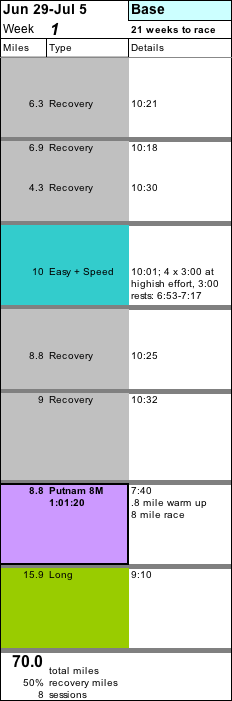
sum09-base-01Here we go again.

Now that the dark days of May (and somewhat drunken days of June) are behind me, it’s time to put nose to grindstone once again in preparation for the California International Marathon, taking place on December 7th. On that morning, at 7AM, I will run from Folsom to Sacramento. And I plan to run it a lot faster than an anemic 7:45 pace this time around.

Was my pace in Newport literally anemic? I’m beginning to think it may have been at least flirting with anemic the more I read about blood test results and after a couple of dismal performances in local races. In any case, I’m taking action to try to correct the problem via handfuls of iron and vitamins B, C and D.

I’m also working on dropping some fat during the coming weeks of basebuilding. I’ve found it impossible to lose any significant extra fat while actually in the throes of marathon training, but I’ve had luck doing so in the past during basebuilding. Throw in a pledge of complete sobriety until after Labor Day (since weekend drinking tends to derail the weight loss effort) and you’ve got either a recipe for success or misery.

I winged it last week since Coach Kevin was still off in the wilds of Colorado, basically taking an early week from our last go-round of basebuilding and modifying (okay, bastardizing) it. I also threw in a race yesterday, which didn’t go nearly as well as I’d hoped.

Highlights of the week: Lost of slow recovery running as I continued to try to become acclimated to the summer heat and humidity. On Wednesday I went to the track and attempted some faster running. It was quite hot and humid, though, so it was hard to run fast or particularly hard. I got my HR up to 92% but found that my lungs gave out before my heart did on those efforts.

Yesterday I did an 8 mile race, the Putnam County Classic, which I’d thought would be flat, as the majority of the course was running around a large lake. But it was actually quite hilly, with lots of sharp ups and downs and very little flat bits. The weather was very nearly ideal, at least for a race in July: 65-70F and dew point around 58 or so. Since I’ve been racing so badly lately I decided to just run the whole thing by effort and not even look at pace during the actual race, since I’ve found it so depressing to do so. It’s hard to keep running the remaining miles when you know how slow you’re going.

I ran at as high an effort as possible, which averaged 93% MRH, although I did finish up the last half mile at 95%. Still, I was slloooowww. I was not happy to see a time well over an hour upon reaching the finish line. All I could muster was an average 7:40 pace. Barely faster than I could run for 18 miles five weeks ago in Oregon. Sheesh, it’s so depressing to see how far I’ve fallen, and continue to fall.

I should note that I’ve become a chronic napper lately. I needed a 3 hour nap on Friday (thank goodness it was holiday for the company I contract for and I’d already put in my work hours for the day). Then another yesterday post-race (not quite as surprising). It’s probably a reaction to the increased mileage + heat/humidity running + two races in eight days. Still…uh…what the fuck is wrong with me?

Today I felt okay and the weather was fantastic: mid-60s and an unheard of July dew point of 48. I had to take advantage of it since it will be hotter than Hades soon enough. So I did a hair short of 16 miles up past White Plains at a halfway decent pace.

My experience over the past few weeks has shown me how performance issues can sneak up on you. Everything can seem fine during regular “bread and butter” runs like recovery and long, steady distance efforts. The problems only make themselves known — and in quite dramatic fashion — when trying to run fast, or at least they do for me.

I may do a few more races over the summer if the weather isn’t horrible, just to try to gauge if taking supplements is helping at all. There’s a nine miler later this month that I might try, as well as the Van Cortlandt Track Club’s summer series of 5K races on Thursday evening. And I’ll definitely do the 10 miler I do every September in South Nyack, the weekend after Labor Day. I really hope I’m in better shape by then. I ran that one in 1:14:20 last year (with 80 miles on my legs already going in). I’d love to break 1:09 this time around.

Don’t get me wrong — I know so many people right now who are struggling with injuries and who can barely run at all. I’m grateful that I can run. I just wish I could run fast again.

Post Mortem: Newport Marathon

An appropriately titled post, since roughly two thirds of the way into this race I wanted to crawl into a hole and die.

It’s been exactly a month since my debacle in Oregon. In the intervening weeks I’ve had time to review my training log and diary, and discuss theories with Coach Kevin.

I’ve also had bloodwork to rule out anything there. And, although I suspect I could potentially feel better with higher iron-related numbers (and may start supplementing as an experiment), I don’t feel that the root cause is to be found there. No, I think it was simply a matter of too much for too long.

A couple of days after the race, I sat in my room in the Crater Lake Lodge (during a rare evening of relative sobriety) and penned (okay, typed) a document that I entitled “Training Theories.” Here it is verbatim, with some helpful links:

What went wrong?

Peaked too early?
I was running my best in mid-April. The workouts were going very well. I had that “magical run” on April 21 when I couldn’t hold back from running fast and had wished that were a race day. A few days later I flew around the track for those sub-6:20 mile repeats. I’m convinced that if I’d simply tapered for two weeks after around April 12 and run a marathon around April 26 I would have had a great run.

Couldn’t hold fitness?
I suspect that not only was it impossible to hold that peak for the following seven weeks, but I probably managed to degrade that fitness by foolishly pushing too hard through some exhausting runs. The ones that stand out are the two very hot runs in late April (20 miles in Central Park in 91 degree heat on April 26 and that awful track session two days later). Then I ran the NJ Half on May 3, which I thought would serve as a good training run (if a lousy race), but now I think it probably dug me in further in terms of creating a deficit in recovery.

“Up and down” schedule around tuneup half?
Then the next few weeks were so up and down due to the “interruption” of that race that I suspect the result may have been a staleness that settled in slowly. This was evident, although very subtle, in the remaining key workouts. I chalked up any issues with those to weather factors or just the regular ups and downs of not being quite recovered from day to day.

The run the day before the race should have been a red flag. I chose not to wear my HRM (although now I wish I had). But at one point I decided to run a fast quarter mile. I managed to get down to 7:00 pace but I was working very hard to do so. I decided it was just nerves and didn’t give it another thought.

Possible modifications
If left to my own devices, here’s what I would do differently next time around:

  • Shorten the total training+taper cycle by about seven weeks.
  • Shorten the taper, assuming the buildup has been invigorating rather than exhausting. Maybe two weeks rather than three?
  • Introduce Mpace miles much earlier in the cycle, with a gradual buildup. More on this below.
  • If I’m going to race during training, choose the races only so much as they support the specific marathon event (similar terrain, etc.), and allow adequate recovery from them. If that means fewer races (or none), so be it.
  • Include a little bit of fast running early in the taper. I do wonder if those solid two weeks of recovery running somehow contributed to the extreme slowdown on race day.
  • Do more Mpace running on the roads rather than the track.

As for Mpace running, I think I need to do more of it and a lot earlier. I never quite clicked with that pace in terms of matching pace to appropriate effort level. Although I can race a full at 88-89% MHR, I’d be a lot more comfortable getting to a point where I’m at more like 86-87%.

What we could try is having me do a few Mpace miles every week (or every other, if we started this during basebuilding), starting with just a few miles thrown into a longer run and working up to lengthy Mpace efforts toward the end. This method worked very well for me for my Spring 08 race, when I basically took one of Pete’s plans and modified it by adding in a few more of those faster miles every week. By the time I got to the 12 mile and 10 mile Mpace efforts during this cycle, I think I was already cooked. I’m not completely sure that I even needed those two workouts, and they may have further exhausted me.

So there you have — the best I can do with the data (and gut feelings) that I have.

I know I learned a lot from this experience, as has Kevin. When we were talking a few days after the race he said, “I have to remember that you’re a mortal.” By that he meant that between the 9 week basebuilding period (during which I got faster) and the following 22 weeks of training, it seemed like I had the capacity to absorb any amount of work and continue to flourish. That durability and work ethic, when coupled with a capacity for self-denial and dare I say irrational optimism, added up to  our both missing some subtle yet insistent signs.

Looking back, I think the cracks were beginning to show at the tail end of April in that I was really struggling to hit times in workouts (and the NJ half wasn’t even close). It was easy to attribute those problems to other forces, but I’ll be a lot more attentive going forward to, as well as more communicative about, the qualitative aspects of the work. Heart rate data is valuable. But seeing and acknowledging that you’re working way too hard, regardless of what the stupid watch says, is more important than any data.

Hot weather training presents its own challenges, of course, but the plan I’m getting will allow for it. The timing looks to work out to around a 14 week training schedule, including the taper (which we discussed shortening). I’m hopeful that between a shorter training cycle and having learned some important lessons, I can look forward to a happier experience in Sacramento come December. (knock wood)

NYC Marathon: How to get in if you didn’t get in

On behalf of a friend of a friend, I’m shamelessly plugging a charity that’s offering guaranteed entry for this year’s NYC marathon in exchange for a fundraising commitment: Team Continuum. They engage in fundraising through a bunch of different events, including NYC. I notice that their page about NYC mentions a per-runner goal of $3,750, but the note I received stated the minimum for entry as $2,950.

If Team Continuum doesn’t float your boat, it’s one of several official “charity partners” for NYC you might hook up with, as well as Team for Kids and Fred’s Team (which fellow blogger Marci runs/fundraises for). And there are lots of others too.

Okay, that’s enough recovery

I’m going to consider this week as my last week of post-marathon (as it were) recovery. Which means basebuilding begins anew tomorrow.

I know I’m recovered because I have been determined to run a race. Not because I expect to PR in anything (especially in the summer heat and humidity of NY), but mostly because I’ve missed running fast in a crowd. I tried to race in a brand new 10K up in Rockefeller State Park yesterday, but had to skip it after getting horribly lost. So I tried again today, with greater success, and ran the Achilles Track Club 5 miler in Central Park.

I’m not even going to bother putting together a race report, because this wasn’t really a “race” race. I just wanted an atmosphere in which I could run fast for more than a mile or two. I went in with no expectations and a liberating “I don’t give a shit about this race” attitude.

As a result, nothing bothered me. The lady at registration gets annoyed because I only have $25 (that’s what the NYRR web site said it cost) and they suddenly wanted $35? I don’t give a shit. I get stuck behind a bunch of 8:00 pace people for the first half mile? I don’t give a shit. Four women pass me in the last two miles? I don’t give a shit.

Yes, it was fun to race and not really care much about it. Although I did find one thing to motivate me: a woman with 12% body fat passed me in the first mile and said, “Nice job” and instead of appreciating her innocently offered good tidings, my inward competitive bitch muttered, “Lady, you’re dead meat.”

We spent the next 3.5 miles passing each other. She’d pass me on the uphills, I’d pass her on the downhills. At mile 4.5, a downhill, I passed her for the last time and kept up the effort all the way through the uphill finish. I did not hear “Nice job” again.

Final time was 37:17, good for 45th Female overall and 4th in my AG. I realized somewhere after mile 3 that I could have run harder. I guess it’s been over half a year since my last short race (a 10K), so I’ve forgotten how to run them. I knew I hadn’t raced all out because I still had plenty of energy afterward. So I came home and then went out and ran another 8 miles. Now I’m tired.

All in all, this was a good transitional week between the relative slothdom of the weeks immediately after the Newport race and next week, in which I hope to keep running some faster miles and get the mileage up around 70. I may even try to race again next week. I covered 58 miles this week, which is close to the 60 I wanted to hit.

I’ve not yet built the new spreadsheet for this season, so here’s the low-tech, unflashy breakdown:

  • Monday: 5 miles, recovery
  • Tuesday: 9.6 miles general aerobic with last 15 mins at harder effort (~91-93% MHR)
  • Wednesday: 7.1 miles, recovery
  • Thursday: 8.2 miles, recovery
  • Friday: 4.9 miles, recovery
  • Saturday: 10.1 miles, recovery
  • Sunday: 5 mile race, 7.8 miles general aerobic

Tomorrow I’m scheduled to get the results from last week’s bloodwork. I’ve held off on posting a post-Newport post-mortem until those come in. I have lots of theories about what could have been done better in the training (opinions that are shared by Coach Kevin), but if the bloodwork comes back with neon numbers pointing to an obvious problem at the cellular level then I’m apt to revise some (but not all) of those opinions. I still think there’s room for improvement in the next cycle, but the extent to which (and how) I think the training should be tweaked will rest in no small part on what the lab numbers say tomorrow.

Race Report: Newport Marathon

Where on Earth do I begin? Hmm.

Well, the gist is this: I was running around 40 seconds slower than intended marathon pace, but at marathon effort, for the first 15 miles or so. Then, after the turnaround, my pace began to degrade further (while my effort increased). After some consideration (and mental math) I decided to cut my losses and drop out just before the 18 mile mark.

That’s the dry, fact-based summary. The more interesting dimension to this event is the one that featured a constant give and take between my emotional side and my rational side. The rational side won out and, while I’m obviously disappointed, I know I did the right thing by deciding to drop out. Or, rather, I am at peace with having dropped out, because I know I did it for the right reasons.

There was obviously something very wrong going on today. It was as though I was transported back a year into the body I had then. The mile-by-mile lowdown provides more detail, but the big picture is that I was just terribly, inexplicably (and consistently) slow from the moment the horn blew. There is either some training-related issue to address (Residual fatigue? Loss of fitness/early peak?), or a medical one (Anemia/low ferritin? A sub-clinical illness or infection?). Either that or my chakras are out of whack or I am being punished for a past life transgression. Who knows?

So here’s the narrative of how the race played out:

My plan was to run the first 4.2 miles completely by effort and not pay attention to pace. That’s because the first miles of this race are nuts. They snake through the streets of Nye Beach and feature hairpin turns, running on gravel or rough sub-pavement surfaces, and some short but very steep uphills. So I promised that I’d keep things in the 87% MHR range and not even look at pace.

During these early miles I felt not just good, but great. I truly thought I was going to have a bang-up day and had set myself up for the sort of race I wanted to run: well-paced and featuring a negative split, as well as a big PR.

Then I looked at my watch for the first time and had the initial big shock of the day. As I approached the 5 mile mark, merrily running along at 88-89% I saw that my average pace was around 30-40 seconds off my desired pace of 7:05-7:10. So I had a deficit of 2-3 minutes already. What should I do?

First I questioned the watch. Was it giving me accurate speed data? Apparently so, since someone else with a Garmin nearby called out a mile split that was in line with my own. So that data was correct. Next, I questioned the heart rate monitor. But I know what “marathon effort” should feel like – even without an HRM telling me – and this was it. I was applying myself to the right degree, but my legs were moving much slower than they should have been.

So this was my new reality: I was running at marathon effort, but for some reason that translated into a marathon pace that had me on track for around a 3:20 race. In the past, my response would be to deny this fact and start running faster, even if it meant going to half marathon or tempo effort. But I promised myself I wouldn’t do stupid things in this race, so I kept on the current pace and kept thinking. What else could be going on?

The miles went by as I pondered. I also tried some little experiments: How fast could I go if I picked it up to 90% effort? I could swing around 7:30 at that pace. But I knew I’d be done for if I tried to run the early miles at 90%. So I split the difference between my goal effort level of 88% and somewhat improved prospects of 90% and decided to see what I could manage at 89%. If I could make it to the halfway point still feeling reasonably fresh, it might be feasible to salvage things (meaning at least not do worse than my last marathon time).

I also managed to convince myself that the problem was external. It simply had to be a headwind. What else could explain the disparity between my training paces and today’s race pace? Around mile 10, I’d started to make peace with the fact that there was no way I’d get close to 3:06 or even 3:15. But I could keep racing, still get a PR and perhaps pick up an award.

I plodded on, alternating between 89% and 90% now, but still feeling good. Then I hit the halfway mark at 13.1. My watch read 1:40:59. I started doing the math. Double that and you get 3:22. Slower than Steamtown’s 3:19. Plus there was the stark reality of the last two miles, which are a steady slog uphill. So I might be lucky to make 3:24 at this rate.

Still, I reasoned, I was running into a headwind. I’d be hitting the turnaround point at mile 15.4. Surely with the wind at my back I could count on an easier time and perhaps at least even splits.

At the turnaround I got the second shock of the day. Rounding the pylon I was hit with a full on headwind of more than 10mph. So for the last 11 miles or so I’d been running this badly with the aid of a tailwind. Holy shit. I was done for. Now I was thinking I’d be lucky to run 3:34. This would be a giant step backward. Not just six months of training down the drain, but a leap back to 14 months ago.

I watched in horror as, predictably, my pace slowed and my effort level increased. The thought that rang into my head, clear as a bell, was this: “I have a choice between two failures. I can either finish the race with a shit time or I can DNF.”

I had no physical issues with finishing. I knew I could. There was no question about that. But the idea of looking at a 3:30 or whatever it was going to be instilled a sense of demoralization that overwhelmed me. I’ve never dropped out of a race, even when I should have. When I’ve wanted to, it’s always been because of discomfort. This time, though, it was because I didn’t see the point in finishing when the reward was an indelible record of this mysteriously terrible performance. A DNF is indelible too, but at least it’s abstract. So I decided to drop out.

Having never DNF’d, I had no idea what a production it can be. First of all, I had to be able to talk to race volunteers without bursting into tears, which was a big challenge. Then I had to deal with all the volunteers thinking I was still running and saying, “You’re halfway there! You can do it! Great job!” and wanting to throttle them, nice as they were. Finally, it took over half an hour for the sweep van to show up. So, in the meantime, after wandering the periphery and moping for five minutes, I decided to rejoin humanity and take a chair next to the pickup from which they were grabbing water and cups.

There was a very sweet dog on a blanket next to me, a boxer named Dexter. I have never been so happy to see a dog in my life. Dexter didn’t give a rat’s ass that I’d just DNF’d. He just wanted to lick all the salt off me and have his back rubbed. I got the love and comfort I needed for the 20 minutes I sat with Dexter. Finally the van showed up and in it were three locals, two of them runners. We chatted a bit, but they could tell I was in a somewhat fragile emotional state, so they only spoke when I spoke to them. Nice people and perfect for manning a sweep van.

We picked up two other struggling runners on the way, one of whom I ran with for about a mile early on. His explanation was the same as my own: “I’m not injured or sick. Just having a really bad day.” The other guy had back problems which flared up in the home stretch at mile 24. He was dead silent for the entire ride.

Finally, an hour after my decision to drop I got let out near the finish and found Jonathan in the crowd, searching for me on the course so intently that he didn’t notice me until I was a foot away.

He had a rough day out there too, although not anywhere near as bad as mine. He was off pace for the first 15 miles by about 10 seconds per mile. Once he hit the headwind, he was running a good 40-60 seconds per miles slower than intended, having also thrown in the towel mentally and turned the finish into a training run. He’s in the host hotel right now attempting to collect whatever AG award he won as I sit here composing. I couldn’t bear to join him, for obvious reasons.

I’m trying not to get totally depressed and discouraged. It’s not the DNF that’s bothering me. It’s not knowing why things went so wrong.

More pre-race ponderings

[Composed at 39,000 feet]

We’re about four hours into the flight and I can tell we’re getting close. The terrain 39,000 below has turned from urban to suburban to rural and now progressively more and more hilly. I expect to spot Mount Hood in an hour or so. Then I’ll know we’re almost there.

As a side note, I just love this little “netbook.” It’s a Samsung NC10. It’s very elegant: matte white, light (under 3 lbs) and like a little toy. It boots up in about 15 seconds (which was helpful going through security) and it’s very zippy with 2 Gigs of RAM. The keyboard is almost full-size to, so it’s very easy to type quickly on.

Today was a good day for distraction. In the morning I had a six mile run to do, followed by loose ends to tie up at work before disappearing for three weeks. Then I had to finish packing, which involved checking and rechecking my numerous lists. I wanted to make sure that if I forgot something, it wouldn’t be an important thing to forget. Or, as Jonathan put it a bit more succinctly, “It had its chance to be remembered.”

Now I find myself sitting on the plane, trying to ignore the several hours of mild turbulence we’ve been suffering (and the mild nausea it’s brought on, thanks to my penchant for motion sickness) and with eyes tired from reading. My mind drifts to Saturday’s race. I’ve spent time reminding myself of all the obvious lessons I’ve learned:

  • Don’t get pulled out too fast by the crowd or your own excitement

  • Run what feels like too slow a pace in the beginning; the first 10 miles should feel easy

  • Drink water early and often

  • Take a gel at least 15 minutes before you think you’ll need it

  • Try to zone out mentally for the first 15 miles; reserve mental energy for later

  • Don’t obsess over missed mile splits and don’t try to “make up” lost seconds in subsequent miles

  • Seconds lost in the first few miles equal minutes gained in the last few

  • Don’t let anyone else set your pace

  • Focus on running each individual mile, not on how many are left

  • Pass people decisively; don’t look back

  • If it’s windy, find a big guy to run behind, or try to run in the middle of a pack

  • Never walk

  • Never quit – unless you are injured, unconscious or dead

And here are a few new tips I got from Kevin yesterday:

  • Feeling bad for the first few miles happens sometimes; mile four is too early to start telling yourself you’re having a bad day

  • Following from that, you often can’t know what sort of day you’re having until about 6-8 miles in, so remain calm

  • Don’t try to fight a headwind, because you’ll always lose; accept it and adjust your pace to the appropriate effort level

I’ve had such bad luck with weather for training and racing that it’s been hard to remain confident in what pace I can actually maintain. But I do have several things going for me.

For one, settling into something right around a 7:05 pace has happened fairly naturally in all conditions. I’ve had to work harder for that pace on some (most?) days than others. But it’s a pace I know I can run even in the worst of circumstances and it’s an easy one for me to “find” and lock into. So if I luck out and end up with good race conditions, I have a good shot at running that pace for the duration at the appropriate effort level.

I know I can run at a very high level very late in the race. I’ve run marathons at a consistent 88-89% effort for the first 20 miles and ended up in the low 90%s at the end. Unless I succumb to exhaustion (like I did at Steamtown, due to muscle damage from the early downhills), I can run strong to the finish.

I’ve also run four marathons and, if the list above is anything to go by, I’ve learned a great deal about racing that distance. I’ve had the benefit of running just one good marathon (which, while sad, is certainly not unusual), and that one good race is the one that I’ve been sitting here thinking about. Why did it go so well? How can I repeat it?

The key to racing a marathon well is simple, although not easy. It is not about “running with heart” or pushing through the wall or any of that Hollywood garbage. It’s not about wanting something badly enough, or overcoming some inherent weakness through sheer force of will. Where people want magic, there is only this dull fact: marathon racing is a purely physiological endeavor. If you are not trained to run 7:05 over 26.2 miles, you cannot run 7:05 over 26.2 miles.

Moreover, to make an even duller point, from what I’ve observed and experienced, racing a marathon well all comes down to one essential act: practicing effective energy management. This is true for people running 10:45 pace as much as it is for people running 4:45 pace.

It’s this rather dry requirement that I will bear in mind over the next few days. I will burn it into my brain so that as soon as I start running, that mantra is all I will know, all I will think and all I will do.

The reason that putting this truism into practice is not easy is that you can’t ever know how much energy you have on a given day. You may have done everything right in terms of training over the preceding months, tapering over the preceding weeks, and eating and sleeping over the preceding days. Your workouts and shorter races may have all pointed to sure success. You may even find yourself standing on the starting line feeling fantastic. But for some reason, all things being seemingly equal, the outcome is never predictable. Sometimes it’s downright disastrous. One day you run out of gas at mile 18. Another day, six months later, it’s mile 25. And perhaps on another day, you have a magical day when your energy stores seem limitless, because you’ve somehow managed to perfectly nail the rate of energy expenditure and replenishment.

I suppose that’s one of the biggest reasons why I love the marathon, both as a racer and as a fan. It’s such an unforgiving distance. Yet so satisfying to experience and witness when things come together.

To be honest, I feel strangely unconcerned about the outcome of Saturday’s race, considering the enormous effort I’ve put into getting ready for it. Whatever happens, it will be okay. Barring injury or some other catastrophe, I should easily best my last time of 3:19.

I tend toward thinking of this race as a stepping stone, a necessary stopover on the way down to the 3:00 mark. Perhaps I should give this race more weight, meaning focus on the task at hand rather than looking six months down the road to the next goal of breaking three hours. But I’m hoping that my lack of worry doesn’t stem from overconfidence as much as it does from the certainty that I’ve done everything I can to succeed.

I know I’ve done the requisite training and I know how to run the race. If for some reason I don’t do as well as I’d like to, I’ll learn something from it for next time as I’ve had to do several times before. But I’ve no doubt I’ll continue to improve over the long run.

Spring Race Training: Week 18 / Taper Week 2

09spr-training-18This should be short. Because I only ran about 39 miles this week.

I’m headed into full on taper madness, much as I’ve tried to avoid it. Where should I start?

I feel fat and slow (I’ve been reassured that this is a good sign).

Where making lists and plans typically calm me, they’ve had no effect.

Every stupid ache and twinge heralds pre-race injury. This is especially ridiculous considering that I spent most of this cycle training with a groin injury as my constant companion.

I have zero discipline in the evening when it comes to drinking (although I have managed to avoid overeating). I want to quiet the voices of taper madness, so I have that extra shot of vodka. This in turn raises my heart rate the next morning, so I have no clue what my RHR would be sans alcohol.

I’m convinced that I’m going to catch a cold from some idiot over the next few days. What was I thinking when I scheduled our flight three days before the race?

On the positive side, my legs are finally starting to feel as if they’re coming around. Although my upper legs are way ahead of my lower legs, making for an oddly schizophrenic recovery. I went out this morning and wanted to rock, running 8:26 pace for the first quarter mile before I came to my senses.

I’m sleeping well, something that has surprised me given the cutback in miles and effort. I typically have bad insomnia during recovery weeks.

As for pre-race preparation:

I’m not bothering with “mental training” this time around. Doing visualization exercises has never had any demonstrable effect on how I race. So screw it. I’m going to approach this one as a purely physical animal.

I feel strangely calm when I think about previewing the course, which we plan to do on Friday — the first two miles on foot (easy run through the streets of downtown Newport) and the rest by car. I usually freak out when I drive a marathon course (because it becomes all too clear just how far I have to run). I don’t think it’s going to be an issue this time around, for some reason. (Famous last words.)

The only hard running I’ve got between now and Saturday is a seven mile “rehearsal run” on Tuesday morning. Forecast looks nice: low 50s and very low humidity. Windy, of course, but I don’t care. I only need to run three of those miles at slightly below MPace.

In the meantime…

* twiddle twiddle twiddle *

More anxiety-ridden overanalysis

Sometimes my legs feel pretty good. Other times, they feel like crap. What does that mean? Does it mean anything? Surely it must.

My resting heart rate in the morning is all over the place. But that may be due to hitting the booze some nights and not others. Or is it?

My chosen racing shorts made me look thin the other day. Today they made me look fat. But why?

The weather forecast for Saturday in Newport says “low 53, high 62.” How is that even possible?

Should I eat pizza on the drive from Portland to Newport or is that overdoing it on the carbohydrate loading? Speaking of which, should I do the full deplete phase? That will just make me really bitchy. Probably. (I think.)

Will I be able to buy Swedish Fish in Newport? What happens if I can’t? Maybe I should buy it here and travel with it. In my carryon. In case my luggage is lost.

Does Airborne really work? Or is it a load of crap? I should take it anyway. Or should I?

Should I kill myself now? Or wait for a few more days on the off chance that my suffering will abate? What if it gets worse? Then I’ll really regret not having killed myself now…