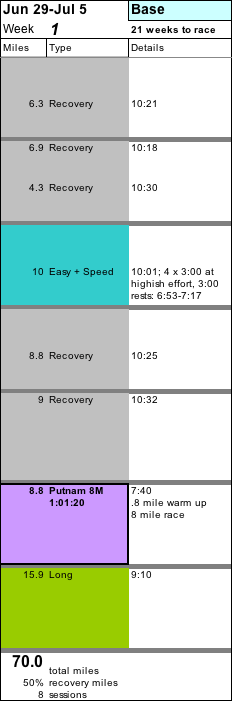
Summer Basebuilding: Week 5

sum09-base-04Hail pills and rest. All hail pills and rest.

Finally, after five weeks of either total rest or puttering along at a strictly recovery pace and relatively low mileage, I’m starting to feel like the runner I once knew. Who is this mysterious stranger? She sleeps 8-8.5 hours a night without interruption. She looks forward to longer runs. She yearns to run fast. She does not complain about chafing — nay, she celebrates chafing.

I ran nine times this week, again strictly by time and, with only one exception, sans gadgetry. My new watch/HRM combo is on backorder, which hasn’t been too much of a hardship. I borrowed Jonathan’s HRM (which worked fine with my watch) for yesterday’s run. More on that in a moment.

The heat and humidity this week were tough, plus we had a lot of rain. Wednesday was the worst day, like running in a giant dryer vent. This weather pattern looks to continue for at least another 10 days. And, let’s face it, it’s August. So we can probably bank on crap weather for the next six weeks minimum, longer if we’re unlucky.

Fortunately, after one false start (caused by an electrical short from a misplaced wire; oopsie) we managed to fix our ailing treadmill, which seems stable again — it’s no longer throwing random errors and shutting down unpredictably. It’s unreliability made for some very nervous running. How relaxed can you be when the treadmill may suddenly stop at any moment? Running slow was nervewracking enough — going fast on that flakey beast was out of the question from a safety standpoint.

I had some issues with my left side later in the week. The entire left side of my body, from left foot all the way to left shoulder felt achy and stiff. The outer fingers on my left hand were numb too. My suspicion is that my “nervous runner form” on the treadmill was probably responsible for these issues. Things are better today.

But did I let any of this — the heat, the humidity, the schizoid treadmill, the broken HRM, one half of me messed up — get me down? Nope. I was a happy, happy runner this week.

The highlight was yesterday’s run. It was a warm morning, but with reasonable humidity (dew point of around 62). I borrowed Jonathan’s HRM in order to do another round of data gathering. The plan was to clock another 8:20ish mile and see what my HR did for the duration. It held in the 80% range, which I was very pleased to see.  Two weeks earlier I ran at about the same pace, but at a much lower dew point of 54, at about the same HR.

I’d asked Kevin if I could do 30 minutes of faster running this week should the mood strike, and it had in a big way. So I ran four miles between 8:00 – 8:20 pace, with the HR% topping out at 82%. Good stuff.

Today I felt no worse for the wear (and my HR was at a cooperative 43) so I went forward with the plan to do 2:15 of recovery running. I would have liked to have run this outside but we had rain and lightning moving through all morning. In the end, I’m glad I did the run inside where it was cooler and drier. I expect I won’t feel as knocked out tomorrow.

Now that I’m reasonably back on track I should be able to get into the rotating three week maintenance plan I was slated to start in June before all hell broke loose. I’ll start this tomorrow, with a week in the 80 mile range featuring some “perceived lactate threshold” running, some 1 minute repeats, and a longer run (16 miles next Sunday). I am so excited to be running long and running fast again.

The next race on the horizon is the South Nyack 10 Miler, one of my favorite races to run. I don’t have high expectations, meaning I’d be surprised if I PR’ed after this significant a pause in training (not to mention the fact that early September is still heat wave season). But it gives me something to look forward to and work toward over the next six weeks.

Summer Basebuilding: Week 3

sum09-base-02Note: There was no week 2 in this basebuilding effort. I took the entire week off in an attempt to hasten recovery.

I’m somewhat reluctant to honor this week with the label of “basebuilding” lest I tempt fate. But, what the hey. I’ll be an optimist.

Basebuilding? No, not really. More like continued recovery from whatever ails me. But it was a good week from that perspective. I’ve not run “by time” (as opposed to “by miles”) since my first foray into jogging 10 years ago. And, like back then, I ran with no gadgetry to quantify the effort.

Monday through Saturday I ran with a plain vanilla watch and when I hit the halfway point of the prescribed time, turned around and headed home. I’ve noted approximate distances anyway because, well, I’m anal retentive and can’t stop myself from doing so. I’ve run my route a few thousand times, so those guesstimates are good within a few meters. But I didn’t pay attention to distance while actually running, which is what was important.

Running without constant feedback on HR, pace and distance was a challenge to get used to. But after the first run I found it liberating. I will probably go gadgetless for most of next week as well.

The two days of note were Friday and today (Sunday). Friday was notable because despite high humidity, I felt really good on my run. Good as in “I haven’t felt this good since April” good. It occured to me that this feeling is what I should have experienced during my taper, but didn’t. I’m trying not to read too much into it. I know I’m still crawling out of whatever mysterious performance hole I’ve fallen into. So I won’t get overly enthused. I am trying to remain patient, which is not my strong point.

Today’s run featured a bout of faster running, but only for the purposes of gathering some data to help give clues as to how my recovery is coming along (and to use as a comparison in the coming weeks). For a mile I ran varying paces, most of them in the 8:30 range, but I tacked on some fast running for the last .2 just to see what I could get myself down to. I managed to hit 5:46 for a few seconds. This is good news, as I struggled to get down to 6:30 during a race warmup a couple weeks back.

Whatever the issue is — overtraining, iron deficiency, vitamin deficiency, or simply the lack of a proper recovery — it’s abating slowly but surely. This makes me happy. It also helps me remain patient. Progress is exciting to see, but it’s also a reminder that I trashed myself before and it would be easy to do so again in short order, while I’m still groping my way along during this nascent state of training readiness.

On another encouraging note, the compulsive napping dropped off early in the week. Unfortunately, mild insomnia has moved into its place. But my gut tells me that it’s temporary.

So patient I will be. Next week looks a lot like this one: all running for time, 99% of it recovery pace, with a little faster running thrown in to have some data to look at. We’re building up the mileage again, probably by about 25% or so. But that’s discretionary; if I feel tired or otherwise overstretched, I’ll back off.

It’s official: I’m completely effed up

I dutifully forwarded the last two weeks’ worth of SportTracks logs to Coach Kevin and got a reply shortly thereafter (I’m paraphrashing): “You are really messed up! Stop training right now.”

I’ve known my running was rapidly going from bad to worse, with the abysmal 8 mile race on Sunday being the cardiac Klieg light. But it was helpful to have a third party confirm this, with exclamation points.

It’s probably this iron/vitamin deficiency business, but there’s also a chance of some kind of weird overtraining effect at work. So I was told to run very easy this week, 3-5 mile sessions at most. Since I’m a woman of extremes (which is what got me into this mess in the first place), I’m going to up the ante by not running at all this week.

In the meantime, I’m huffing 27mg of Ferrochel, 1,000 mg of Vitamin C and 4,000 mg of Vitamin D on a daily basis. And rediscovering the pleasures of chicken livers, leafy greens and roasted pumpkin seeds. The cast iron cookware is getting a good workout too.

Now we wait and watch. I’m awaiting whatever modified training plan I’m to start on next week. Then we’ll set up some sort of pace vs. HR workout to do as a baseline for evaluating how I’m doing over the coming weeks.

This is so frustrating. I feel as though now, rather than spending the summer in preparatory mode for marathon training in the fall, I’m instead going to be just trying to get back to where I was in April, before things when all pear-shaped and running a 7:30 mile became a huge challenge.

The fact that something like this has happened probably shouldn’t surprise me so much. When I look back over my training, I realize that I’ve been working very hard and running at high mileage now — at least for a newcomer to competitive running — for two years, pretty much without a break. If I ever wondered what my limits were, at least in training, now I know.

It’s better than being injured, I suppose. But it still sucks.

Summer Basebuilding: Week 1

sum09-base-01Here we go again.

Now that the dark days of May (and somewhat drunken days of June) are behind me, it’s time to put nose to grindstone once again in preparation for the California International Marathon, taking place on December 7th. On that morning, at 7AM, I will run from Folsom to Sacramento. And I plan to run it a lot faster than an anemic 7:45 pace this time around.

Was my pace in Newport literally anemic? I’m beginning to think it may have been at least flirting with anemic the more I read about blood test results and after a couple of dismal performances in local races. In any case, I’m taking action to try to correct the problem via handfuls of iron and vitamins B, C and D.

I’m also working on dropping some fat during the coming weeks of basebuilding. I’ve found it impossible to lose any significant extra fat while actually in the throes of marathon training, but I’ve had luck doing so in the past during basebuilding. Throw in a pledge of complete sobriety until after Labor Day (since weekend drinking tends to derail the weight loss effort) and you’ve got either a recipe for success or misery.

I winged it last week since Coach Kevin was still off in the wilds of Colorado, basically taking an early week from our last go-round of basebuilding and modifying (okay, bastardizing) it. I also threw in a race yesterday, which didn’t go nearly as well as I’d hoped.

Highlights of the week: Lost of slow recovery running as I continued to try to become acclimated to the summer heat and humidity. On Wednesday I went to the track and attempted some faster running. It was quite hot and humid, though, so it was hard to run fast or particularly hard. I got my HR up to 92% but found that my lungs gave out before my heart did on those efforts.

Yesterday I did an 8 mile race, the Putnam County Classic, which I’d thought would be flat, as the majority of the course was running around a large lake. But it was actually quite hilly, with lots of sharp ups and downs and very little flat bits. The weather was very nearly ideal, at least for a race in July: 65-70F and dew point around 58 or so. Since I’ve been racing so badly lately I decided to just run the whole thing by effort and not even look at pace during the actual race, since I’ve found it so depressing to do so. It’s hard to keep running the remaining miles when you know how slow you’re going.

I ran at as high an effort as possible, which averaged 93% MRH, although I did finish up the last half mile at 95%. Still, I was slloooowww. I was not happy to see a time well over an hour upon reaching the finish line. All I could muster was an average 7:40 pace. Barely faster than I could run for 18 miles five weeks ago in Oregon. Sheesh, it’s so depressing to see how far I’ve fallen, and continue to fall.

I should note that I’ve become a chronic napper lately. I needed a 3 hour nap on Friday (thank goodness it was holiday for the company I contract for and I’d already put in my work hours for the day). Then another yesterday post-race (not quite as surprising). It’s probably a reaction to the increased mileage + heat/humidity running + two races in eight days. Still…uh…what the fuck is wrong with me?

Today I felt okay and the weather was fantastic: mid-60s and an unheard of July dew point of 48. I had to take advantage of it since it will be hotter than Hades soon enough. So I did a hair short of 16 miles up past White Plains at a halfway decent pace.

My experience over the past few weeks has shown me how performance issues can sneak up on you. Everything can seem fine during regular “bread and butter” runs like recovery and long, steady distance efforts. The problems only make themselves known — and in quite dramatic fashion — when trying to run fast, or at least they do for me.

I may do a few more races over the summer if the weather isn’t horrible, just to try to gauge if taking supplements is helping at all. There’s a nine miler later this month that I might try, as well as the Van Cortlandt Track Club’s summer series of 5K races on Thursday evening. And I’ll definitely do the 10 miler I do every September in South Nyack, the weekend after Labor Day. I really hope I’m in better shape by then. I ran that one in 1:14:20 last year (with 80 miles on my legs already going in). I’d love to break 1:09 this time around.

Don’t get me wrong — I know so many people right now who are struggling with injuries and who can barely run at all. I’m grateful that I can run. I just wish I could run fast again.

Post Mortem: Newport Marathon

An appropriately titled post, since roughly two thirds of the way into this race I wanted to crawl into a hole and die.

It’s been exactly a month since my debacle in Oregon. In the intervening weeks I’ve had time to review my training log and diary, and discuss theories with Coach Kevin.

I’ve also had bloodwork to rule out anything there. And, although I suspect I could potentially feel better with higher iron-related numbers (and may start supplementing as an experiment), I don’t feel that the root cause is to be found there. No, I think it was simply a matter of too much for too long.

A couple of days after the race, I sat in my room in the Crater Lake Lodge (during a rare evening of relative sobriety) and penned (okay, typed) a document that I entitled “Training Theories.” Here it is verbatim, with some helpful links:

What went wrong?

Peaked too early?
I was running my best in mid-April. The workouts were going very well. I had that “magical run” on April 21 when I couldn’t hold back from running fast and had wished that were a race day. A few days later I flew around the track for those sub-6:20 mile repeats. I’m convinced that if I’d simply tapered for two weeks after around April 12 and run a marathon around April 26 I would have had a great run.

Couldn’t hold fitness?
I suspect that not only was it impossible to hold that peak for the following seven weeks, but I probably managed to degrade that fitness by foolishly pushing too hard through some exhausting runs. The ones that stand out are the two very hot runs in late April (20 miles in Central Park in 91 degree heat on April 26 and that awful track session two days later). Then I ran the NJ Half on May 3, which I thought would serve as a good training run (if a lousy race), but now I think it probably dug me in further in terms of creating a deficit in recovery.

“Up and down” schedule around tuneup half?
Then the next few weeks were so up and down due to the “interruption” of that race that I suspect the result may have been a staleness that settled in slowly. This was evident, although very subtle, in the remaining key workouts. I chalked up any issues with those to weather factors or just the regular ups and downs of not being quite recovered from day to day.

The run the day before the race should have been a red flag. I chose not to wear my HRM (although now I wish I had). But at one point I decided to run a fast quarter mile. I managed to get down to 7:00 pace but I was working very hard to do so. I decided it was just nerves and didn’t give it another thought.

Possible modifications
If left to my own devices, here’s what I would do differently next time around:

  • Shorten the total training+taper cycle by about seven weeks.
  • Shorten the taper, assuming the buildup has been invigorating rather than exhausting. Maybe two weeks rather than three?
  • Introduce Mpace miles much earlier in the cycle, with a gradual buildup. More on this below.
  • If I’m going to race during training, choose the races only so much as they support the specific marathon event (similar terrain, etc.), and allow adequate recovery from them. If that means fewer races (or none), so be it.
  • Include a little bit of fast running early in the taper. I do wonder if those solid two weeks of recovery running somehow contributed to the extreme slowdown on race day.
  • Do more Mpace running on the roads rather than the track.

As for Mpace running, I think I need to do more of it and a lot earlier. I never quite clicked with that pace in terms of matching pace to appropriate effort level. Although I can race a full at 88-89% MHR, I’d be a lot more comfortable getting to a point where I’m at more like 86-87%.

What we could try is having me do a few Mpace miles every week (or every other, if we started this during basebuilding), starting with just a few miles thrown into a longer run and working up to lengthy Mpace efforts toward the end. This method worked very well for me for my Spring 08 race, when I basically took one of Pete’s plans and modified it by adding in a few more of those faster miles every week. By the time I got to the 12 mile and 10 mile Mpace efforts during this cycle, I think I was already cooked. I’m not completely sure that I even needed those two workouts, and they may have further exhausted me.

So there you have — the best I can do with the data (and gut feelings) that I have.

I know I learned a lot from this experience, as has Kevin. When we were talking a few days after the race he said, “I have to remember that you’re a mortal.” By that he meant that between the 9 week basebuilding period (during which I got faster) and the following 22 weeks of training, it seemed like I had the capacity to absorb any amount of work and continue to flourish. That durability and work ethic, when coupled with a capacity for self-denial and dare I say irrational optimism, added up to  our both missing some subtle yet insistent signs.

Looking back, I think the cracks were beginning to show at the tail end of April in that I was really struggling to hit times in workouts (and the NJ half wasn’t even close). It was easy to attribute those problems to other forces, but I’ll be a lot more attentive going forward to, as well as more communicative about, the qualitative aspects of the work. Heart rate data is valuable. But seeing and acknowledging that you’re working way too hard, regardless of what the stupid watch says, is more important than any data.

Hot weather training presents its own challenges, of course, but the plan I’m getting will allow for it. The timing looks to work out to around a 14 week training schedule, including the taper (which we discussed shortening). I’m hopeful that between a shorter training cycle and having learned some important lessons, I can look forward to a happier experience in Sacramento come December. (knock wood)

Bloody good

Just got the call from my doc. Good news: Bloodwork came back normal. Bad news: This confirms that the problem was somewhere in my training.

I get the full results by fax tomorrow morning. But, for the curious, the ferritin level was 35. My notes say a female endurance athlete should be, at minimum, somewhere in the 25-50 range. So that’s a good number, although perhaps not great. I’ll see what the other iron-related readings are (he did the whole shebang) and decide if I want to supplement anyway.

Meanwhile, Coach Kevin is putting the frosting and sprinkles on a nine week basebuilding schedule. I don’t know the details, but he’s said it will be different from the previous basebuilding schedule because I’m fitter this time around, plus he’s allowing for the horrible summer heat and humidity.

A nine week schedule sets me up to start training for CIM at the start of September. That yields a 14 week training cycle, including the taper. I think this will work better than Newport’s 22 weeks.

But more on that in a bit…

Suckage fake out?

For those who want to know every detail of my running: I did 5 miles inside on the treadmill in a hot room last evening. Felt fine and even ran a fast last half mile or so (7:30ish). The difference yesterday was that I actually wanted to go running (even if it was inside). The last week or so I’ve wanted to do anything but (and have).

I’ll try again today and tomorrow. Will probably do a longish run on Sunday (12?) if weather permits.

I’m awaiting a new maintenance/base-rebuilding plan that should start on Monday. I’ll probably still go get blood tested, but I’m yet again unconvinced that therein lies the problem.

I’ve also dropped 2.5 of the 5 lbs gained already. So most of it was water weight.

Kevin was scheduled to chat with Lorraine Moller yesterday. So I’ve been awaiting his web updates with (as our more illiterate web posters like to say) “baited breath.” In the meantime, I’ve posted a review of her book on Amazon.

Now. Would you like to know what I had for breakfast?

Wham!

I’m back at work today after a 15 hour travel odyssey that involved screaming toddlers, cranky fellow passengers, glacially paced baggage handling and a lost taxi driver further impeded by inexplicable police action at Newark Airport. Then up half the night being batted about the head by a needy cat. And now the past three weeks of non-workdom are rearing their ugly little heads. 200+ emails? Save me.

Go running this evening? Hah! I have bills to pay, groceries to buy and laundry to do (although with my 5 lb. weight gain, there’s very little that I can actually wear). But I hope to go for a spin tomorrow and catch up on the blogging soon, which will include more boring vacation photos and a full post-mortem of the possible why’s behind my disastrous marathon.

For those who just can’t get enough of runners talking about running, Coach Kevin is in Boulder, CO on a whirlwind tour of interviews of runners and coaches, including more than one of my idols, for a book project. You can follow his daily reports here.

I will say for now that Oregon is an interesting, beautiful and fun place. And despite the May 30 meltdown, I’m looking forward to working toward the next big one in Sacramento in December.

More pre-race ponderings

[Composed at 39,000 feet]

We’re about four hours into the flight and I can tell we’re getting close. The terrain 39,000 below has turned from urban to suburban to rural and now progressively more and more hilly. I expect to spot Mount Hood in an hour or so. Then I’ll know we’re almost there.

As a side note, I just love this little “netbook.” It’s a Samsung NC10. It’s very elegant: matte white, light (under 3 lbs) and like a little toy. It boots up in about 15 seconds (which was helpful going through security) and it’s very zippy with 2 Gigs of RAM. The keyboard is almost full-size to, so it’s very easy to type quickly on.

Today was a good day for distraction. In the morning I had a six mile run to do, followed by loose ends to tie up at work before disappearing for three weeks. Then I had to finish packing, which involved checking and rechecking my numerous lists. I wanted to make sure that if I forgot something, it wouldn’t be an important thing to forget. Or, as Jonathan put it a bit more succinctly, “It had its chance to be remembered.”

Now I find myself sitting on the plane, trying to ignore the several hours of mild turbulence we’ve been suffering (and the mild nausea it’s brought on, thanks to my penchant for motion sickness) and with eyes tired from reading. My mind drifts to Saturday’s race. I’ve spent time reminding myself of all the obvious lessons I’ve learned:

  • Don’t get pulled out too fast by the crowd or your own excitement

  • Run what feels like too slow a pace in the beginning; the first 10 miles should feel easy

  • Drink water early and often

  • Take a gel at least 15 minutes before you think you’ll need it

  • Try to zone out mentally for the first 15 miles; reserve mental energy for later

  • Don’t obsess over missed mile splits and don’t try to “make up” lost seconds in subsequent miles

  • Seconds lost in the first few miles equal minutes gained in the last few

  • Don’t let anyone else set your pace

  • Focus on running each individual mile, not on how many are left

  • Pass people decisively; don’t look back

  • If it’s windy, find a big guy to run behind, or try to run in the middle of a pack

  • Never walk

  • Never quit – unless you are injured, unconscious or dead

And here are a few new tips I got from Kevin yesterday:

  • Feeling bad for the first few miles happens sometimes; mile four is too early to start telling yourself you’re having a bad day

  • Following from that, you often can’t know what sort of day you’re having until about 6-8 miles in, so remain calm

  • Don’t try to fight a headwind, because you’ll always lose; accept it and adjust your pace to the appropriate effort level

I’ve had such bad luck with weather for training and racing that it’s been hard to remain confident in what pace I can actually maintain. But I do have several things going for me.

For one, settling into something right around a 7:05 pace has happened fairly naturally in all conditions. I’ve had to work harder for that pace on some (most?) days than others. But it’s a pace I know I can run even in the worst of circumstances and it’s an easy one for me to “find” and lock into. So if I luck out and end up with good race conditions, I have a good shot at running that pace for the duration at the appropriate effort level.

I know I can run at a very high level very late in the race. I’ve run marathons at a consistent 88-89% effort for the first 20 miles and ended up in the low 90%s at the end. Unless I succumb to exhaustion (like I did at Steamtown, due to muscle damage from the early downhills), I can run strong to the finish.

I’ve also run four marathons and, if the list above is anything to go by, I’ve learned a great deal about racing that distance. I’ve had the benefit of running just one good marathon (which, while sad, is certainly not unusual), and that one good race is the one that I’ve been sitting here thinking about. Why did it go so well? How can I repeat it?

The key to racing a marathon well is simple, although not easy. It is not about “running with heart” or pushing through the wall or any of that Hollywood garbage. It’s not about wanting something badly enough, or overcoming some inherent weakness through sheer force of will. Where people want magic, there is only this dull fact: marathon racing is a purely physiological endeavor. If you are not trained to run 7:05 over 26.2 miles, you cannot run 7:05 over 26.2 miles.

Moreover, to make an even duller point, from what I’ve observed and experienced, racing a marathon well all comes down to one essential act: practicing effective energy management. This is true for people running 10:45 pace as much as it is for people running 4:45 pace.

It’s this rather dry requirement that I will bear in mind over the next few days. I will burn it into my brain so that as soon as I start running, that mantra is all I will know, all I will think and all I will do.

The reason that putting this truism into practice is not easy is that you can’t ever know how much energy you have on a given day. You may have done everything right in terms of training over the preceding months, tapering over the preceding weeks, and eating and sleeping over the preceding days. Your workouts and shorter races may have all pointed to sure success. You may even find yourself standing on the starting line feeling fantastic. But for some reason, all things being seemingly equal, the outcome is never predictable. Sometimes it’s downright disastrous. One day you run out of gas at mile 18. Another day, six months later, it’s mile 25. And perhaps on another day, you have a magical day when your energy stores seem limitless, because you’ve somehow managed to perfectly nail the rate of energy expenditure and replenishment.

I suppose that’s one of the biggest reasons why I love the marathon, both as a racer and as a fan. It’s such an unforgiving distance. Yet so satisfying to experience and witness when things come together.

To be honest, I feel strangely unconcerned about the outcome of Saturday’s race, considering the enormous effort I’ve put into getting ready for it. Whatever happens, it will be okay. Barring injury or some other catastrophe, I should easily best my last time of 3:19.

I tend toward thinking of this race as a stepping stone, a necessary stopover on the way down to the 3:00 mark. Perhaps I should give this race more weight, meaning focus on the task at hand rather than looking six months down the road to the next goal of breaking three hours. But I’m hoping that my lack of worry doesn’t stem from overconfidence as much as it does from the certainty that I’ve done everything I can to succeed.

I know I’ve done the requisite training and I know how to run the race. If for some reason I don’t do as well as I’d like to, I’ll learn something from it for next time as I’ve had to do several times before. But I’ve no doubt I’ll continue to improve over the long run.

What progress looks like

Of all the supposedly “essential” running equipment I use, there are two tools that I couldn’t do without: Sporttracks software and my Garmin GPS watch. Using the two in combination, I’m not only able to see my progress from day to day, but also from month to month, season to season, and — perhaps most dramatically — year to year.

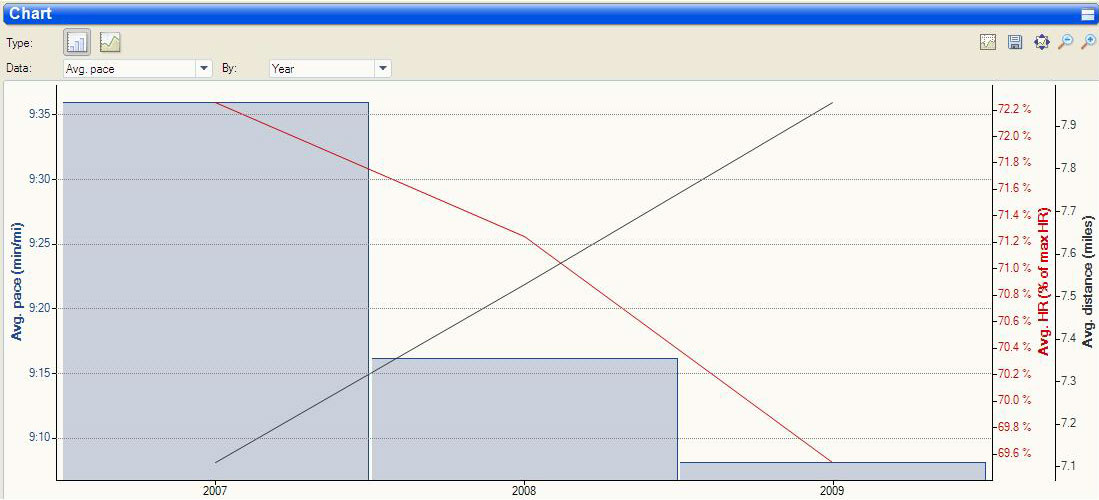
Take a look at this chart. It shows three pieces of data: Average pace, average heart rate (% of max) and average length of run.

What a difference a couple of years (and a few thousand miles) makes. (Click to enlarge.)

What a difference a couple of years (and a few thousand miles) makes. (Click to enlarge.)

Notice how the average pace and the average heart rate have dropped as the average distance has increased? Funny that.